

Most Web3 games don’t die loudly. They fade.
One week the timelines are full of them. Next month, nobody’s talking about them.
PIXEL feels like it’s trying to avoid that exact fate—but not by doing anything flashy. In fact, what’s interesting is how unflashy the design philosophy is.
It starts with a simple gamble: what if the game is actually fun first?
That sounds obvious. It isn’t in Web3.
For years, most games in this space have been flipped the other way around. Build the economy, attach incentives, then hope the gameplay holds it together. Sometimes it works for a while. Then it turns into farming. Then it turns into spreadsheets with graphics.
Pixels is basically trying to reverse that order.
And honestly—it’s a risky move.
Because once you say “fun first,” you’re also admitting something else: rewards alone are not enough to keep people around.
The interesting part is how rewards are handled after that.
Instead of treating every action like it’s equally valuable, Pixels leans toward selective rewarding. Some behaviors matter more than others. That sounds fair in theory, but in practice it changes how people play.
Players always optimize. Always.
If you reward repetition, you get repetition. If you reward depth, players eventually move toward depth—even if reluctantly.
That’s the quiet logic behind the system.
There’s no magic here. Just behavior shaping.
But here’s where it gets more subtle.
Most Web3 games try to “scale users.” Pixels is trying to scale behavior quality.
That’s a very different problem.
Because scaling users is easy. You just add incentives. Scaling quality means you’re constantly fighting against the natural tendency of players to find the easiest reward path available.
And they will find it. They always do.
So the system has to keep adjusting itself—not loudly, not with announcements, but through structure.
There’s also a loop effect happening in the background.
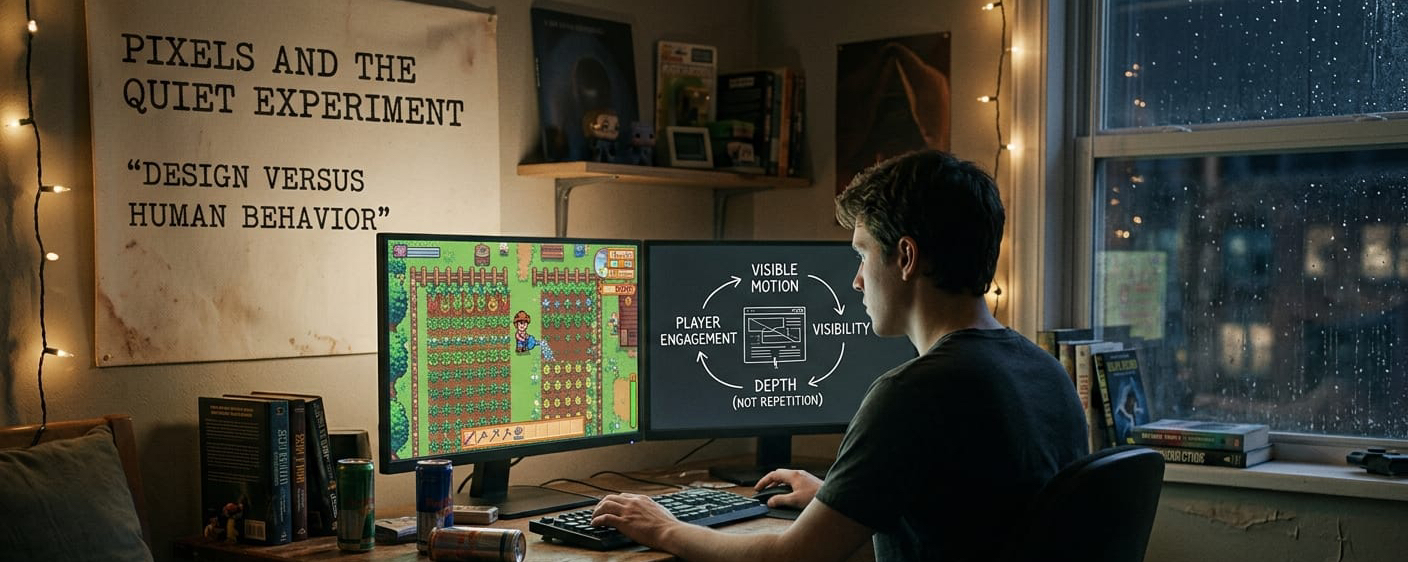
When players actually engage with the game instead of just extracting from it, they generate activity that pulls in other players. Not through ads or hype cycles, but through visible in-game motion—progress, interaction, presence.
That’s the real idea behind the growth engine here.
Not “marketing brings users.”
But “users create visibility, visibility brings users.”
If that sounds fragile, it kind of is.
But it’s also more organic than the usual boom-and-bust cycle most crypto games go through.
The real question is not whether Pixels is designed well on paper.
It’s whether it can survive player behavior in the wild.
Because every system looks smart until users start breaking it down to its simplest exploit path.
And they always try.
That’s the tension here. Not hype. Not price.
Just design versus human behavior.
If Pixels holds up under that pressure, it won’t just be another game with a token attached.
It becomes something rarer in Web3: a system where gameplay actually resists being reduced into farming.
And that’s the real test.
