Most people still try to understand Pixels using the same old template:
a casual farming game with a token attached.
I think that framing completely misses what is actually being built.
Pixels is not a game that added an economy.
It is an economy that uses a game as its interface.
If you read through the litepaper and ecosystem design, the core idea is not “play and earn.”
It is closer to:
players participate in a persistent, player-driven economy where actions inside the game produce, transform, and redistribute value.
That shifts the question from:
“how much can I earn playing?”
to something much more structural:
what role does each player have inside the economy, and what value are they creating or consuming?
Player-owned economy is not a slogan here
Most Web3 games say “player-owned economy,” but in practice, they still operate like closed systems:
the game prints rewards
players extract value
the system inflates and collapses.
Pixels tries to break that loop.
Resources are not just rewards — they are inputs for other players.
Farming feeds crafting.
Crafting feeds progression.
Progression feeds status and efficiency.
The economy is not linear. It is circular.
And that matters, because circular economies are harder to drain.
$PIXEL is not the main currency — and that’s intentional
One of the most important design choices in Pixels is what not to use the token for.
$PIXEL not trying to be:
the only medium of exchange
the basic in-game currency
the thing you spend every minute
Instead, it acts more like a coordination and premium layer.
It sits on top of the economy, not inside every transaction.
That creates a separation:
low-level activity → handled by soft currencies and resources
high-level decisions → mediated by $PIXEL
This is subtle, but critical.
Because most GameFi systems fail when the main token is tied directly to every action.
That’s how you turn gameplay into constant sell pressure.
Pixels avoids that trap by letting the economy breathe without forcing $PIXEL every loop.
Why this is different from Axie-like models
Games like Axie Infinity proved that crypto games can scale.
They also showed exactly where things break.
The classic model looks like this:
new players bring capital →
rewards are paid out →
token supply increases →
selling pressure rises →
economy collapses.
The problem is not just inflation.
It is that the system depends on external demand to survive internal activity.
Pixels moves in a different direction.
Instead of:
earn → sell
it leans toward:
produce → trade → use → upgrade → repeat
Value is circulated more than extracted.
And that changes player behavior.
Retention > speculation
This is probably the most important shift.
Pixels is designed to be played daily, not just farmed temporarily.
The loops are simple on the surface:
plant → harvest → craft → upgrade → interact
But underneath, they create:
habit formation
social interaction
long-term progression
Which means players stay for reasons that have nothing to do with token price.
That’s a big deal.
Because speculation is volatile.
Retention is structural.
Infrastructure matters more than it looks
The move to Ronin is not just a technical detail.
It directly impacts the economy.
Lower friction means:
more transactions
more interactions
more active players
And in a player-driven system, activity is everything.
An economy without activity is just a chart.
So what is Pixels really building?
When you put it all together, Pixels is not trying to be:
a better farming game
or a more efficient token system
It is trying to align four layers at once:
gameplay loops that people actually enjoy
a resource economy driven by players
a token that coordinates rather than dominates
infrastructure that keeps everything fluid
So when I look at $PIXEL, I don’t see “a GameFi token.”
I see an attempt to answer a much harder question:
Can you build a digital economy where players stay even if they stop caring about the token price?
That’s a much higher bar than launching a game.
But it’s also the only direction that has a chance to last.
@Pixels #pixel

Articol
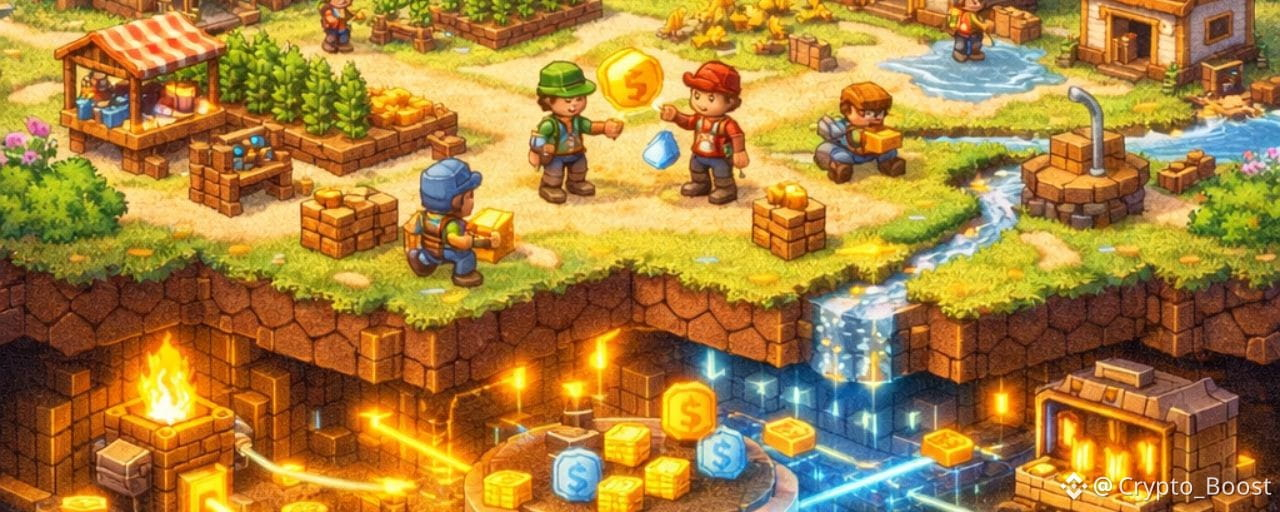
Pixels is not just a Web3 game, it's an economic layer
Declinarea răspunderii: include opinii ale terților. Nu constituie recomandări. Binance Ai poate fi utilizat fără garanții. Consultați Termenii și condițiile