
I’ll admit it I walked into Pixels with my usual crypto skepticism dialed up. “Community,” right? That word’s been stretched thinner than cheap chewing gum. Half the time it just means a noisy Discord where everyone’s grinding for colored roles and pretending announcements are plot twists.
But Pixels it’s a different animal.
“Where communities come to life” sounds like marketing fluff until you actually linger in the world for a bit. Then it sneaks up on you. Not loudly. More like background noise you suddenly realize is music.
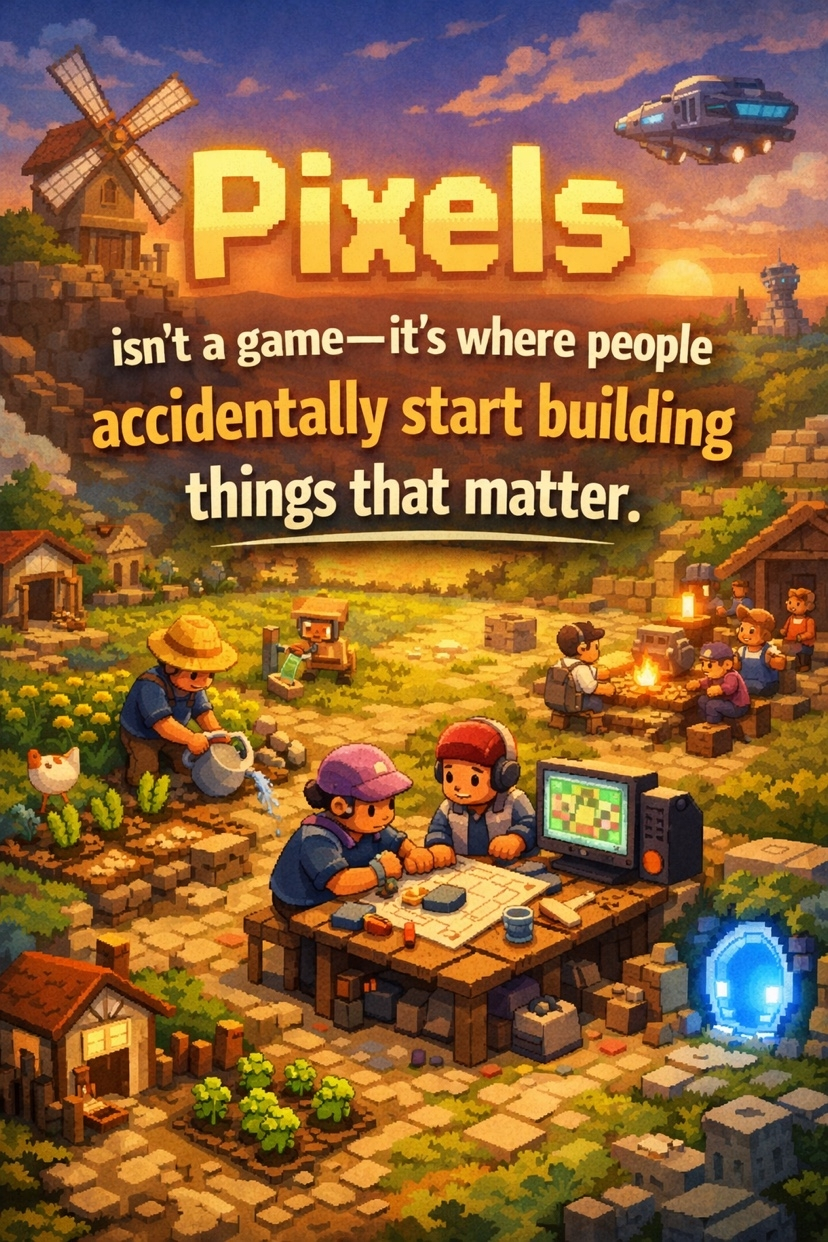
At first glance? It’s almost underwhelming. You plant stuff. Run errands. Wander around. You’ve seen this before. A dozen times. Maybe more. But hang on stay a little longer and something odd clicks into place: this world isn’t built just for players. It’s built for people who can’t help but tinker. Builders. The ones who look at a system and think, “Yeah but what if?”
That shift? It’s everything.
Pixels isn’t chasing the “next big game” label. It’s sidestepping it entirely. Feels more like a canvas than a product somewhere between a sandbox and a toolkit. You don’t just log in to consume content; you log in and realize you could make something. Dangerous idea, that.
And ownership now that’s where it stops pretending to be like the rest of crypto.
No hollow “buy this JPEG and pray” energy. The assets here actually do things. They persist. They evolve. They become part of your footprint in the world. You tweak something, build something, earn something it doesn’t vanish into a server void. It sticks. Like digital calluses. Proof you were there.
That’s when “community” mutates into something less performative.
Instead of one monolithic experience handed down from on high, you start spotting these little pockets micro-worlds bubbling up. Someone’s crafting a social hangout with its own vibe. Someone else is building a weirdly addictive mini-game loop. Another group is remixing familiar IP into something that feels half nostalgia, half experiment.
It gets messy. In a good way.
Suddenly Pixels isn’t a game. It’s a patchwork of intentions. A living thing stitched together by people who refuse to just play by the rules they rewrite them.
And here’s the kicker: it lowers the intimidation factor. Drastically.
You don’t need to disappear for two years to build a full Web3 game that maybe maybe five people will play. You’re dropping ideas into an ecosystem that already has traffic, culture, momentum. It’s like opening a shop in a busy bazaar instead of shouting into an empty field.
That’s not a small shift. That’s tectonic.
Honestly, it feels less like GameFi and more like the early days of sandbox platforms when creativity was scrappy and weird and contagious. Except this time, ownership isn’t duct-taped on. It’s baked in. Progress isn’t some fragile thing locked behind a developer’s backend. It moves. It stacks. It can even pay you back in ways that don’t feel exploitative.
And this is where it gets interesting psychologically, even.
People act differently when they own what they’re doing. They linger. They poke at systems. They collaborate, argue, remix. The social layer stops being cosmetic no more empty “gm” rituals and starts carrying weight. Economic weight. Creative weight. Sometimes even emotional weight.You’re not just logging in to grind out another loop.
You’re showing up because something you touched yesterday is still there today and might still be there tomorrow.
That “build around existing IP” angle? Sneaky brilliant. Instead of forcing creators to conjure entire universes from thin air, Pixels lets them riff on ideas people already recognize. Less friction. Faster engagement. And users don’t need a manual to understand what’s going on—they just get it.
Meanwhile, most projects are still obsessing over retention hacks like it’s 2019.
Pixels is playing a quieter game. A deeper one.
Not “How do we keep them clicking?”
But “Why would they care enough to stay?”
And the answer isn’t complicated. It’s just rare:
Give people tools that don’t fight them.Let them actually own what they make
Build a world that doesn’t sit still when they push on it.That’s when the shift happens.When “community” stops being a buzzword slapped on a landing page and starts behaving like something alive.