
Most GameFi projects feel predictable. They launch with rewards, attract a wave of players, and then slowly lose momentum once the incentives stop feeling exciting. The pattern repeats so often that it almost feels like a script.
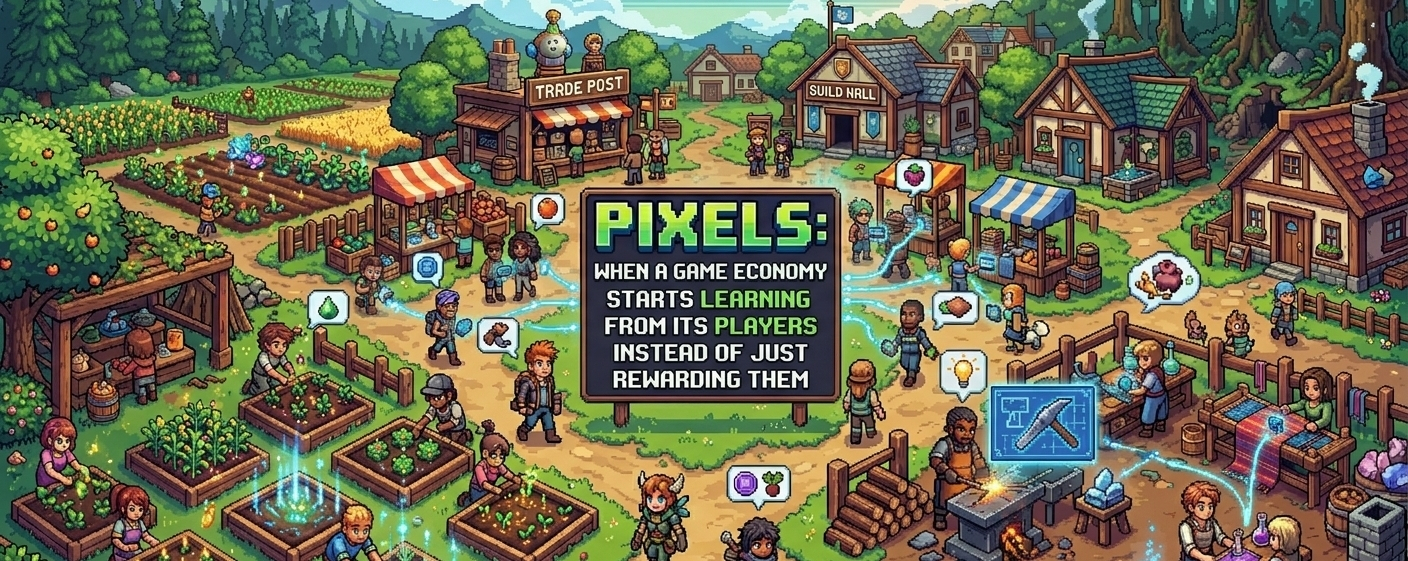
But Pixels doesn’t give that same impression at first glance. It doesn’t feel like it’s just “giving rewards for playing.” It feels more like something is quietly observing how people play—and adjusting itself over time.
It doesn’t just reward you—it reacts to you
In most games like this, the loop is simple: do something, earn a token. That’s it.
Pixels feels a bit more alive than that. When you play—whether you’re farming, crafting, trading, or just progressing—you’re not only earning. You’re also creating data about how the economy is behaving.
Which actions are actually useful?
Which ones keep people coming back?
Which ones just attract short-term farming?
The system seems to notice these patterns and slowly shifts attention toward what works better.
So instead of fixed rewards, it feels like a system that keeps adjusting the “rules of earning” in the background.
Rewards that try to make sense, not just spread everywhere
Most token economies struggle because rewards go out in a flat way—whoever is active gets something, regardless of whether it helps the ecosystem or not.
Pixels takes a different approach through what’s often described as Return on Reward Spend (RORS).
In simple terms, it asks:
> “Did this reward actually help the game grow, or just temporarily increase activity?”
If something leads to stronger engagement or healthier trading, it gets more support. If it doesn’t, it slowly gets less.
It’s not perfect, but the idea is closer to learning than broadcasting.
The infrastructure matters more than it looks
Behind the game is the Ronin Network, which helps everything run smoothly—fast transactions, low fees, and constant in-game interaction without friction.
That matters more than people think, because a system like this only works if the economy can move as fast as the players do.
PIXEL is less about holding, more about moving
A lot of people look at tokens as something to accumulate. In Pixels, the role of $PIXEL feels more like fuel than savings.
It’s used inside the game for:
crafting and upgrades
progression systems
rewards and participation loops
What really matters is not just earning it—but how long it keeps circulating inside the system before leaving it.
If it moves through the economy instead of exiting immediately, the game stays alive longer.
The hidden importance of “sinks”
Every game economy needs places where tokens are spent, otherwise everything inflates and breaks.
Pixels tries to solve this with constant demand points:
upgrading land
crafting items
progressing systems
in-game improvements
These aren’t just “fees.” They’re what keeps the loop going. You earn, you spend, and then you need to play again.
That cycle is what keeps the economy from freezing.
$vPIXEL changes the feeling of ownership
With $vPIXEL, long-term players get more say in how rewards are distributed.
It’s not just “I earned tokens.”
It becomes “I can influence where rewards go next.”
That shifts the mindset a bit—from passive participation to something closer to involvement in how the game grows.
Players slowly become part of the system itself
One of the quieter changes is how much the community starts to shape growth.
Guilds form. People specialize. Some trade, some farm, some organize. Over time, players start doing things that naturally bring in more players.
So instead of growth only coming from ads or hype, it starts coming from inside the game itself—through people building around it.
The real question isn’t “is it good,” it’s “does it learn?”
The interesting idea behind Pixels isn’t that it has perfect economics. It’s that it tries to adjust as it goes.
But that also makes it fragile.
If it rewards the wrong behavior, the system can drift.
If too many tokens leave too fast, it weakens.
If players stop engaging, the loop slows down.
So everything depends on one thing:
Can the system understand its own players well enough to keep improving?
Final thought
Pixels isn’t just trying to be a game where you earn tokens.
It’s trying to become a system that quietly learns what kind of play actually matters—and rewards that more over time.
If it succeeds, the game stops feeling like a fixed economy… and starts feeling like something that evolves alongside the people inside it.