
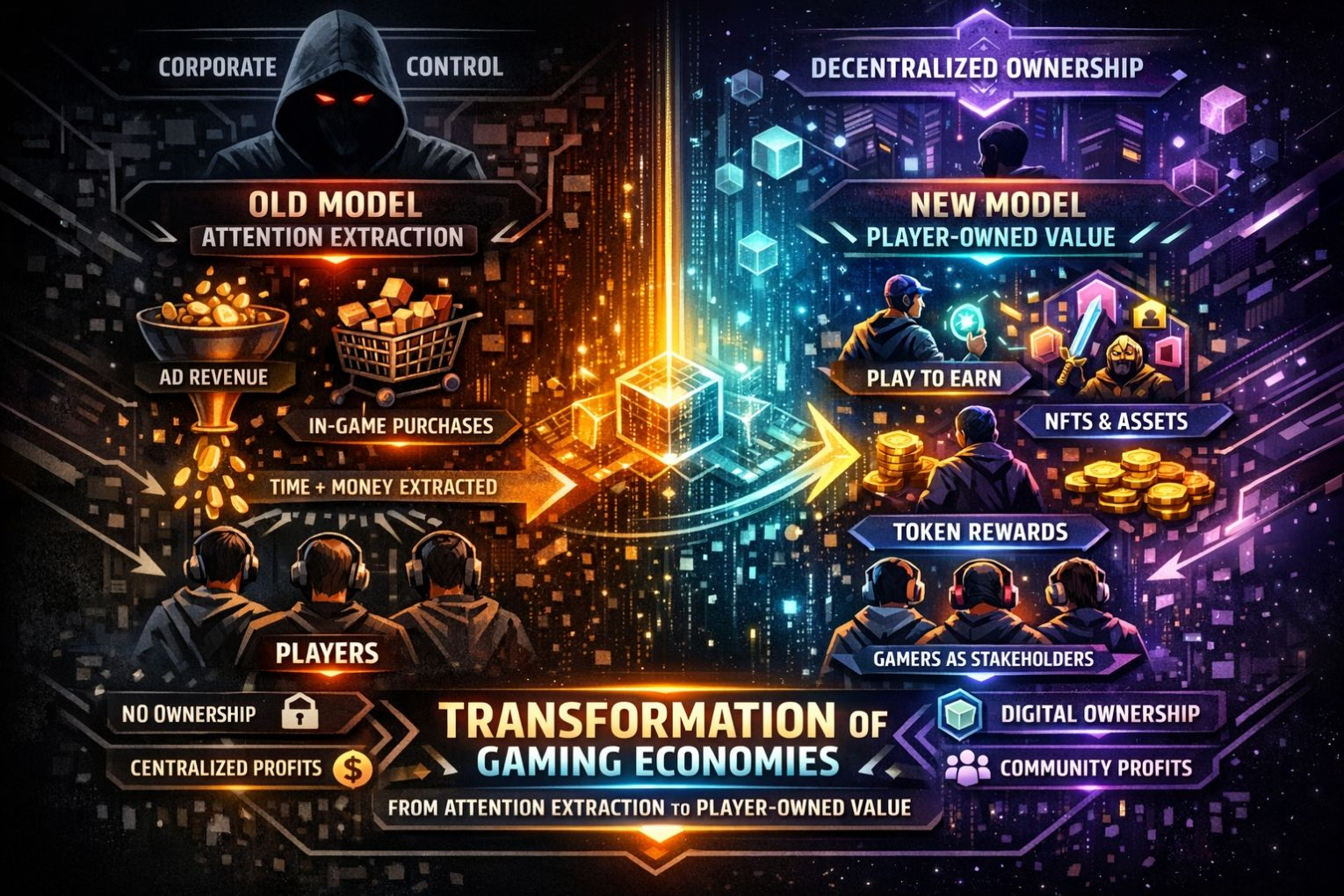
“The most important economic transitions are rarely loud. They unfold silently, until the old system no longer explains reality.”
Gaming is undergoing a structural transformation that is not immediately obvious to the average player, yet it is reshaping how value is created and distributed inside digital ecosystems.
For decades, the economic model of gaming has been stable:
Players generate attention
Studios monetize attention
Advertising platforms capture the majority of value
In this structure, players contribute heavily to engagement, but receive no direct financial participation in the value they help create. That model is now beginning to evolve.
The Structural Problem in Traditional Gaming Economies
The legacy gaming economy is built on a one-directional value flow:
1. Users spend time inside games
2. Studios invest in acquisition and retention through marketing
3. Third-party platforms capture engagement value via advertising systems
4. Players receive entertainment, but no economic return
“Engagement was always the most valuable input—but never treated as a financial asset belonging to the player.”
This imbalance created highly efficient entertainment systems, but weak value distribution mechanisms for participants.
The Emerging Model: Participation-Based Value Systems
A new structure is forming within Web3 gaming ecosystems. Instead of treating engagement as a monetization input for external platforms, it is being restructured into a direct reward mechanism for players. In this model, users can receive:
Cash-based rewards
Crypto assets
Gift card value equivalents
However, the key innovation is not the reward type, it is the logic of distribution. Rewards are increasingly tied to measurable participation quality rather than passive time spent.
Redefining What “Value Contribution” Means in Games
Modern Web3 gaming systems are beginning to classify player activity into structured contribution layers:
1. Meaningful Missions
Tasks designed to contribute directly to ecosystem development and progression.
2. Competitive Participation
Skill-based systems where performance is prioritized over time consumption.
3. Community Contribution
Player-driven feedback, testing, and ecosystem support roles that influence product evolution.
4. Sustained Engagement
Long-term participation patterns that reflect retention quality rather than exploitative farming behavior.
This represents a shift from time-based $metrics to contribution-based metrics.
Case Study: $PIXEL ls and the Evolution of Reward Infrastructure
A notable example of this transition can be observed in @pixels, which is actively exploring more advanced reward distribution systems within its gaming ecosystem.
Through its LiveOps reward infrastructure, the ecosystem is testing how engagement can be translated into dynamic reward allocation based on timing, behavior, and participation quality.
Its reward engine, known as Stacked, introduces a model where rewards are not distributed uniformly, but instead allocated through contextual engagement signals.
This reduces reliance on repetitive farming mechanics and instead emphasizes active, meaningful participation within the ecosystem.
As the ecosystem expands, $PIXEL is evolving beyond a single-game utility token and moving toward a broader role as a reward and engagement layer across interconnected gaming environments.
Why This Shift Matters
The most significant change is not visible in gameplay mechanics, but in economic flow.
Traditional structure:
Advertising budgets → Platforms → Indirect user exposure
Emerging structure:
Gaming studios → Direct player reward distribution
This changes the role of players fundamentally: From passive users to active contributors From engagement sources to value participants From consumers to ecosystem stakeholders
The New Behavioral Economy in Gaming
As this model matures, a new participation framework is emerging:
Old model:
Play → Grind → Exit
New model:
Participate → Contribute → Earn → Reinvest
This introduces compounding behavior loops where participation itself becomes economically meaningful over time.
Early participants in such systems typically benefit from asymmetrical exposure to reward mechanisms before they fully mature and standardize.
Conclusion:
Gaming is transitioning from a pure attention-based entertainment model into a structured participation economy where engagement becomes a measurable and rewardable asset.
Projects such as @Pixels and tokens like $PIXEL represent early indicators of this shift toward programmable reward systems in gaming ecosystems.
The long-term implication is clear:
Value is no longer just extracted from players.
It is increasingly being distributed back to them based on contribution.