
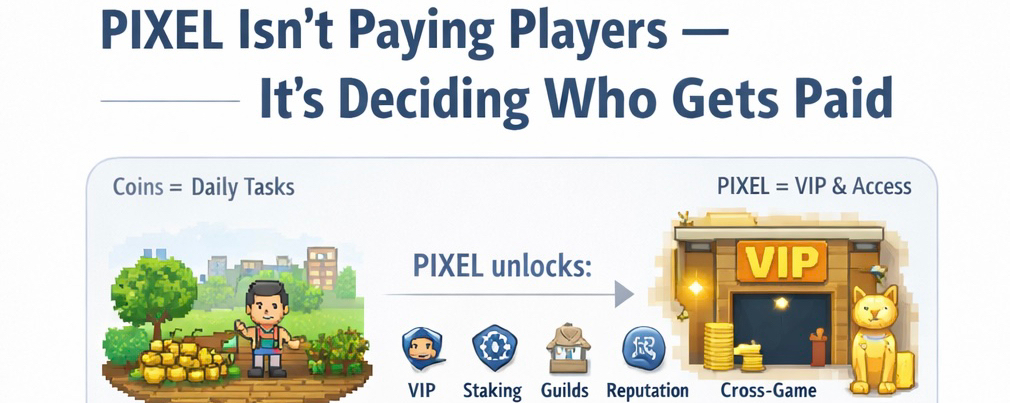
Pixels looks like a simple pixel-art farming MMO on the surface, but the economy underneath behaves very differently from most Web3 games. The easiest way to understand it is this: PIXEL isn’t really designed to pay everyone — it’s designed to decide who gets access to better opportunities. That distinction changes everything.
Most blockchain games push their token into every action. You harvest, craft, trade, fight — everything spits out tokens. Pixels quietly moved in the opposite direction. Day-to-day gameplay runs mostly on coins, energy, and reputation. PIXEL sits one layer above that. It unlocks VIP, improves task access, enables staking, allows guild creation, gates withdrawals, and increasingly works across multiple games. The token behaves less like a reward and more like a reservation system.
A useful analogy is an airport. Coins are like walking around the terminal — everyone can do it. PIXEL is the fast-track pass that determines who gets priority lanes, lounge access, and earlier boarding. You don’t need it to exist in the space, but if you want efficiency and higher-value loops, it becomes important.
That structure started to become obvious after the recent Bountyfall season. Instead of rewarding individual grinding, players were divided into unions competing to fill shared progress meters. Rewards leaned toward the winning group. This subtly shifted incentives from “farm alone” to “coordinate with others.” Suddenly, being in the right group mattered more than just grinding harder. The token’s value moved from output to alignment.
Around the same time, Pixels introduced Stacked — a cross-game rewards layer. On paper it looks like another rewards app, but the implication is bigger. It allows different games to distribute incentives while Pixels tracks behavior and optimizes engagement. That turns PIXEL into something closer to a routing asset. Players can move between experiences while the token ties those loops together. It’s less like earning inside one game and more like earning within a network.
The Forgotten Runiverse collaboration reinforced that idea. Players used PIXEL for boosts and competed for shared reward pools outside the main Pixels world. This matters because most game tokens fail when they try to leave their native environment. Pixels is testing whether demand can travel. If that works, the token stops depending entirely on one game’s retention.
Another quieter but important change has been tightening reputation gates. Withdrawals, marketplace access, guild creation, and trading now require higher reputation thresholds. That makes the token harder to extract quickly. It also shifts the experience from “play and dump” to “play and build access.” Security here is not just backend protection — it’s part of the user journey. You earn trust first, then unlock liquidity.
Looking at the numbers helps explain why these changes matter. The total supply is 5 billion PIXEL, with roughly 15% circulating. That means future unlocks are still significant. The token previously reached around $1.02 at its peak, and it currently trades far below that level, leaving a large gap between past speculation and current utility. VIP membership costs about $10 in PIXEL per month, staking requires at least 100 PIXEL, and task board rewards refresh daily but don’t guarantee token payouts. These mechanics all slow down distribution and create recurring demand rather than constant emission.
What emerges from this is a deliberate design choice: Pixels is trying to slow token velocity. Instead of pushing more PIXEL into the system, it creates reasons to hold it — VIP perks, staking, event participation, guild mechanics, and cross-game boosts. The token doesn’t need to be everywhere. It just needs to sit at the control points.
Another analogy helps here. Coins in Pixels behave like water flowing through pipes — they move constantly and power everyday actions. PIXEL behaves like the valve controlling the pressure. You don’t see it moving as often, but it determines how the whole system operates.
This leads to a contrarian takeaway. Many players assume Pixels is still a play-to-earn farming game. In reality, it’s closer to a token-gated labor market. Players aren’t just farming resources; they’re competing for access to higher-yield loops. PIXEL doesn’t reward activity directly — it decides who gets to access the best opportunities. That’s a subtle but important shift.
The ecosystem direction supports this interpretation. Pixels is expanding across the Ronin network, experimenting with shared rewards, linking progression between experiences, and introducing AI-driven reward tuning. The goal seems less about building one massive game and more about building reward infrastructure across several. If that works, PIXEL becomes less dependent on any single gameplay loop.
There are still real risks. The large remaining supply means future unlocks could create pressure if demand doesn’t expand. Reputation gating improves security but can make onboarding slower. Cross-game utility is still early, and if partner integrations stall, PIXEL may fall back into a single-game token. There’s also the possibility that VIP and staking mechanics become too important, which could tilt perception toward pay-to-optimize.
What matters next is measurable. If more games start distributing rewards through the Pixels ecosystem, demand becomes structural. If staking levels increase, token velocity drops. If cross-game events continue, PIXEL becomes portable instead of isolated. Those signals will show whether this coordination model actually works.
Pixels is quietly moving away from the loud play-to-earn narrative. Instead of paying everyone, it’s trying to organize them. The token isn’t designed to be a paycheck — it’s designed to be the key that unlocks better positioning inside the system. That’s less obvious, less hype-driven, and harder to notice. But if it succeeds, it may also be more sustainable.
The core idea is simple:
PIXEL doesn’t reward the grind — it rewards being in the right place, at the right time, with the right access.
