
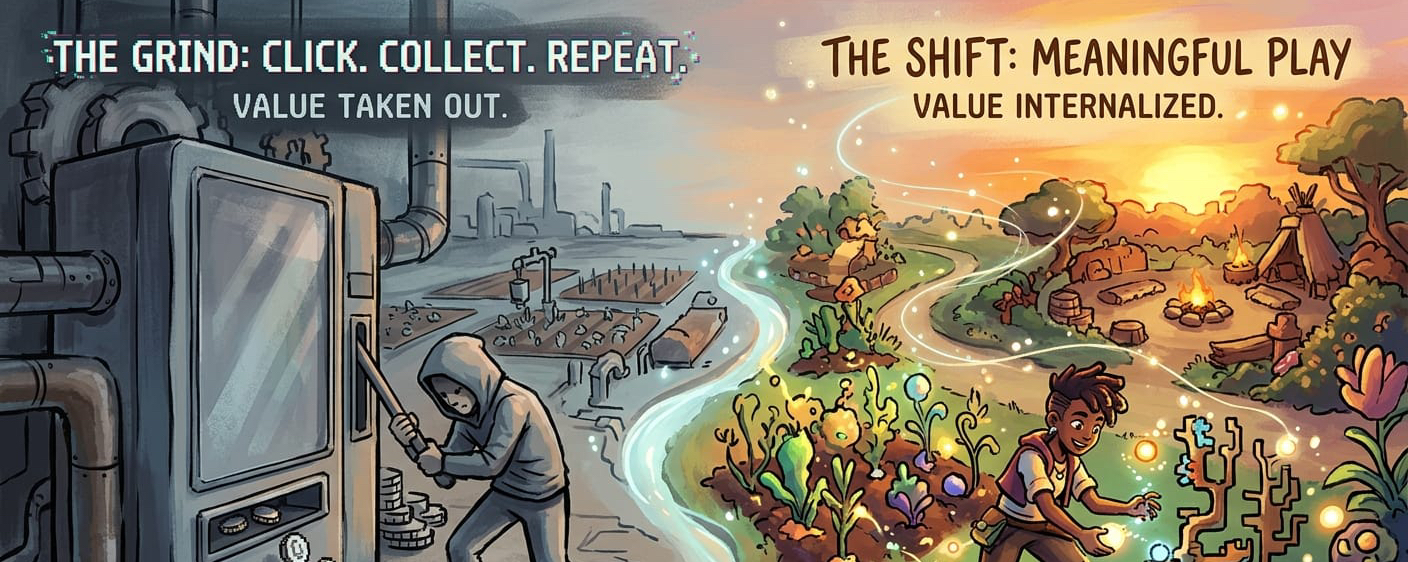

What actually stands out in Pixels isn’t the rewards—it’s how the game quietly retools what players think is "worth their time." Most Web3 titles accidentally Pavlovian-train their players into a hollow loop: click, collect, repeat. Eventually, the world disappears, and all that's left is a spreadsheet to be exploited. Pixels is trying to break that cycle, and it's doing it without some loud, preachy announcement. Instead of just slashing rewards, they’ve tweaked how predictable they are. It’s a tiny design pivot, but it shifts something much deeper than just the economy. It shifts our attention.
When a reward is 100% predictable, we start acting like machines. We find the shortest path to the payout and mash that button until it breaks. But when rewards are tied to a broader vibe—actual engagement rather than isolated clicks—the mental model changes. You stop asking, "What gives me the most right now?" and start wondering, "What actually matters in this world over the long haul?" It sounds subtle, but the minute-to-minute feel of the game changes completely. Suddenly, you aren't optimizing for repetition; you're optimizing for quality. You start caring about context, timing, and actually mixing up your activities.
The brilliance here is that it doesn’t rely on heavy-handed bans. You don’t need to block farmers if you make pure extraction less efficient. By introducing "structured variability," the system raises the effort cost for low-energy behavior without explicitly banning it. It favors continuity over bursts. Most exploitative behavior in crypto is burst-based—bots and grinders want high intensity for a short window. A system that values someone who sticks around and adapts naturally gives the edge to real humans. It doesn't kill automation entirely, but it definitely makes it harder to win that way.
The game stops feeling like a vending machine and starts feeling like an actual environment. In a vending machine model, one coin always equals one soda. In an environment, the value of an action depends on the weather, the time, or what you did yesterday. That uncertainty isn’t just chaos; it’s what keeps us interested. If a system is "solved," we get bored and leave. If it’s totally incomprehensible, we get frustrated and leave. Pixels sits in that sweet spot where patterns exist, but you can’t just exhaust them in an afternoon.
In the old models, value was something you took out of the game. In Pixels, value is becoming internalized again. Progress and interaction start to carry weight on their own, regardless of the immediate token output. Communities built on extraction are temporary—they swarm, strip-mine, and vanish. But communities built on this kind of meaningful uncertainty stick around. The formation is slower, sure, but the attachment is real because the participation isn't purely transactional. Pixels is essentially a living experiment: can you guide human behavior toward something sustainable without taking away the freedom that made them join in the first place? It’s a fragile balance, but it’s a hell of a lot more interesting than another click-to-earn loop.
