
👇👇👇👇👇
Last Thursday I opened CoinGecko to check one number for a different post — and accidentally spent twenty minutes staring at the Pixels chart. Not because it was inspiring. Because it looked like a textbook example of how a P2E token dies.
February 2024 — Binance listing, price around $0.40. Hype, Launchpool, tens of thousands of new players.
April 2026 — $0.008. Down 98% from peak.
For a long time I thought P2E problems came from bad projects. That if the team was serious and backers were strong — and here we're talking Animoca Brands, Twitch co-founder, CrunchyRoll CEO — the token would hold. Pixels proved me wrong.
Where the mechanic breaks
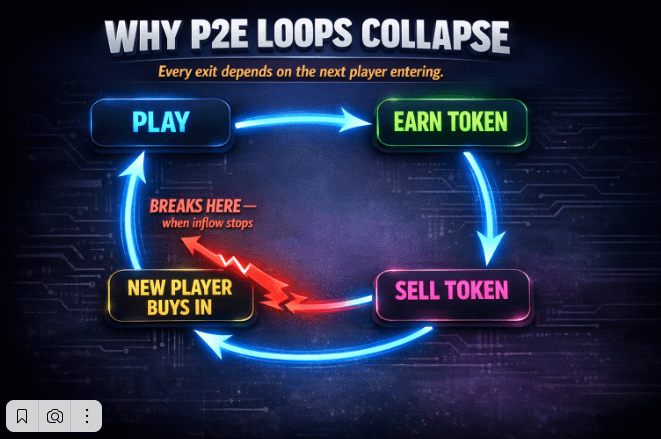
Classic P2E loop: player plays → earns token → sells token → new player buys token to enter. While inflow exceeds outflow, everything holds. But structurally this is a pyramid. Not a fraudulent one — just an unstable one.
Pixels also had BERRY — an inflationary in-game token. The team already announced its elimination as part of the "Chapter 2" transition. Two tokens, two sell vectors, double the pressure.
This is where I soften my criticism a bit — the team clearly sees the problem and is trying to fix it. These arent abandoned developers.
What is Stacked and why it matters
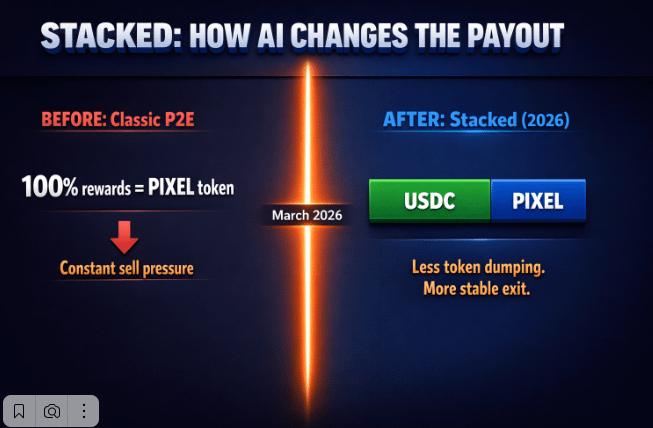
In March 2026, @Pixels launched "Stacked" — an AI reward infrastructure. Core change: part of player rewards now goes out in USDC, not PIXEL.
The logic is elegant. If a player receives a stablecoin, they dont need to sell PIXEL to take profit. Sell pressure drops. Token theoretically stabilizes.
The AI handles dynamic reward balancing — determining how much goes to whom based on activity and ecosystem contribution. Not a fixed distribution, but an adaptive system.
Sounds smart. But I read through that section of the documentation several times — and every time one thing stoped me: where does the USDC actually come from? If it comes from NFT sales and in-game transaction revenue — then the system depends on new player activity. Which brings us back to the same structural dependency.
Maybe I missed something in the docs. But I havent closed that question for myself.
Numbers worth watching
Max supply of PIXEL — 5,000,000,000 tokens. April 19, 2026 — another major unlock event. Additional downward pressure incoming.
Daily trading volume sits around $27M — volume exists, liquidity exists. The project isn t dead. But "alive" and "recovering" are different things.
Where my thinking shifted
I started this post with the idea that Stacked was a real structural solution. Now I think it's more a symptom management tool than a cure for the underlying cause.
The cause is that most P2E games dont generate enough real value to justify their token's market cap. Players earn. But where does that earning come from? From new players buying entry. Until the next wave arrives — the system contracts.
AI can make that contraction more managed and less painful. But whether it changes the foundation — I honestly dont know.
Maybe the real question isnt "will AI save P2E" — but whether a blockchain game can ever generate enough organic revenue without depending on constant new player inflow?