I will be honest, I went into Pixels thinkIng it was just another chIll farming game with some token rewards on top. You know the usual loop plant, harvest, repeat, maybe earn a bit if you stay consistent. I have seen that model before, and If you have been around Web3 games long enough, you already know how that usually ends.
but after actually reading the litepaper properly not just skimming like I did the first time, something felt off… in a good way.
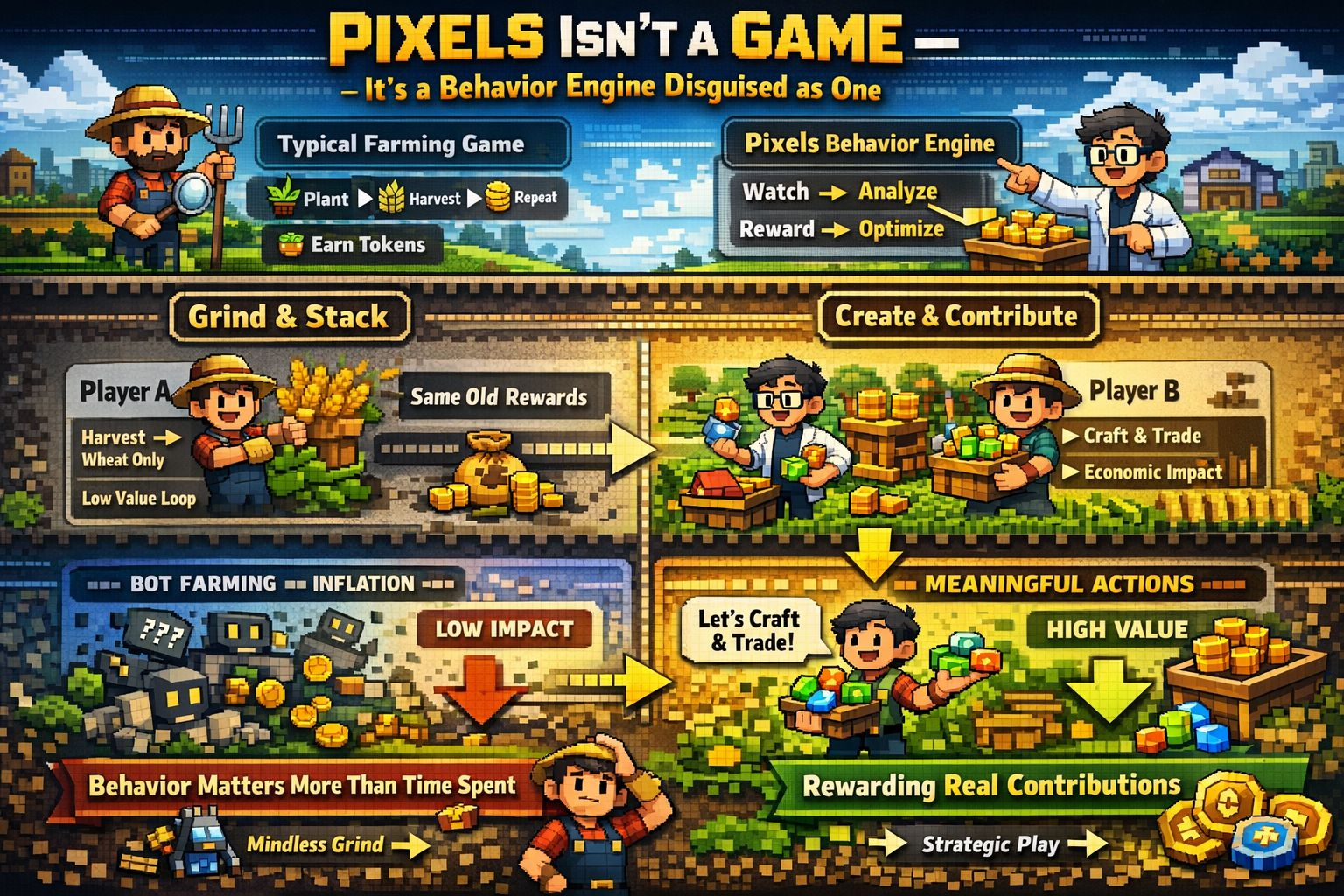
it did not read lIke a typical game pitch. it felt more lIke they are building a system that watches how people behave inside the game and then quietly decides who deserves rewards. that is a very different direction, and honestly, I did not expect that level of depth from something that looks so simple on the surface.
what really hit me was this Idea that Pixels is not rewarding you just for playing. it is trying to reward you for being useful. and yeah, that sounds vague at first, but the more I thought about it, the more it clIcked.
I have personally tried a few play to earn games before, and I will admit it I have been that guy who just farms the easiest loop over and over. no strategy, no thinking, just maximizing output. and it worked… until it did not. Rewards dropped, tokens inflated, and suddenly all that time felt kinda pointless.
Pixels feels lIke it is designed to break that exact behavior.
instead of asking how long did you play today?, it feels lIke the system is asking something deeper. LIke, did you actually contribute anything meaningful? were you part of a loop that matters, or were you just extracting value?
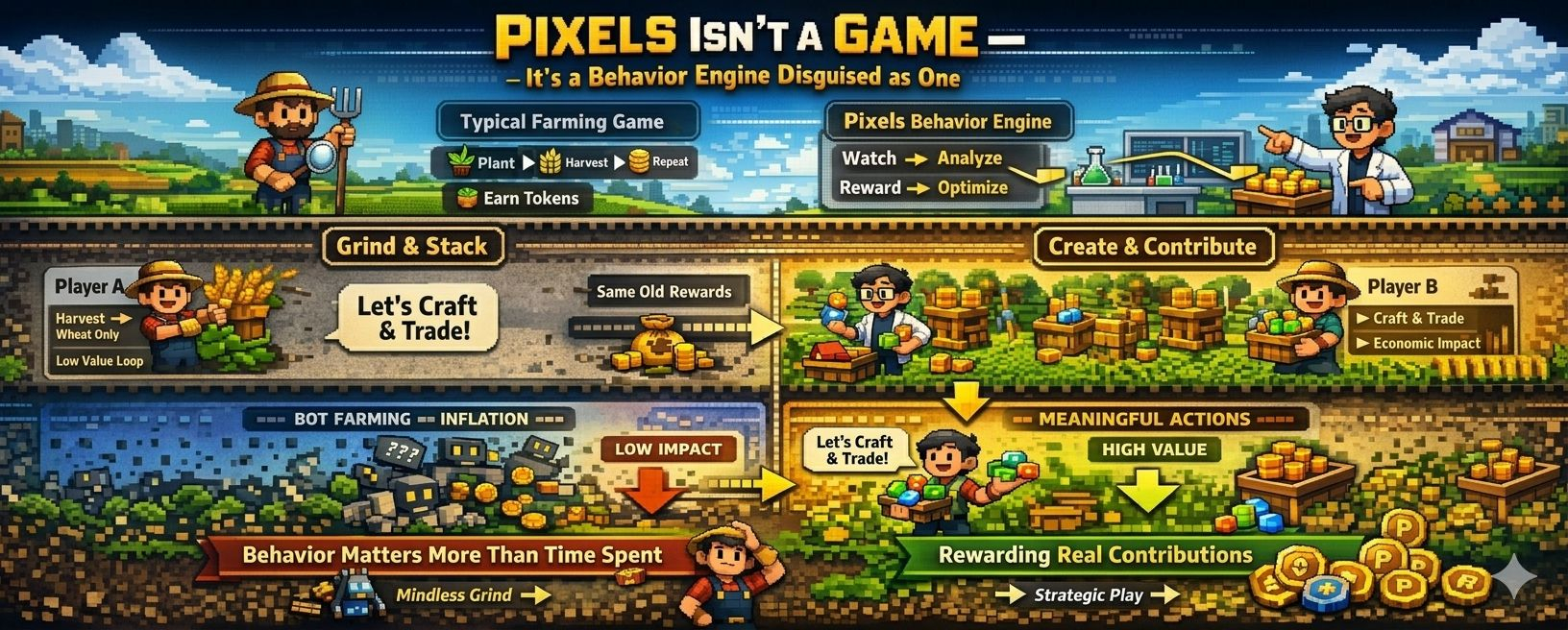
let me give a simple real example to explain what I mean imagine two players both farming wheat for an hour. Player A just keeps harvesting and stacking wheat without doing anything else. Player B, on the other hand, uses that wheat to craft items, trades them in the marketplace, or supplies something other players actually need. Same time spent, same base activity but completely different impact. In a traditional game, both get rewarded equally. In Pixels, it feels like Player B is the one the system wants to reward more.
that difference changes how you approach the game. It is subtle, but once you notice it, you can not unsee it.
I even caught myself thinking dIfferently while imagining the gameplay. LIke, if two players are doing the same task, why should they earn the same? one might just be repeating a low value loop, while the other is actually connected to crafting, trading, or helping the in game economy flow. it makes sense that the system would treat them differently.
and that is where the behavior engine idea really lands.
Pixels does not feel like it is built to reward activity. It feels like it is built to filter it. Some actions get amplified, others just… don’t matter as much. That is a bit uncomfortable if you are used to guaranteed rewards, but at the same time, it is way more sustainable.
also, quick side note I used to think tokens lIke $PIXEL were just another reward layer. but now it feels more like feedback. LIke the game is saying, yeah, what you did here actually mattered, instead of just paying you for showing up. that is a completely different vibe.
and I am not gonna pretend this is perfect or fully proven yet. It is still early, and we have all seen innovative token models fail before. but at least this approach is trying to solve a real problem instead of ignoring it.
the biggest issue with Web3 games has always been incentives. the system rewards the wrong behavior, and then everyone acts surprised when bots and farmers take over. Pixels seems like it is actually trying to fix that by rewarding players who add value, not just volume.
that is the part I respect.
if this works, it is not just a better game it is a smarter system. One that actually understands the difference between someone who’s just grinding and someone who is playing with intent.
Right now, Pixels still looks lIke a simple farming game you can play casually. and maybe that’s the point. It does not need to look complex on the outside.
because underneath, it is doing something way more interesting.
It is watching how you play, learning from it, and quietly deciding if what you’re doing is worth rewarding.
And yeah… that is not really a game anymore.