
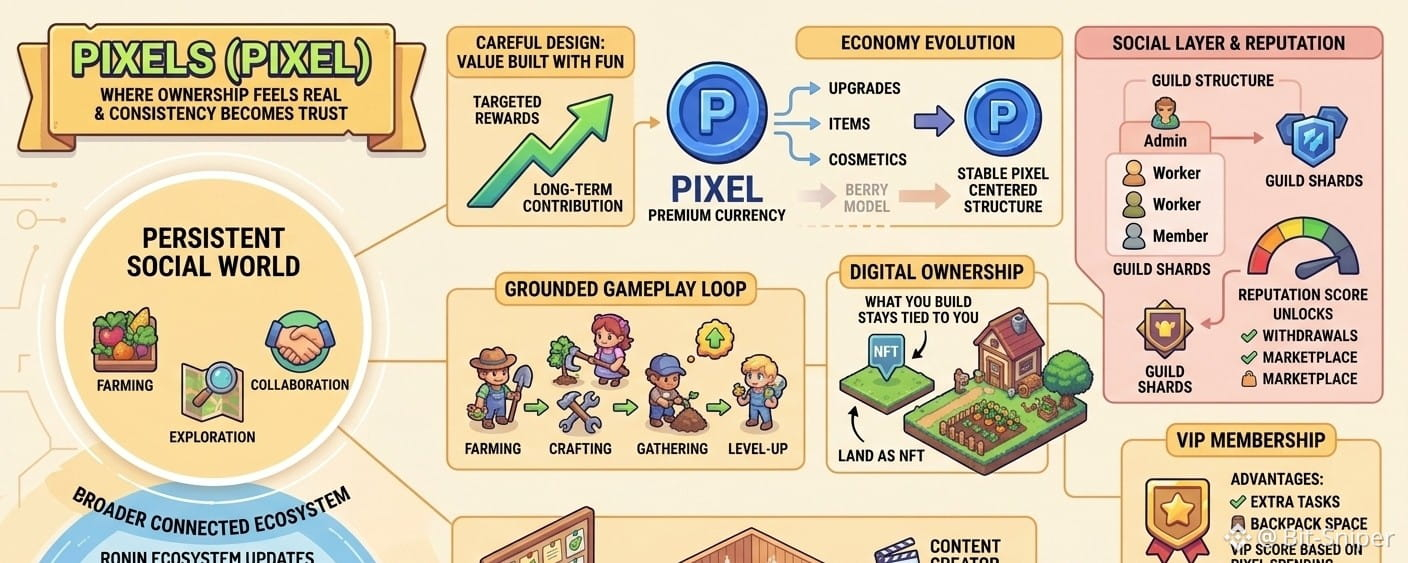
I keep coming back to Pixels in a way that feels quiet and almost unnoticeable at first, because nothing about it tries to pull you in aggressively or demand your attention, and yet over time it settles somewhere in your routine like something familiar that you do not question anymore. It is a social casual Web3 game built on the Ronin Network, shaped around farming, exploration, and creation, but those words only explain what you do, not what it feels like to be there. When I spend time inside it, planting crops, walking through open spaces, or slowly improving a small piece of land, it does not feel like I am chasing progress in the usual sense, it feels like I am just existing inside a system that moves at its own calm pace.
What makes it different is the way it refuses to rush you. Most digital games are built on pressure, on speed, on the idea that you always need to be doing more or doing better, but here the rhythm is slower and more forgiving. If you plant something, you wait. If you explore, you take your time. If you build, it happens gradually, step by step, without the feeling that you are falling behind. That creates a kind of space that is rare, especially in blockchain based projects where systems can often feel heavy or transactional. In Pixels, the systems are there, but they do not sit on top of everything else. They stay in the background while you focus on the simple act of being present.
Ownership exists inside the game, but it does not feel like a barrier. You can start without owning anything, you can use simple land, you can grow at your own pace, and if you decide to own land later, it adds depth instead of creating distance from other players. Over time, that land stops feeling like a feature and starts feeling like a place that reflects your time, your choices, and your small routines. It becomes something you recognize, something you return to without thinking too much about why.
The PIXEL token plays its role in the background, used for upgrades, cosmetics, and speeding up certain parts of the experience, but it does not define whether you can enjoy the game or not. You can move forward without it, you can take your time, and that balance keeps the experience from turning into something purely transactional. It becomes less about extracting value and more about participating in a system that continues to grow around you.
There is also a quiet social layer that you start to notice the longer you stay. Other players are not just competitors, they are part of the environment, moving through the same world, shaping it in their own ways. Systems like reputation slowly connect your activity with recognition, not in a loud or forced way, but in a way that reflects how much time and presence you have given to the game. It feels less like a scoreboard and more like a memory of what you have been doing inside the space.
As the project continues to evolve with new updates, new features, and small changes that keep expanding the experience, it never feels like it is trying to reinvent itself completely. Instead, it grows in a steady and natural way, allowing players to grow with it rather than constantly adjusting to something new. That sense of ongoing development makes the world feel alive, not finished, not fixed, but still becoming something over time.
What stays with me the most is not any single mechanic or feature, but the overall feeling that builds slowly without forcing itself. Pixels does not try to impress you instantly. It does not try to hold your attention through intensity. It simply gives you a space where your time matters in small ways, where your actions connect over days instead of minutes, and where the experience becomes something personal without asking you to treat it that way.
If you spend enough time there, something shifts almost without you noticing. You stop thinking about what you are supposed to achieve and start paying attention to what you are actually doing. You stop chasing progress and start settling into a rhythm that feels comfortable. And somewhere in that quiet repetition, the game changes from something you play into something you return to, not because you have to, but because it has slowly made a place for you inside it.