

I realized I hadn’t opened the marketplace in three days, which, if you’ve played any Web3 game before, is basically heresy. No price checking, no flipping, no “did I miss a pump?” anxiety. Just logging in, watering crops, moving things around like I actually cared where they sat.
That’s when it hit me. Pixels wasn’t pulling me in with rewards. It was trapping me with something worse.
A sense that this place was mine.
I didn’t buy that idea at first. Honestly, I rolled my eyes at it. Pixels looks like every other cozy grind sim that’s been duct-taped onto a token economy same loops, same quests, same soft-colored distraction while the real game happens in the background where people are busy vulture-mining a dying server for yield. I’ve seen that movie. It ends with empty maps and a Discord full of people asking if the devs are still alive.
Pixels doesn’t play that game. Or at least, it doesn’t feel like it does.
Most Web3 titles train you to behave like a tourist with a calculator. You show up, figure out the fastest route to extract value, and then you’re gone the second the numbers stop making sense. There’s no attachment because there’s no point. Why get attached to something that can be rebalanced into irrelevance overnight?
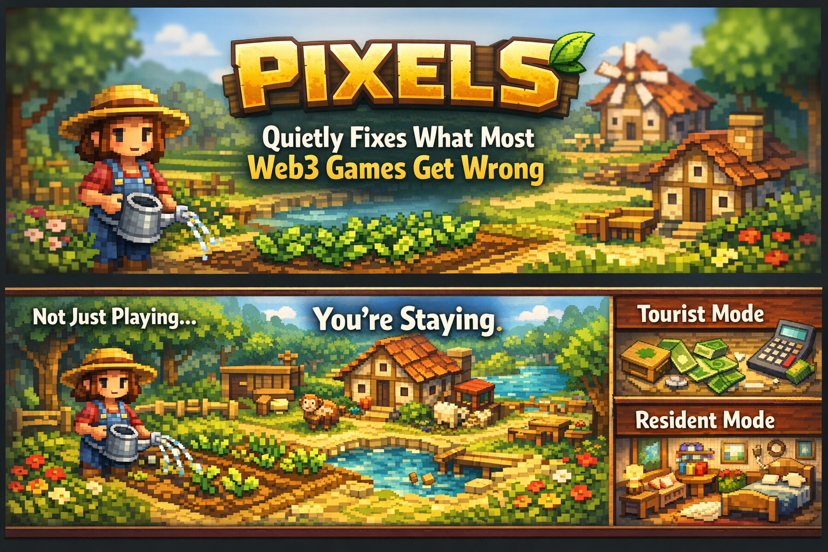
So you min-max everything. You don’t decorate you optimize. You don’t explore you route. You don’t stay you cash out.
That’s participation. It’s shallow, even when it’s profitable
Pixels quietly messes with that loop. Not by shouting about ownership, not by throwing NFTs in your face every five seconds, but by doing something almost annoyingly simple: it lets things persist. You leave, you come back, and your stuff is still there, right where you left it. Not in a “here’s your asset ID” way, more like your corner of the world didn’t forget you existed.
It sounds small. It isn’t.
Because once your brain clocks that persistence, it starts rewiring how you behave. You stop thinking in sessions and start thinking in continuity. I’ll just adjust this one thing before I log off. I’ll come back later and check on it. You’re not chasing rewards anymore you’re maintaining something.
And maintenance turns into attachment faster than people expect.
The weird part is how much Pixels hides the machinery that makes this possible. In most Web3 games, the tech is the main character. Wallets, tokens, transactions constant reminders that you’re inside a financial system wearing a game’s skin. Pixels does the opposite. The blockchain is there, sure, but it’s buried. It’s doing its job in the background, like plumbing. You don’t think about it unless it breaks.
That restraint matters. A lot.
Because the second you foreground the money, players revert to extraction mode. Always. No exceptions. Pixels dodges that by letting the feeling come first and the verification sit quietly underneath it. You feel like you own something before you’re ever asked to prove it.
And once that feeling sticks, it’s hard to shake.
I noticed it in dumb ways. Logging in without a plan. Rearranging things that didn’t need rearranging. Coming back not because there was something to earn, but because I wanted to see how things looked. That’s not rational behavior if you’re treating a game like a spreadsheet.
It is, however, exactly how people behave in spaces they think of as theirs.
So when people ask why Pixels works while a lot of other Web3 games stall out, I don’t think it’s about better tokenomics or smarter sinks or whatever new buzzword is making the rounds. Those things matter, but they’re not the hook.
The hook is that Pixels gets you to stop acting like a contractor and start acting like a resident.
And once that shift happens once you’re not just passing through, once you’re not measuring every action against an exit you’re in deeper than you planned. Not because the game forced you, but because leaving starts to feel like abandoning something.
That’s a different kind of retention. Messier. Harder to quantify. Probably more durable.
I didn’t expect to care. That was the whole point.