
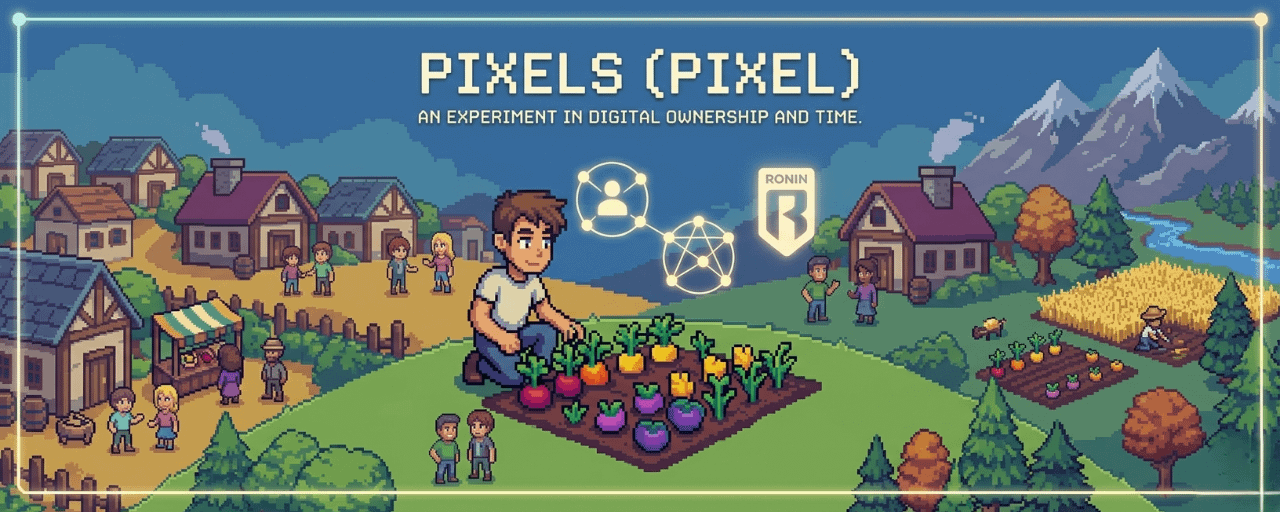

Pixels (PIXEL) is one of those projects that makes me pause and think a bit deeper than I normally would about a game. At first glance, it feels simple farming, exploring, building but the more I look at it, the more I see what it’s actually trying to do. It’s not just about gameplay. It’s about changing the relationship between me as a player and the time I spend inside a digital world. Built on the Ronin Network, it quietly pushes the idea that what I earn or create in a game shouldn’t just sit locked inside someone else’s system.
I’ll be honest, part of me really likes that idea. I’ve spent years playing games where I’ve built things, collected items, or invested time, only to realize none of it really belongs to me. So when I see a project like Pixels trying to give players some level of ownership, it feels refreshing. But at the same time, I can’t ignore a bit of skepticism. I’ve seen how quickly things can shift when money gets involved in games. What starts as fun can slowly turn into something that feels more like work, and I think that’s a real risk here.
When I break it down, I see Pixels trying to solve a pretty clear problem. In traditional games, I’m basically contributing value my time, my creativity, sometimes even my money but I don’t actually control anything I earn. Pixels flips that idea by letting players have more control over their in game assets. That sounds simple, but it’s actually a big shift in thinking.
What I find interesting is who this is really for. On one hand, I can see casual players being drawn in because it looks and feels like a relaxing farming game. On the other hand, people already familiar with Web3 will probably see it as an opportunity to engage with a digital economy. Personally, I think the real challenge is people like me somewhere in the middle. I don’t want to deal with complexity every time I log in, but I’m still curious about the idea of ownership.
From what I can tell, Pixels does a decent job of making things feel smooth. Using Ronin helps reduce some of the usual friction that comes with blockchain games, which I think is important. If I have to constantly think about wallets, fees, or transactions, I’m probably going to lose interest quickly. The fact that it tries to keep those things in the background makes the experience feel more natural.
What really makes me think, though, is how this idea connects to things outside of gaming. When I look at industries like AI or healthcare, I see similar conversations happening around control and ownership of data. For example, in healthcare, a patient’s data might need to be shared with researchers, but only in a limited, controlled way. The same goes for AI, where datasets are valuable but sensitive. In both cases, there’s a need to share just enough without giving everything away. In a strange way, Pixels reflects a lighter version of that idea where I can control what I own and how it’s used, instead of giving full control to a centralized system.
But this is also where my doubts come in. In healthcare or AI, these systems are backed by strict rules and serious consequences. In gaming, things are still evolving. So even if Pixels promises ownership, I have to ask myself how strong that ownership really is. It still depends on the network, the developers, and the overall ecosystem staying stable. If any of that breaks down, the idea of ownership could start to feel a bit fragile.
Looking at where things stand in 2026, I feel like Web3 gaming is still trying to find its balance. I’ve seen projects gain attention quickly and then fade just as fast. At the same time, I can’t ignore that the bigger ideas like decentralization, ownership, and user control are gaining traction across different industries. So even if individual projects struggle, the direction itself feels meaningful.
For Pixels, I think the biggest opportunity is staying focused on being a good game first. If I enjoy playing it without constantly thinking about tokens or value, then it has a real chance. If the ownership aspect becomes something that enhances the experience rather than dominates it, that’s where it could stand out.
But the risks are always there in the back of my mind. If the economy becomes too central, it could change how people play. If prices fluctuate too much, it might scare off players who just want a stable experience. And if things get even slightly complicated, I know a lot of casual players including myself might not stick around.
At the end of the day, when I think about Pixels, I don’t see a perfect system. I see an experiment one that’s trying to merge something simple and nostalgic with something complex and forward looking. And I think whether it succeeds or not will come down to one simple thing: does it still feel like a game I want to come back to, or does it start to feel like something else entirely?
