
👇👇👇👇👇
A few days ago I was going through DAU charts for various Web3 games. Boring work honestly — most look identical: a huge spike at launch, then a cliff. But the @Pixels chart confused me a little. It dropped too — just not to zero.
So I started digging.
What I assumed at first
My first reaction was: marketing trick. Classic P2E playbook where the team inflates engagement metrics to look alive before the next funding round. I've seen it too many times.
But then I found specific changes in the game's economy — and the picture got more complicated.
What they actually changed
Pixels is built on Ronin Network. The PIXEL token launched in February 2024 as Binance's 46th Launchpool. Loud start, price pumped, then — standard P2E decline.
But then the team did a few things I didn't expect:
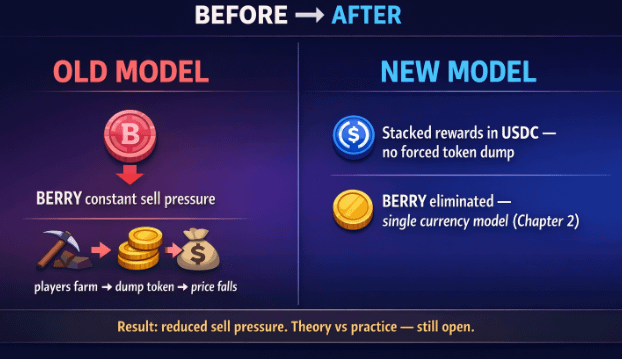
First — they killed BERRY. That was the game's internal inflationary token. Instead of quietly rebranding it or letting it rot — they publicly announced a move to a single currency under Chapter 2. I read that announcement twice because I didn't quite belive it the first time.
Second — they launched "Stacked". An AI-powered reward infrastructure where part of payouts go in USDC instead of pixel. The logic: if a player earns real dollars they don't need to immediately dump the token to lock in profit. Sell pressure drops. In theory.
And here I start to cool off a little. Because "in theory" and "in practice" are different universes in crypto.
Where I got stuck
The Stacked mechanic is described pretty vaguely in the documentation. I spent about half an hour trying to understand how exactly the AI determines reward size for an individual player. No clear answer. Either I missed it or they haven't fully disclosed the logic yet.
That's either a flexible system that's hard to formalize — or a black box that can change the rules any time. For a player that distinction is critical.
What's actually holding DAU
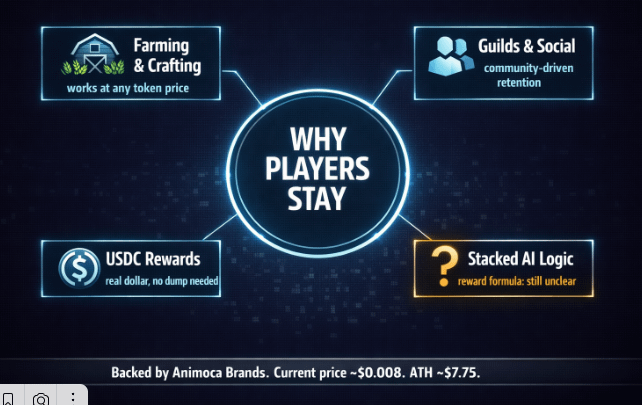
Pixels isn't just "click button, get token". There's farming, crafting, guilds, open world, social interaction. Casual mechanics that work regardless of asset price.
And here's the paradox: the most successfull thing about Pixels is the least "Web3" part. People just enjoy playing.
@Pixels is backed by Animoca Brands and several notable investors — that gives some survival buffer. But backing doesn't solve the fundamental problem: if the next hype cycle brings new games with bigger payouts, player loyalty will evaporate fast.
Current price is around $0.008. ATH was somewhere around $0.70–0.80. That's a drop of over 98%.
The question I leave open:
Can a Web3 game survive long-term if its token has effectively stopped being the motivation — and the only thing keeping players is the game itself?
If yes — why does the token exist at all?