
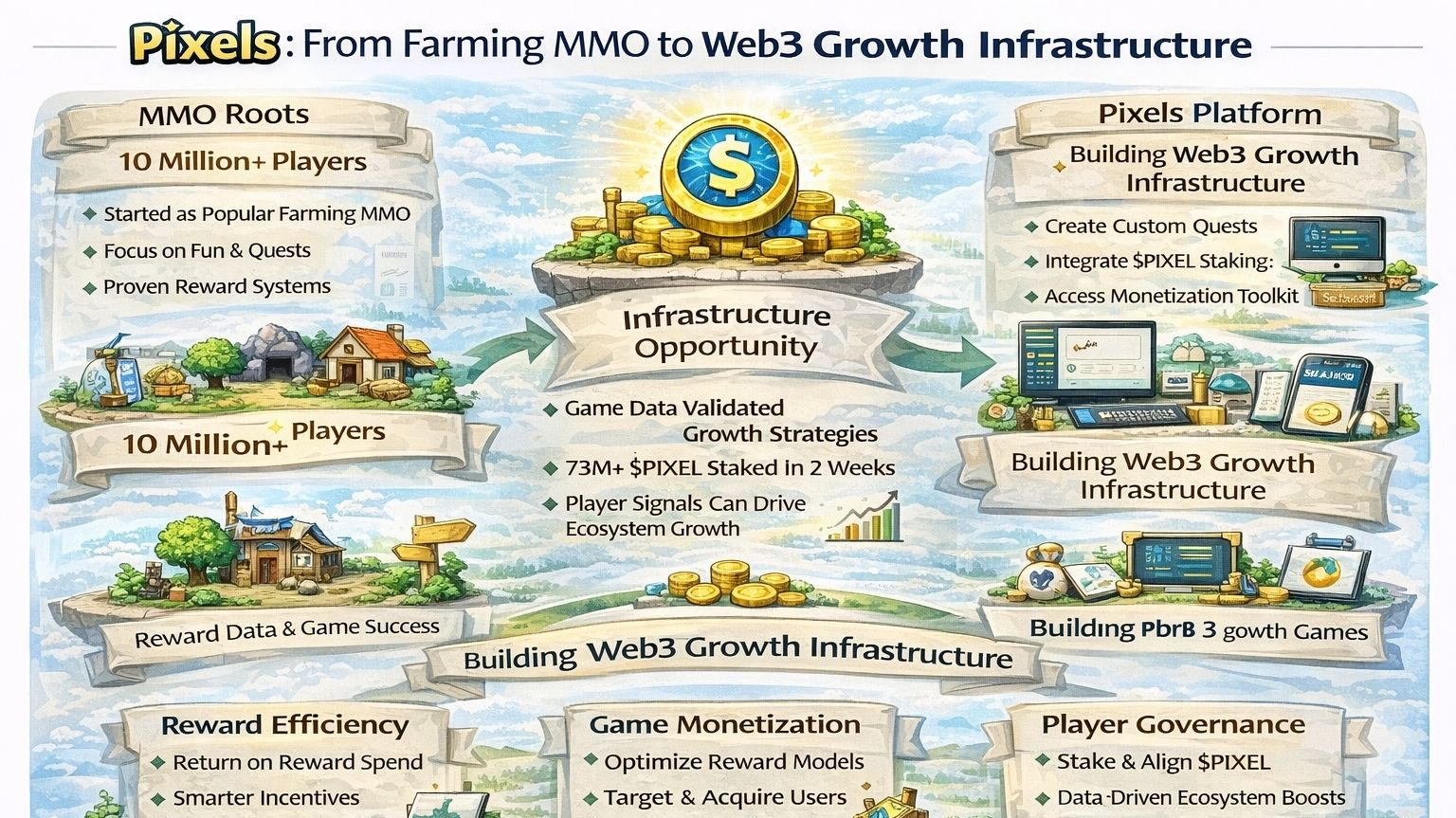

@Pixels I think the market still misreads Pixels. Most people still see a farming game with a token attached and stop there. That frame feels stale to me. Pixels’ own whitepaper has long emphasized fun first, interoperability, and gradual decentralization, while also describing the company as a builder of tooling for multiplayer spaces, quests, stores, items, and worlds. The current site pushes that idea further by saying Pixels is building a platform where users can build games that natively integrate digital collectibles. When I connect that older platform thesis to the March 2026 launch messaging around Stacked, I do not see a project drifting away from its roots. I see a game using its roots as a laboratory, then packaging what it learned into infrastructure.
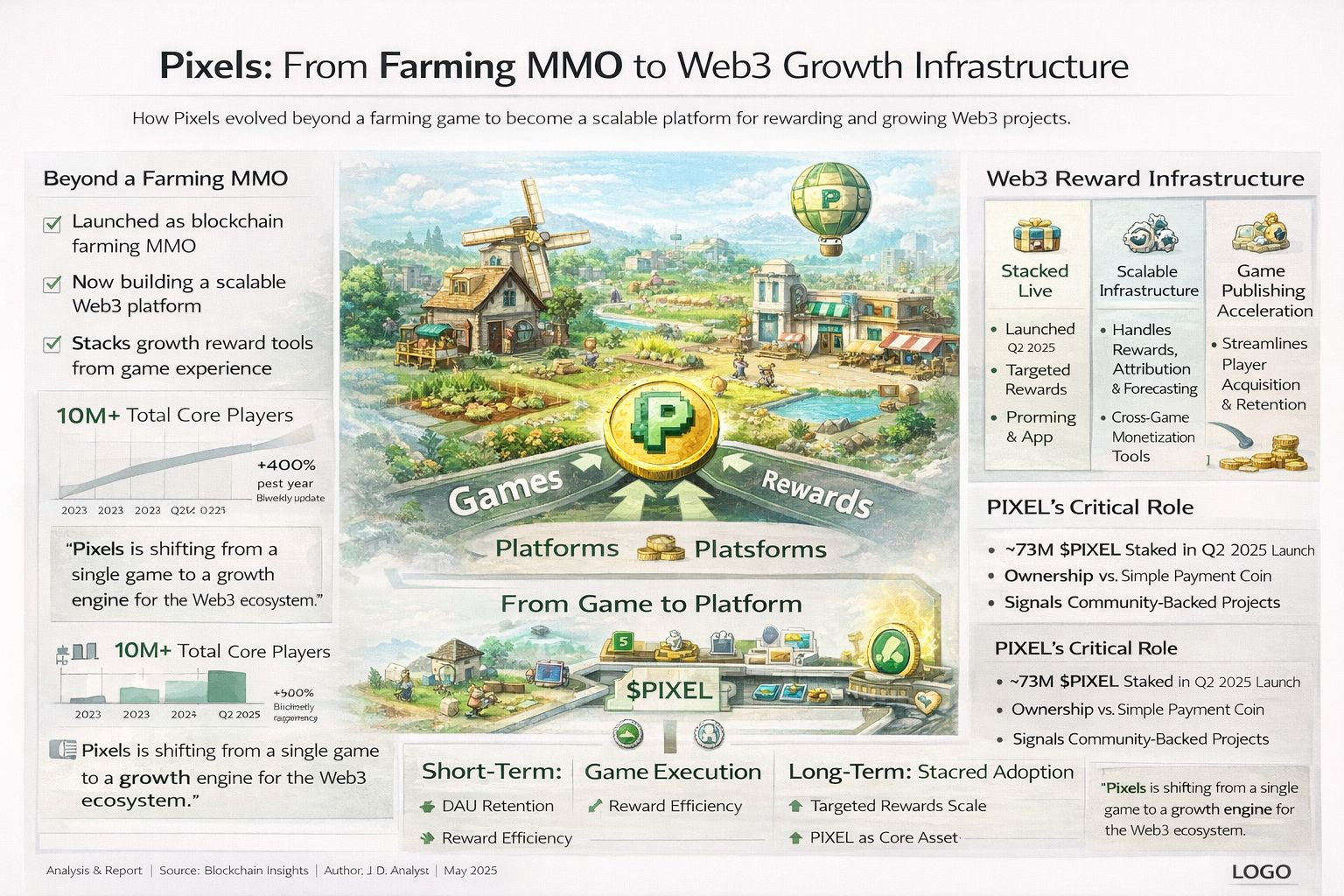
What makes that shift matter now is that Pixels has actual operating history behind it. The company says the core game has over 10 million players and updates every two weeks, and recent official commentary says the team has already lived through the jump from thousands of users to more than one million daily active users. That scale matters because reward systems always look smarter in theory than they do under pressure. In May 2025 Pixels launched $PIXEL staking as part of what it explicitly described as a player-driven and data-driven publishing ecosystem. Within two weeks it said more than 73 million $PIXEL had been staked across its first games. I read that less as a token event and more as a test of governance and distribution that asks whether Pixels can turn player attention into signals about where rewards visibility and future support should go.
My core thesis is that Pixels only becomes truly important if rewarded play turns into infrastructure, not if the market squeezes one more narrative cycle out of a gaming token. The company’s own language around Return on Reward Spend is the clue. In plain English, Pixels is trying to make sure rewards bring back more value than they leak out. Official materials say staking data helps train prediction models, improve reward efficiency, and shape future publishing decisions. Recent commentary around Stacked goes even further, describing it as a rewards app and monetization layer that handles targeting, pricing, attribution, intent modeling, and bot resistance. To me, that is the most mature thing Pixels has said in a long time, because it treats incentives as a system design problem rather than a promise that users will forever show up for emissions.
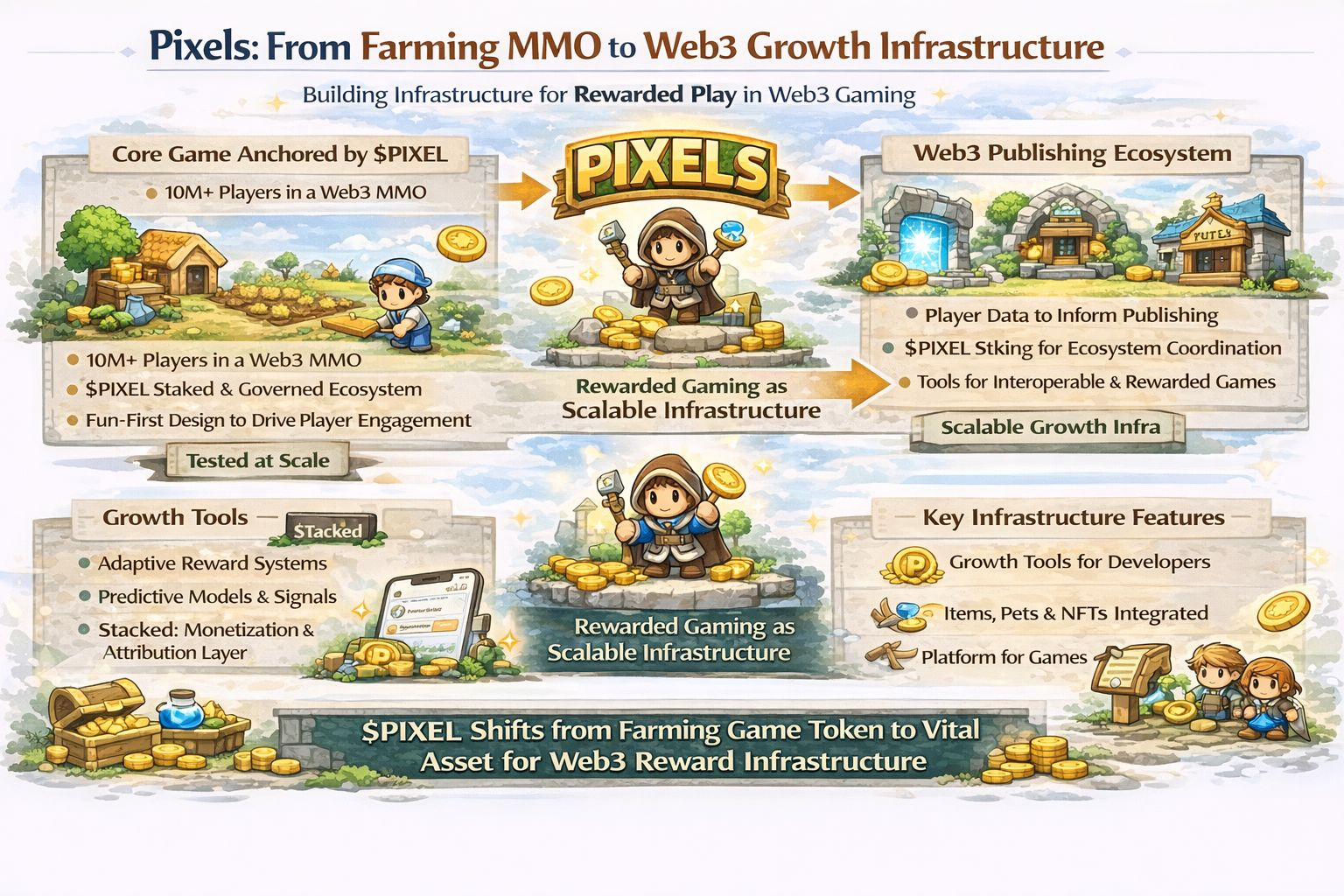
I also think this is where investors can get the story wrong in both directions. The bull case is stronger than the market gave it credit for a year ago, because Pixels is no longer selling only a game loop; it is selling a reusable growth and rewards stack built from live experience. But the risk is more serious too. Pixels’ older economics writing was unusually clear that real value has to come from gameplay people would actually pay for, not from speculation, and that discipline still matters. The team has also admitted Stacked’s current in-game experience is not user-friendly enough yet, said the rollout will open gradually rather than all at once, and argued the system only works if it improves monetization for games while remaining better for players. That means Pixels has moved from the familiar risk of game balance into the harder risk of productizing internal tooling for outside use.
From a practical market perspective, I would look at Pixels in two time frames. In the short run, it will still be judged like a live game and token ecosystem, with sentiment reacting to update cadence, staking design, and new reward surfaces. In the long run, I care about three tests. Can the core game keep retaining people on its own fun-first merits. Can Stacked convince more studios that targeted rewards are a better growth spend than blunt acquisition. And can $PIXEL keep a durable role as the coordination asset for staking and ecosystem alignment rather than getting diluted into a generic payment chip. Recent team comments suggest the plan is exactly that: keep $PIXEL central to staking, while allowing more rewards and spending to move into a cleaner, more monetization-friendly structure. That is why I no longer view Pixels mainly as a farming MMO. I view it as a serious attempt to turn reward design into infrastructure, which is a harder business, but potentially a much more durable one.