
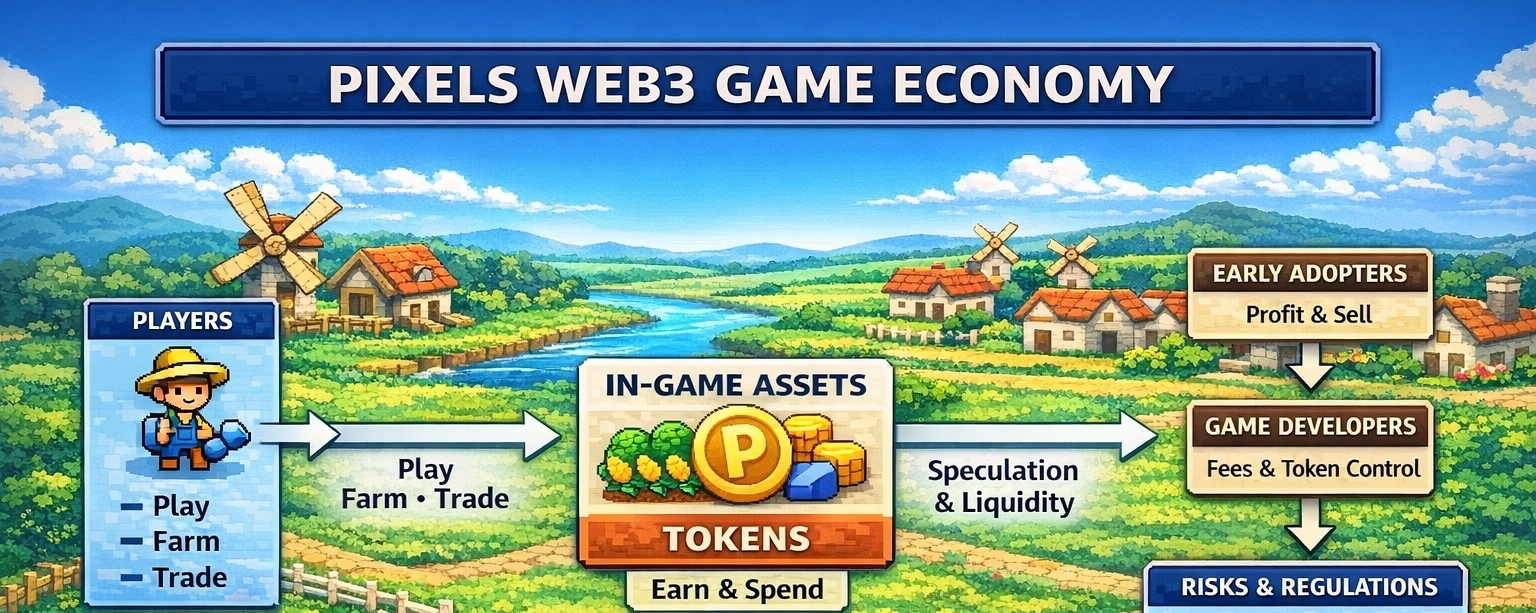
Look, I’ve seen this movie before.
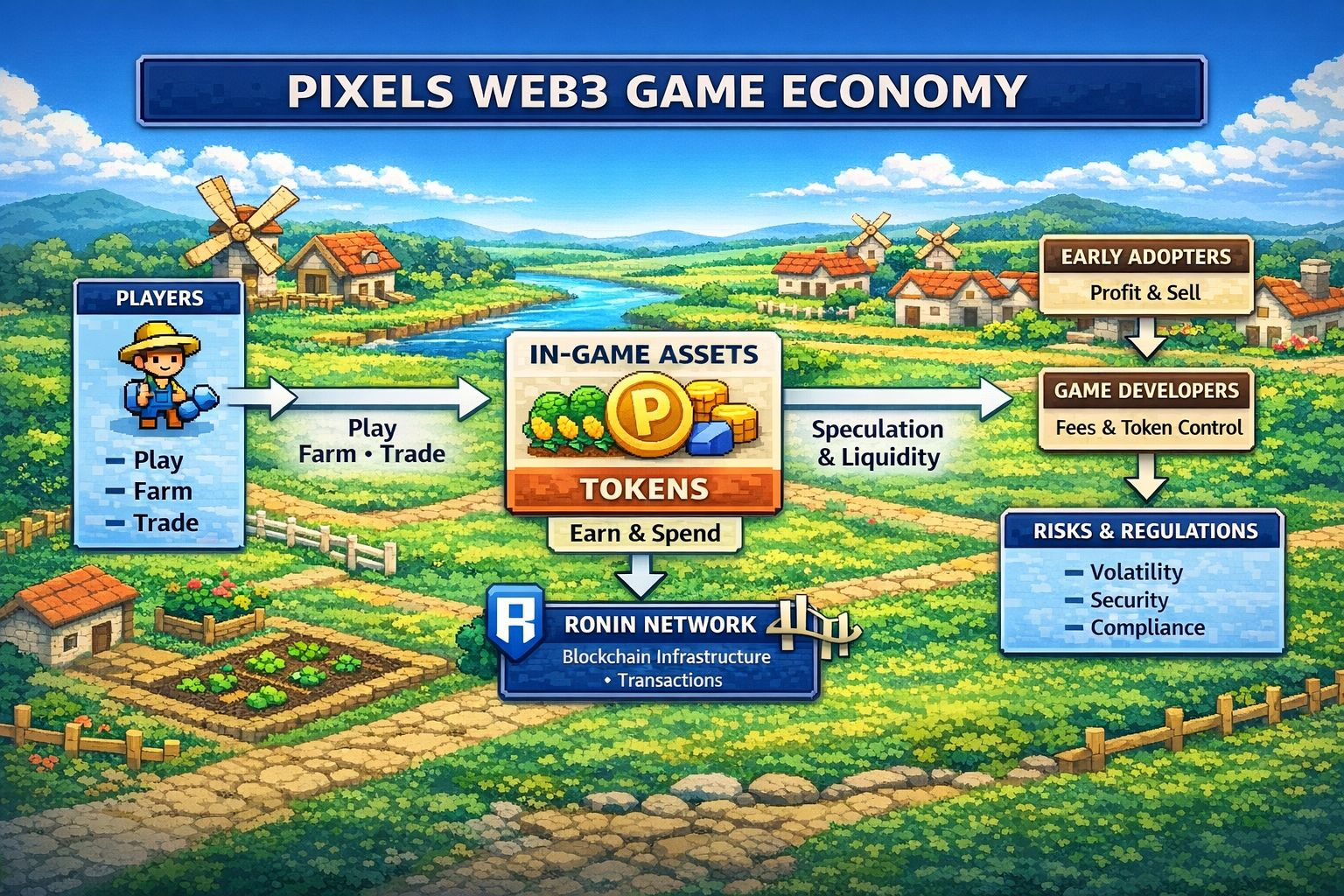
A simple game shows up. Friendly graphics. Low barrier to entry. A quiet promise in the background that, this time, the economics actually make sense. No loud slogans. No aggressive “get rich playing games” pitch. Just a soft suggestion that you can play, maybe earn a little, and enjoy the experience along the way.
That’s the pitch behind Pixels. And on the surface, it’s cleaner than what came before. Less noise. Better packaging. More restraint.
But the core problem hasn’t gone anywhere.
Let’s be honest. The thing Web3 games claim to fix is broken incentives in traditional gaming. Players don’t own their assets. They can’t trade them freely. They spend money, but don’t participate in the upside. That’s the grievance. And it’s not entirely wrong.
So the proposed fix is ownership. Tokenized assets. Open economies. Players become stakeholders.
It sounds tidy. On paper, at least.
But here’s the part that gets glossed over: once you financialize a game, it stops behaving like a game. It starts behaving like a market. And markets don’t care about fun. They care about extraction.
Pixels doesn’t escape that. It just softens the edges.
Underneath the farming mechanics and social features, you’re still dealing with an economy that depends on inflow. New players arrive, buy assets, participate in the system. Existing players benefit. That loop continues until it doesn’t.
And when it doesn’t, things get tight. Fast.
I’ve seen this exact arc play out with earlier projects. The names change. The art style improves. The language gets more careful. But the structure stays the same.
Now, to their credit, Pixels tries to reframe the whole thing. It’s not “play-to-earn” anymore. It’s more casual. More social. The earning is supposed to feel secondary.
I get the intention.
But users aren’t stupid. The moment there’s real value attached to in-game activity, behavior shifts. People optimize. They min-max. They grind. The game loop stops being about enjoyment and starts being about efficiency.
That’s not a design flaw. That’s human nature.
Then there’s the infrastructure piece. Pixels runs on the Ronin Network, which, yes, is faster and cheaper than Ethereum. That’s the selling point. It makes all those tiny in-game transactions viable.
But let’s not pretend this is some bulletproof foundation.
Ronin has already had a major security failure. A big one. Not theoretical risk—actual, historical failure. And when something like that happens, it’s not just code breaking. It’s trust evaporating overnight.
So ask yourself a simple question: what exactly do you “own” in a game like this?
You own assets that exist on a network that has to stay secure, governed, and operational. You rely on validators you don’t control. You depend on a system that can freeze, fork, or fail.
That’s not the same as ownership people think they’re getting.
Now let’s talk about the part nobody likes to say out loud: the money.
Who actually gets rich here?
Early participants. Always. The people who get in when assets are cheap, when token emissions are high, when competition is low. They accumulate. They position themselves.
Later players? They provide liquidity. They sustain the system. They’re not necessarily being scammed, but they’re entering a game where the best opportunities have already been taken.
That’s the catch.
And it’s dressed up very carefully. You won’t see “yield farming” language anymore. You’ll see “community,” “exploration,” “player-driven economies.” It sounds healthier. Less extractive.
But the incentives haven’t changed. Not really.
And here’s where the complexity creeps in. To keep the system stable, you need constant tuning. Token emissions. Resource sinks. Reward rates. Market balancing. It becomes this ongoing act of economic micromanagement.
Traditional games don’t need that. They worry about engagement, not monetary policy.
Pixels has to do both. At the same time. Under real market pressure.
That’s not simplification. That’s an added layer of fragility.
And when something breaks—and something always breaks—it won’t just be a gameplay issue. It’ll be financial. Players won’t just be annoyed. They’ll be exposed.
That changes the tone of everything.
Look, I’m not saying Pixels is doomed. It’s clearly more thoughtful than the first wave. Better design. Better pacing. Less hype-driven.
But I’ve been around long enough to know that polish doesn’t fix structural problems.
It just makes them harder to see.
And sooner or later, the numbers matter more than the crops you’re planting.
