
The blockchain gaming industry has reached a critical crossroads. After the initial "Play-to-Earn" (P2P - P2E) boom and subsequent correction, the market has been searching for a model that balances entertainment with sustainable economics. According to the recent Binance Launchpool data and the comprehensive Pixels Litepaper, we are witnessing the birth of a new standard.
Pixels is not just a game about 16-bit farming; it is a complex social experiment in digital resource management, powered by the Ronin Network.
1. The Core Philosophy: Fun First, Finance Second
One of the biggest mistakes of early Web3 games was prioritizing the "Earn" over the "Play." Pixels reverses this. As stated on their official website (pixels.xyz), the game is designed to be a "social sandbox."
The developers understand that for a token to have value, players must want to spend it to enhance their experience, not just sell it to exit the ecosystem. This shift from "extractive" gameplay to "intrinsic" gameplay is what separates Pixel from its predecessors.
2. Deciphering the $PIXEL onomy: A Sustainable Loop
Based on the Litepaper, the economy is built around several sophisticated "sinks" and "faucets."
The Energy Barrier
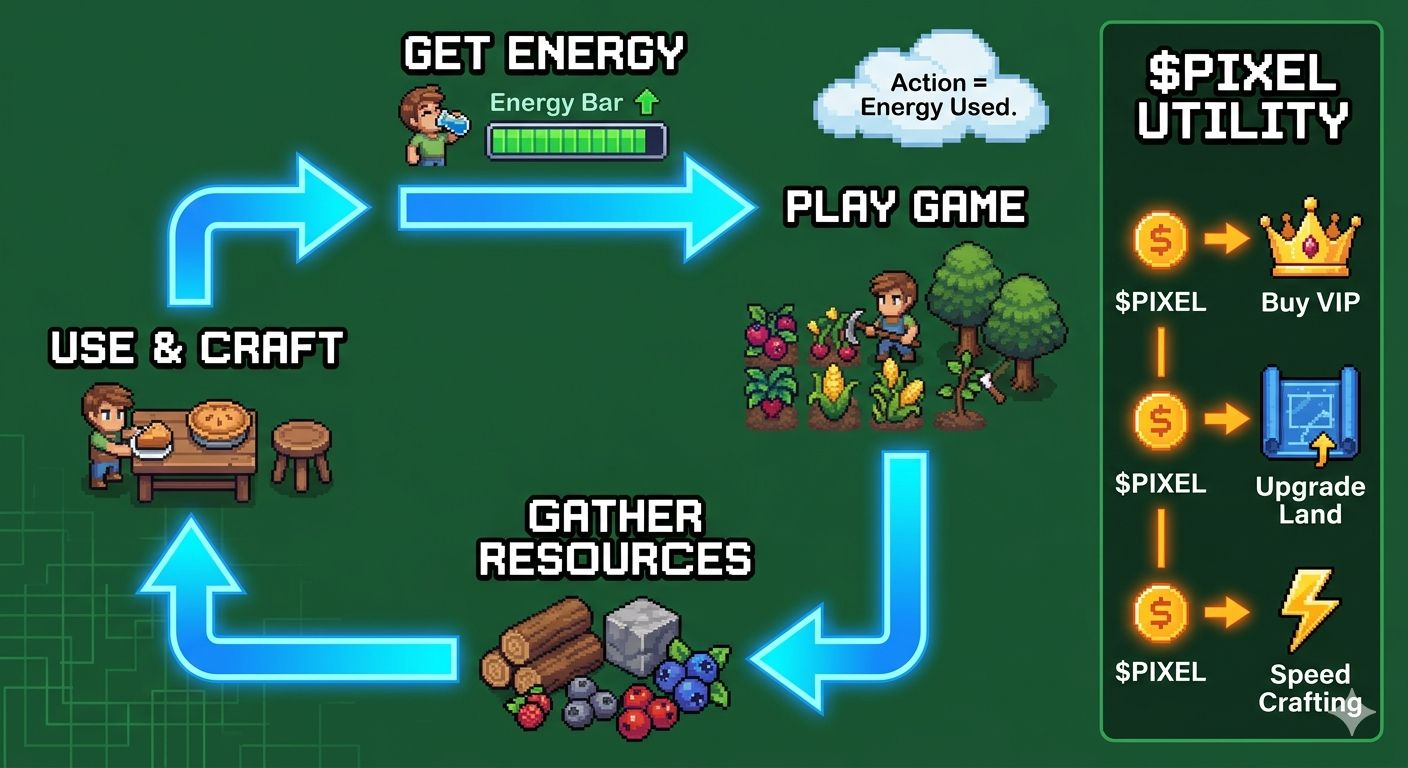
In Pixels, energy is the ultimate currency. Every action—gathering wood, mining stones, or harvesting "Popberries"—requires energy. This creates a natural limit on supply. You cannot simply bot the game 24/7 because your character will run out of steam.
To refill energy, players can wait (passive) or use $PIXEL urchase premium food and boosts (active).
This ensures that pixel stantly being "burned" or recirculated back into the ecosystem.
Land Ownership and Industrialization
Pixels offers a unique land system:
Speck (Free): Entry-level plots for new players.
Owned NFT Land: The crown jewel of the ecosystem. Owners have full control, unique resources, and a share of the production generated by other players working on their land.
The $PIXEL According to the Binance announcement, Pixel mint new Land, upgrade existing farms, and unlock "Industries" (specialized crafting stations).

3. Why the Migration to Ronin Changed Everything
The decision to move from Polygon to Ronin was strategic. As the blockchain specifically built for gaming by Sky Mavis, Ronin offers:
Low Friction: Transactions that cost fractions of a cent.
Community Density: A concentrated base of dedicated Web3 gamers.
Infrastructure: Seamless integration with the Katana DEX and Ronin Wallet, making the onboarding process for new pixel edibly smooth.
@Pixels
4. The Binance Catalyst: More Than Just a Listing
When Binance announced PIXEL oject on its Launchpool, it provided more than just liquidity. It provided legitimacy.
The distribution model (staking BNB and FDUSD) ensured that the token reached a wide, global audience of committed holders. This massive influx of capital and users has allowed the Pixels team to accelerate their "Chapter 2" development, which focuses on deeper guild mechanics and competitive play.
5. The Future: Social Interoperability
Pixels is leading the way in "NFT Interoperability." By allowing players to use their external NFTs (like Pudgy Penguins or BAYC) as in-game avatars, Pixels is becoming the "social layer" of the entire metaverse. It’s a place where your digital identity finally has a world to live in.
#Pixel
Conclusion: Is Pixel data from the Litepaper and the market reaction on Binance suggest that Pixels has solved the most difficult puzzle in crypto: Retention. People aren't just playing to earn; they are playing to stay.
As the game moves into its next phase, the Pixel testament to the power of thoughtful game design and community-centric economics. Whether you are a farmer, a trader, or a land baron, the world of Pixels offers a seat at the table.
The question is: are you ready to sow the seeds of the future?