
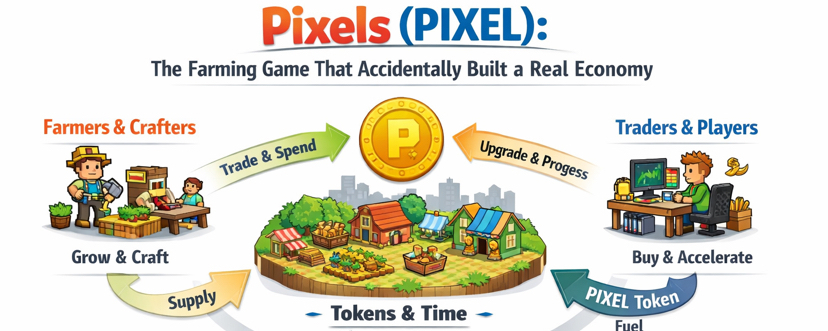
Pixels looks simple. You plant crops, harvest them, craft items, and explore a colorful world. But after spending time watching how players actually behave, it starts to feel less like a game and more like a small digital town trying to run its own economy.
Some players farm all day.
Some rent out land.
Some rush progression.
Some just speculate on the token.
PIXEL sits in the middle of all of them — quietly coordinating who produces, who spends, and who profits.
That’s why Pixels doesn’t behave like most Web3 games. The token isn’t just a reward. It’s closer to fuel that keeps the town running.
Why Pixels Feels Different Right Now
Pixels has gone through waves. A big influx of players arrives, activity explodes, token demand rises — and then things cool down. This pattern isn’t random. It’s what happens when a game’s economy depends heavily on player behavior instead of fixed mechanics.
Imagine a weekend farmers’ market.
If too many farmers show up, prices drop.
If more buyers show up, prices rise.
If people stop visiting, the market goes quiet.
Pixels behaves exactly like that. When new players arrive, everyone needs resources, crafting increases, and PIXEL gets spent. Later, as players accumulate materials, spending slows and supply grows. The economy breathes in and out.
Most people assume more players always means higher prices. But Pixels often shows the opposite: more players can actually increase selling pressure, because many of them are farming rather than spending.
That’s the subtle dynamic many overlook.
What’s Changed Recently — And Why It Matters
The past few months have shown three important shifts.
First, token activity has occasionally surged even without major gameplay updates. That suggests PIXEL is starting to trade like a signal for Web3 gaming sentiment, not just in-game demand. This adds volatility, but also visibility.
Second, player waves are still strong, but retention becomes the real test. Large onboarding pushes bring hundreds of thousands of players, yet the economy only stabilizes when those players transition from farming to spending.
Third, the game is quietly introducing more paid and progression-based sinks. Subscriptions, upgrades, and crafting depth aren’t flashy features, but they matter because they create reasons to spend, not just earn.
Together, these shifts move Pixels away from pure “play-to-earn” toward something more sustainable — a loop where players actually consume what others produce.
What the Activity Tells Us
Looking at how players behave, a pattern appears:
New players arrive → they farm
Resources increase → prices soften
Progression slows → spending begins
Demand rises → economy stabilizes
It’s almost seasonal, like a harvest cycle.
This is why small changes that increase friction sometimes improve the economy. Slower energy recovery, crafting costs, or land fees all encourage players to spend instead of hoard.
That sounds counterintuitive, but in an economy, friction creates value.
How PIXEL Actually Gets Used
Players mainly use PIXEL to save time.
Speeding up crops
Crafting faster
Unlocking progression
Using premium land
Improving efficiency
In other words, PIXEL turns patience into progress.
That creates an interesting balance:
grinders produce resources
spenders buy speed
landowners earn fees
traders provide liquidity
If all four groups stay active, the system feels alive.
If one disappears, things slow quickly.
The Quiet Risks
Pixels doesn’t fail loudly. It fades slowly if the balance breaks.
Too many farmers and not enough spenders can flood the economy.
Short-term players may extract value and leave.
Speculation can disconnect price from gameplay.
Bots can inflate activity without real demand.
None of these kill the game instantly. They just make the town feel emptier over time.
What I’d Watch Going Forward
The most important signals aren’t price-based.
Are players upgrading more often?
Is land being actively used?
Are players progressing deeper into crafting chains?
These show whether the economy is circulating or stagnating.
Closing Thought
Pixels isn’t trying to be a complex strategy game. It’s something softer — a shared space where players slowly build a living economy together. The farming is just the surface. Underneath, it’s about how time, resources, and incentives move between people.
When that movement is healthy, Pixels feels alive.
When it slows, everything else follows.
Takeaways
PIXEL works best when players spend to progress, not just farm
The game behaves like a small player-run economy
Long-term strength depends on circulation, not hype