
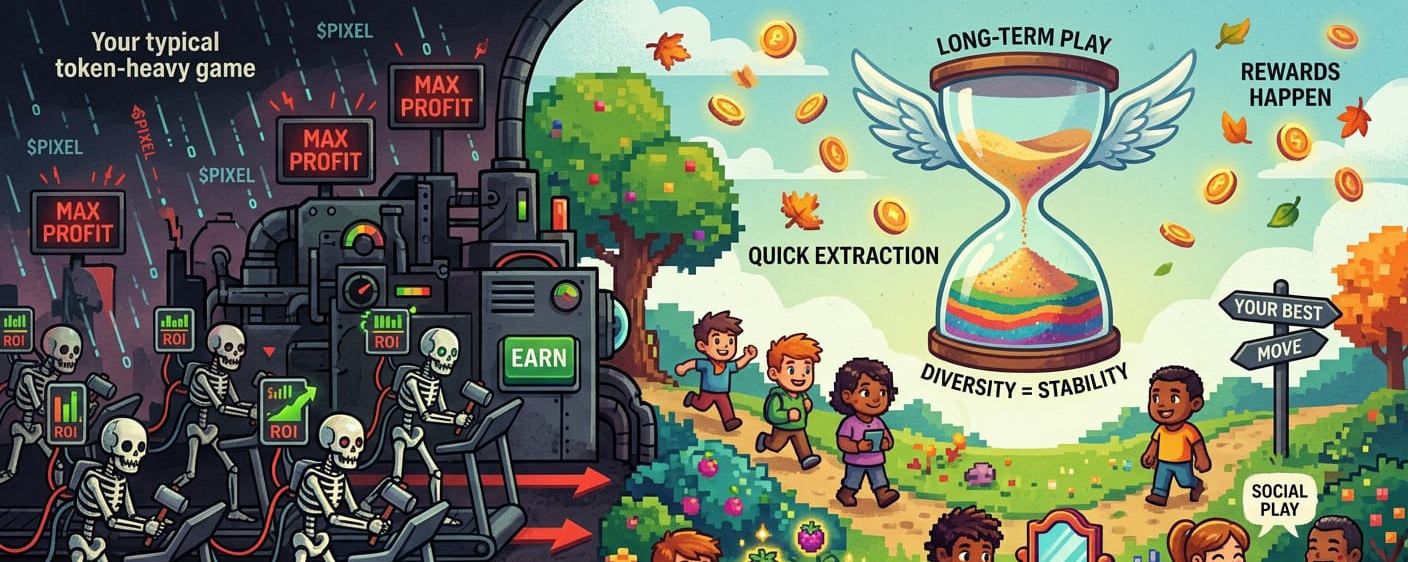

Most Web3 games kill themselves by obsessing over one question: How do we pay people to stay? Pixels effectively ignores that. Instead of using rewards to force a specific behavior, it builds a world where rewards just... happen. It sounds like a tiny tweak, but it’s actually a total shift in how the game feels.
When you drop into Pixels, you aren’t hit with a "to-do" list for maximum profit. There’s no blinking arrow pointing you toward the most efficient grind. That’s a deliberate choice. In your typical token-heavy game, players turn into robots—they find the one loop that pays best and do it until they burn out. The game stops being a world and starts feeling like a job you didn't sign up for. Pixels dodges this by making "efficiency" a moving target. It rewards you for actually poking around.
Under the hood, the game is moving away from those rigid, "if-then" incentives. If you’re a farmer, a crafter, or just a guy who likes talking to people, the system treats you differently. This is huge. When every player isn't sprinting toward the exact same chest, the economy doesn't collapse under its own weight. Diversity is basically their insurance policy against inflation.
Even progression feels different. Usually, in Web3, you measure success by how much you’ve managed to "extract." In Pixels, you’re just getting better at the game. You’re fixing up your land, sharpening your routine, and finally figuring out how the pieces fit together. The rewards follow the fun, they don’t lead it. When the money leads, people optimize the life out of a game. When the experience leads, people actually play.
There’s also a clever trick in how they handle growth. Most games break when they get popular because new players just copy-paste the most profitable strategies, which tanks the returns for everyone. But in Pixels, more people actually means more variety. The economy gets wider, not just taller.
The "sinks" are another win. Instead of forcing players to burn tokens just for the sake of it, things like upgrades and maintenance are baked into the gameplay. It doesn't feel like a tax; it feels like an investment in your own progress.
What’s really cool is watching the player’s mindset change. At first, everyone is looking for the "meta"—the highest-paying action. But after a week, that shifts. You start making choices based on what makes sense for your playstyle. The question goes from "What pays the most?" to "What’s my best move today?"
Web3 gaming is a tightrope walk. If rewards are too loud, they ruin the fun. If they’re too quiet, people leave. Pixels finds that middle ground. It’s testing a scary idea: Can a tokenized game survive just because it’s actually fun? Can an economy stabilize because people are unpredictable? It’s early, but the structure suggests that maybe—just maybe—letting players be players is the only way to build something that lasts.
