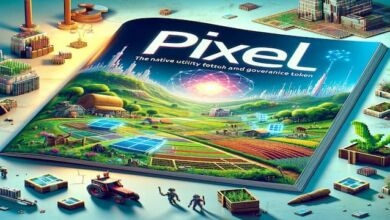
Most Web3 games don’t fail because the idea was weak…
They fail because people simply don’t come back.
That’s where Pixels quietly breaks the pattern.
In a space where hype fades fast and attention disappears even faster, Pixels did something rare:
it turned curiosity into habit.
At first glance, it looks simple. Easy visuals. Smooth entry. No overwhelming mechanics.
But that simplicity isn’t a weakness… it’s a strategy.
It removes friction, pulls players in, and gives them a reason to stay long enough to actually connect with the world.
And that’s the real difference.
Because most Web3 games relied on tokens, promises, and early numbers.
But Pixels understood something deeper:
If the game doesn’t feel alive… nothing else matters.
This is where PIXEL Token starts to make sense.
It’s not just something to trade — it’s tied to real in-game actions: farming, crafting, upgrading, building.
Value here isn’t just speculation… it’s connected to behavior.
That connection changes everything.
Unlike many “play-to-earn” models that attracted users chasing rewards, Pixels leans into something more sustainable:
community, routine, and a sense of belonging.
People don’t just log in to extract value.
They return because they feel part of something.
And that’s a powerful shift.
Pixels also didn’t grow during easy hype cycles.
It gained traction when players were already skeptical of blockchain gaming.
Which means it had to prove itself — not just attract attention.
That matters.
Because in Web3, attention that lasts is never random.
It usually signals that something real is happening beneath the surface.
Of course, nothing is guaranteed.
Like any project, its future depends on execution, balance, and the ability to keep players engaged without breaking the economy.
But here’s the key point:
Pixels isn’t trying to be the loudest project.
It’s trying to be the one people don’t leave.
And in a market full of noise…
that might be the biggest advantage of all. 🚀