
Most blockchain games behave like short-lived experiments in attention. They attract players with rewards, run hot for a while, and then slowly fade as incentives weaken. Pixels (PIXEL) is trying to move in a different direction—not by making louder promises, but by quietly changing how its economy actually works.
At first glance, Pixels looks like a simple pixel-style farming world where players grow crops, explore land, and craft items. But beneath that calm surface, it’s evolving into something closer to a living economy—one that tries to reward consistency and participation over quick extraction.
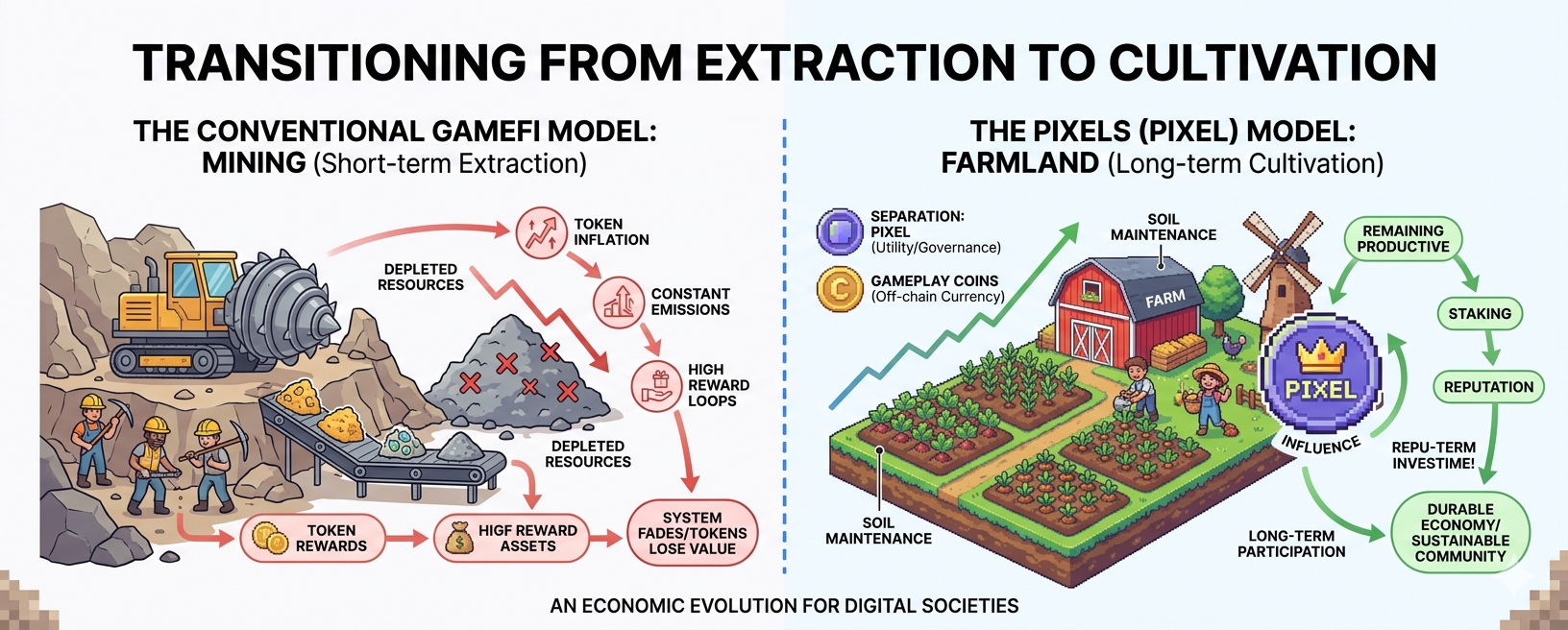
The easiest way to understand this shift is to compare it to natural systems. Most GameFi projects behave like mining operations: value is pulled out until there’s nothing left. Pixels is trying to function more like farmland. It doesn’t produce instant riches, but it can remain productive if it’s maintained, invested in, and cared for over time.
That shift starts with its token design. Earlier versions followed a familiar pattern in Web3 gaming: multiple tokens, constant emissions, and heavy reward loops. It kept activity high but created a hidden problem—too many tokens entering circulation and not enough reasons to hold them.
Over time, Pixels streamlined this structure. It moved away from inflation-heavy mechanics and centered the system around PIXEL as the primary token, while everyday gameplay runs on a separate off-chain currency. That separation matters more than it seems. It means PIXEL is no longer something players use for everything—it becomes something reserved for meaningful decisions.
Several structural signals reflect this change. A large share of the total supply is already circulating, which reduces future dilution pressure. The removal of continuous inflation reduces constant selling behavior. Token usage is now more focused on upgrades, access, and long-term progression rather than basic gameplay actions. In many cases, spending PIXEL either removes it from circulation or redistributes it within the system, which helps tighten supply dynamics. Together, these changes push the token away from being a reward stream and toward being a strategic resource.
That shift also changes how players behave. Instead of optimizing purely for short-term earnings, the experience slowly pushes them toward longer thinking—what to invest in, when to upgrade, and how to position themselves inside the game’s economy. Progress becomes less about speed and more about direction.
Another important layer is how PIXEL is starting to connect players to the wider ecosystem. Through staking and participation mechanisms, the token begins to act less like currency and more like influence. Players are not just spending—it’s becoming possible to support systems, shape growth, and indirectly decide what parts of the ecosystem expand. It’s a subtle but meaningful move toward shared ownership of direction, not just shared access to rewards.
At the same time, Pixels is gradually expanding beyond a single game. The direction suggests a network of interconnected experiences where identity, progress, and social standing carry across different environments. That matters because it changes the meaning of participation. Players are no longer just engaging with one isolated world—they are building a persistent presence across a broader system.
As this happens, behavior naturally shifts. Early engagement was mostly about efficiency—how much can be earned, and how quickly. But over time, more attention goes into social structures like guilds, reputation, and long-term positioning. The game still has economic incentives, but they are increasingly tied to relationships, coordination, and persistence rather than pure extraction.
Of course, the system is not without tension. Market behavior still reflects typical Web3 volatility. Large holders can influence price movement, liquidity can be thin, and sentiment cycles still drive sharp swings. Even as the internal economy becomes more structured, external pricing still reacts to speculation and narrative shifts.
This creates a clear imbalance: the game itself is becoming more stable and intentional, while the market around it is still reactive and unpredictable. That gap is common in emerging ecosystems, but it also defines where Pixels currently sits in its evolution.
The tradeoff is straightforward but important. By reducing inflation and focusing on deeper utility, Pixels becomes more sustainable, but also less immediately exciting for those looking for quick returns. Complexity increases, onboarding takes more effort, and progress feels slower—but what it gains is durability.
What makes Pixels worth watching is not whether it produces short-term spikes in attention or price, but whether it can support a world where players stay even when the incentives are no longer the main attraction. That is a harder problem than launching a game—it is closer to maintaining a functioning digital society.
If Pixels succeeds, it won’t just be remembered as another GameFi project. It will be remembered as one of the early attempts to answer a simple but difficult question: what does a game look like when people are there because they want to be, not because they’re rushing to leave with something?
