

I wasn’t planning to touch Pixels at all. It felt like more of the same another “play-to-earn” pitch dressed up with slightly different branding. After seeing enough of those, you develop a reflex to close the tab before it even loads. But for whatever reason maybe boredom, maybe curiosity I opened it anyway. And instead of bouncing, I stayed.

On the surface, it’s nothing special. Farming mechanics, soft visuals, simple interactions. You plant, you harvest, you repeat. It doesn’t scream innovation. But after a bit of time inside it, you start to notice the structure underneath the way the loop is designed and it doesn’t feel like those hollow GameFi projects where the entire goal is to farm tokens and exit before liquidity dries up.
The first moment it actually felt different wasn’t some headline feature. It was something small. I staked a bit of $PIXEL into one of the games and watched the interface respond. There’s this slight delay before the numbers update, and the button press has a soft, almost tactile feel to it. Subtle, but intentional. It made me stop for a second. Most crypto games don’t even get basic interaction design right they feel like spreadsheets with avatars. This didn’t.
What Pixels is really doing, though, is nudging you into a different mindset. It’s not just asking you to play it’s asking you to choose. Instead of staking into abstract infrastructure you don’t care about, you’re effectively backing a game. You’re making a call: this one might attract players. If it does, you benefit. If it doesn’t, that’s on you. It’s a small shift structurally, but psychologically it’s significant. You stop behaving like a yield farmer and start thinking more like a participant who actually wants something to succeed.
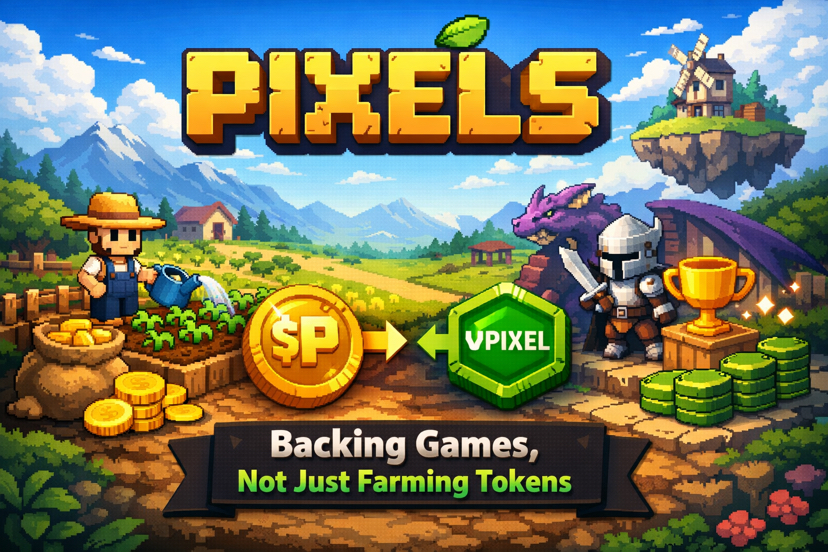
Then there’s the dual-token setup $PIXEL and $vPIXEL. At first glance, it looks like the usual over-engineered token gimmick. But in practice, it serves a purpose. Pulling out $PIXEL comes with friction you feel the cost. Meanwhile, $PIXEL moves freely inside the system. So you hesitate before exiting, not because you’re locked in, but because the system subtly encourages you to stay engaged. It’s not perfect design, but it’s effective.
That said, it’s not all smooth.
The publishing layer where players decide which games gain traction based on staking sounds great in theory. In reality, it’s messy. The data isn’t always reliable. Some games look active but feel empty once you’re inside. Others seem to have momentum, but it’s unclear why. You end up relying on instinct more than information, which undermines the whole idea of informed decision-making. If players are supposed to allocate attention and capital, they need clearer signals.
The reward logic can also feel opaque. You complete actions and earn rewards, but the reasoning behind the payout isn’t always obvious. There’s clearly a system tracking behavior and distributing incentives, but from the outside, it can feel like a black box. That lack of transparency creates a bit of friction you’re participating, but not fully understanding why outcomes differ.
Still, the broader approach makes sense.
Instead of spending heavily on user acquisition and hoping people stick around, Pixels redirects that value back into the player base. Engagement is what gets rewarded activity, referrals, participation. And those rewards loop back into the system rather than existing as disconnected incentives. Growth becomes something that compounds internally rather than relying purely on external hype.
NFTs are part of the equation too land, boosts, minor advantages. Nothing groundbreaking there. But when combined with the staking layer, they create a structure where having assets gives you a slight edge without completely breaking the experience. At least for now, it feels balanced enough.
What stands out most isn’t the pitch it’s the experience. How it actually feels to interact with.
Most GameFi projects try too hard to convince you. They overpromise, overexplain, and still feel empty once you’re inside. Pixels doesn’t do that. It just functions. You interact with it, and it responds. You put something in, and it gives something back. Not perfectly, not always clearly but consistently enough that you don’t feel like you’ve been tricked after a few minutes.
That doesn’t mean it’s guaranteed to succeed. Far from it. Execution is where these systems usually fall apart. If the games themselves aren’t genuinely engaging, no amount of clever token design will carry it.
But one idea sticks: backing games instead of just farming tokens.
It shifts the perspective. You stop asking “what’s pumping?” and start asking “what’s actually being used?” That’s a more meaningful filter. And Pixels, despite its rough edges, is at least moving in that direction.