
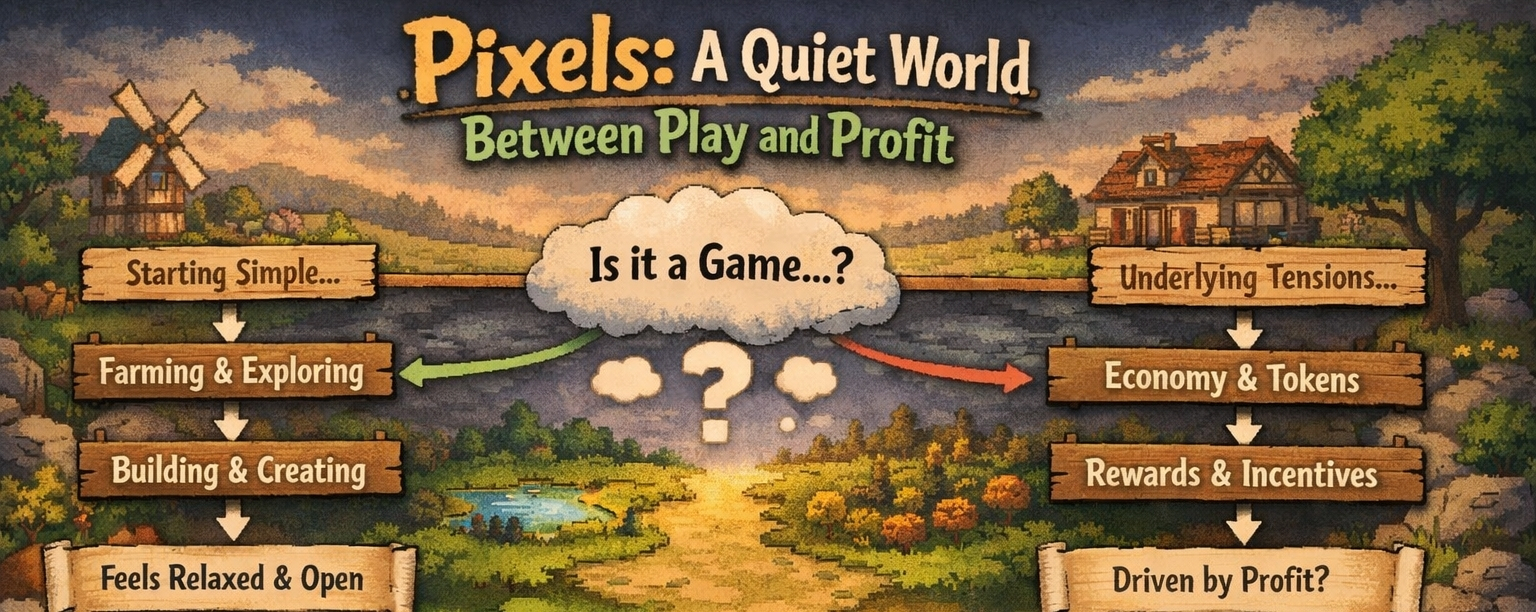
I’ve been watching Pixels for a while now, not in a rush, just letting it sit in the background and seeing what it becomes over time. There’s something about the way these projects usually appear—loud, fully formed, already telling you exactly why they matter—that makes a quieter one stand out. Pixels doesn’t arrive like that. It feels more like something you stumble into than something trying to convince you.
At its core, it’s simple: farming, wandering around, collecting things, building a space that slowly starts to feel like yours. Nothing about that is new, and maybe that’s the point. It doesn’t try too hard to be different on the surface. Built on the Ronin Network, it carries the weight of Web3 expectations, but it doesn’t immediately lean into them. You can spend time in it without constantly being reminded that there’s an economy underneath everything. At least, that’s how it feels at first.
And that “at first” is what I keep coming back to.
Because with Web3 games, there’s always another layer. You can be planting crops, exploring the map, talking to other players—but somewhere in the background, there’s usually a system measuring, rewarding, nudging. That doesn’t automatically ruin the experience, but it changes how you relate to it. You start asking yourself: am I here because I like this, or because there’s something to gain from staying?
Pixels seems aware of that tension. It doesn’t push its financial side too aggressively, which already makes it feel different from a lot of projects that lead with tokens and only later try to justify why you’d want to play. Here, it feels like the game comes first—or at least, it tries to. The farming is slow in a way that feels intentional. You’re not racing through it. You come back, check on things, make small progress. It’s almost آرام (calm), like it doesn’t mind if you take your time.
But that also makes me a bit cautious.
Because sometimes, in this space, calmness is just the surface. Underneath, the same familiar loops can still be running—grind a little, earn a little, optimize a little more. The difference is just how gently you’re pulled into it. And I’m not sure yet where Pixels lands on that spectrum. Is it genuinely trying to be a place people enjoy being in? Or is it just better at hiding the usual pressures?
The social side is another thing I notice. It’s there, but it doesn’t feel forced. You can interact, trade, exist alongside other players without it turning into a constant competition. That openness is nice, but it’s also delicate. In games tied to real value, people don’t always behave like neighbors—they behave like participants in a system. And that can slowly change the atmosphere, even if the design starts out relaxed.
I think what keeps me interested is that Pixels doesn’t feel like it has fully revealed itself yet. It’s not trying to answer every question upfront. It’s just… there. Growing, adjusting, letting players shape part of it. That can go in different directions. Sometimes it leads to something genuine. Other times, it slowly becomes something more mechanical, more predictable.
Right now, it feels like it’s trying to stay grounded. Not too ambitious, not too loud. Just a world where you can plant something, walk around, maybe build a small routine. And honestly, that’s enough—for now.
I’m not convinced. But I’m not dismissing it either.
I’m just watching, waiting to see whether it stays a place… or turns into another system.