
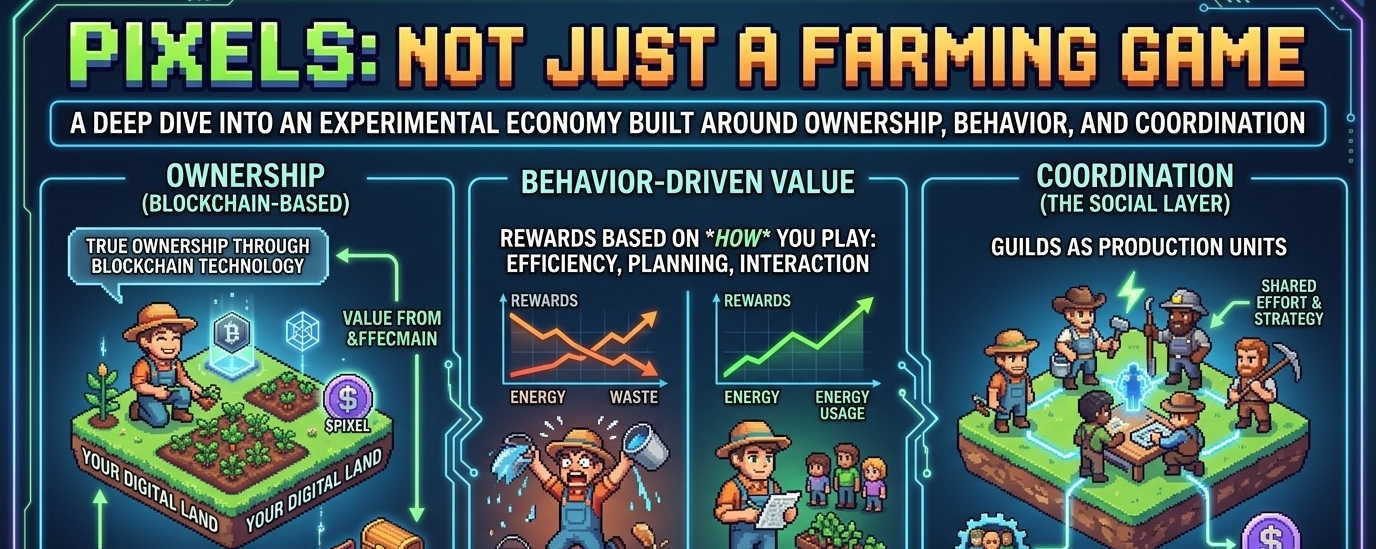
@Pixels There’s something slightly misleading about how simple Pixels looks at first. You log in, see crops, land, a few tasks to complete, and it almost feels like something you’ve already understood before even playing. Plant, wait, harvest, repeat. It carries that familiar rhythm that doesn’t ask much from you. But the longer you stay inside it, the harder it becomes to treat it like just another casual loop. A question slowly forms without really announcing itself — why does a game this simple need an economy at all? Not just a reward system, but something that feels structured, reactive, and oddly persistent. That’s when it starts becoming clear that Pixels isn’t really trying to impress you at the surface level. It’s trying to hold onto something deeper — your time, your patterns, and the way you choose to play.
Most games are built around loops that reset cleanly. You do the work, collect the reward, spend it, and move on. Whatever effort you put in rarely exists beyond that cycle. It feels complete, but also disposable. Pixels quietly pushes against that idea by stretching the meaning of effort beyond a single session. It introduces ownership in a way that feels subtle at first, almost like a background feature you don’t need to think about. But once it clicks, it changes the weight of everything you do. If you spend days building your farm, shaping it, optimizing it, that progress isn’t just progression anymore. It starts to feel like accumulation. Not in a loud, speculative way, but in a slow, grounded sense that your actions might carry forward instead of fading out. And yet, that alone doesn’t solve anything. Ownership without value is just storage. The real tension comes from a much harder question — what actually gives that ownership meaning?
Pixels seems to be exploring that answer through behavior rather than guarantees. There’s no fixed promise that time equals reward in a predictable way. Instead, the system leans into how you approach the game. Two players can spend the same number of hours inside the world and still walk away with completely different outcomes. One might rush through tasks, waste resources, and treat the game like a checklist. Another might slow down, plan crop cycles carefully, coordinate with others, and reduce inefficiencies over time. The difference isn’t dramatic in a single day, but it compounds quietly. That’s where the system starts to feel less like a game loop and more like a small, functioning economy. Not because it is complex, but because it reacts to behavior. It doesn’t just track what you do — it reflects how you do it.
That shift becomes even more noticeable when you look at the social layer. Guilds here don’t feel like temporary alliances or casual friend groups. They begin to resemble small units of coordination, almost like digital cooperatives forming inside the game. People align their actions, share strategies, and sometimes even depend on each other’s efficiency. It stops being just about playing together and starts becoming about working within a shared structure. That kind of interaction is rare in games that appear this simple on the surface. It introduces a quiet form of responsibility, where your decisions don’t only affect your own progress but can ripple through a group dynamic. And when that layer connects with the token system, things become even more delicate. A token like $PIXEL could easily fall into the usual pattern of rewards being distributed and then immediately extracted. But here, there’s an attempt — not perfect, but noticeable — to tie rewards more closely to meaningful participation rather than passive activity. It hints at a shift away from pure extraction toward something that feels closer to contribution.
Even the pace of updates starts to make more sense in that light. At first, frequent changes can look like standard content drops meant to keep players engaged. But over time, they begin to feel more like adjustments to an ecosystem. New items, new sinks, new mechanics — they act as small levers that reshape how the system behaves. It’s less about adding more things to do and more about recalibrating how value moves within the game. That makes Pixels feel like it’s being actively tuned rather than simply expanded. And that tuning reflects a deeper intention. The game doesn’t seem interested in becoming the most complex or overwhelming experience. It stays intentionally simple on the surface, almost to protect accessibility. But underneath that simplicity, it is experimenting with something that is not easy to get right — how to make time, effort, and coordination feel meaningful without turning the experience into work.
Of course, none of this means it has all the answers. There are still open questions that sit quietly in the background. What happens if growth slows down? Can the reward system remain stable without constant expansion? How much control sits behind the scenes, and how does that affect fairness over time? These are not small concerns, and they don’t disappear just because the system feels interesting. But even with those uncertainties, it’s difficult to ignore what Pixels is trying to do. It isn’t loudly claiming to reinvent anything. Instead, it is testing ideas in a more patient way, allowing outcomes to emerge rather than forcing them upfront.
That might be what makes it stand out the most. It doesn’t demand that you see it as something revolutionary. It simply invites you to spend time inside it and notice how it behaves. And if you pay attention long enough, you start to see that it’s not really asking you to just play and earn. It’s asking something slightly different, something quieter but more demanding in its own way. Play, contribute, adapt — and then see if the system recognizes you for it. That subtle shift changes how the entire experience feels. It turns a familiar farming loop into something that carries weight, not because it promises value, but because it’s trying to understand where value actually comes from.
