
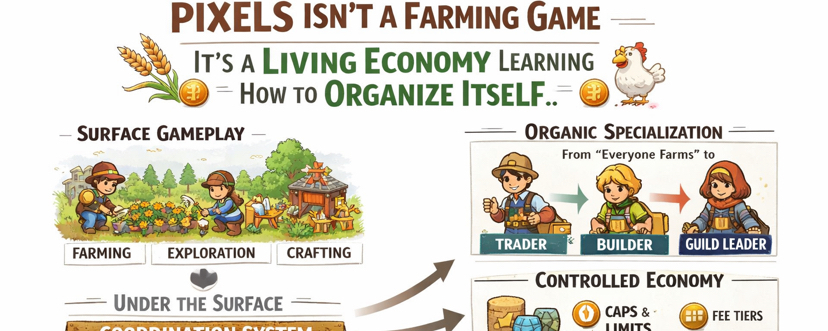
Pixels doesn’t really behave like a farming game. It looks like one — you plant, wander, craft, and talk to other players — but the deeper you go, the more it feels like a quiet coordination system disguised as a cozy world. The crops are just the surface. What’s actually happening is that the game is subtly guiding where players spend time, how value moves, and who becomes important inside the economy.
Most Web3 games push rewards outward as fast as possible. Pixels is doing something slower. It’s tightening the loops, adding friction in specific places, and rewarding reliability over speed. That changes the feeling of the world. Instead of rushing to extract value, players start naturally specializing. One player focuses on production, another on trading, another on reputation, another on coordinating guild activity. Without explicitly forcing roles, the system nudges people into them.
A good way to think about Pixels is like a village market that slowly organizes itself. At first, everyone sells the same crops. Then limits appear, prices shift, and suddenly some people become millers, others become transporters, and others become shopkeepers. Nobody assigns these roles. The economy shapes them. Pixels is quietly doing the same thing.
Recent changes made this even more visible. Production caps and industry limits reduced the ability to endlessly generate resources. That sounds restrictive, but it actually makes the world feel more alive. When output isn’t infinite, players need each other. Trading becomes meaningful again. Reputation starts to matter. Scarcity turns social behavior into strategy.
Creator codes added another layer. Now spending can flow through players, not just the game. Someone who builds a community can earn from the activity they attract. This turns creators into economic connectors instead of just promoters. The game stops being developer-driven and starts becoming player-distributed.
Cross-game PIXEL usage pushes this idea further. When the same token begins appearing in events or other experiences, the economy stops being confined to one map. It starts behaving more like a shared currency across connected worlds. That’s a subtle shift, but an important one. The token stops being a reward and becomes a routing mechanism.
Staking reinforces this behavior. Instead of simply holding tokens, players allocate them. That turns them into participants in growth rather than spectators. The more players stake, the more the ecosystem begins to look like a network of decisions instead of a single game loop.
The interesting part is that Pixels is getting stronger by becoming slightly slower. Caps, reputation gates, fee tiers, and limited tasks all reduce the speed of extraction. At first this feels like the game is holding players back. But in practice it prevents the economy from collapsing under infinite supply. It’s like limiting fishing in a lake — fewer fish today, but a healthier ecosystem tomorrow.
Another way to describe it: Pixels doesn’t run like a factory trying to maximize output. It behaves more like a town trying to balance itself. Factories reward speed. Towns reward trust. Pixels leans toward trust. Players with higher reputation get better fees, smoother trading, and more flexibility. Over time, reliability becomes more valuable than raw grinding.
This also explains why the token feels different here. $PIXEL isn’t just fuel. It acts more like traffic signals. It decides where value flows, who gets cheaper access, who earns distribution, and who participates in expansion. Spending it affects positioning inside the ecosystem, not just inventory.
There’s still risk in this direction. Too many limits could make the experience feel mechanical. If players begin optimizing everything like a spreadsheet, the cozy feeling disappears. Another open question is whether cross-game demand continues. The coordination idea only works if PIXEL keeps moving beyond one experience.
What matters most going forward is whether players continue specializing naturally. If traders, builders, creators, and explorers all find sustainable roles, the economy will stabilize. If everyone reverts to chasing the same loop, the coordination breaks.
Pixels ends up feeling less like a game you beat and more like a place you settle into. You don’t rush through it. You slowly find where you fit. The farms, pets, and crafting are just how you enter. The real game is learning how to move inside a living economy that keeps reorganizing itself.
In that sense, Pixels isn’t really about farming at all. It’s about how people coordinate when the world nudges them gently instead of forcing them directly. And that’s why it feels quieter, slower, and strangely more human than most token-driven games.
