
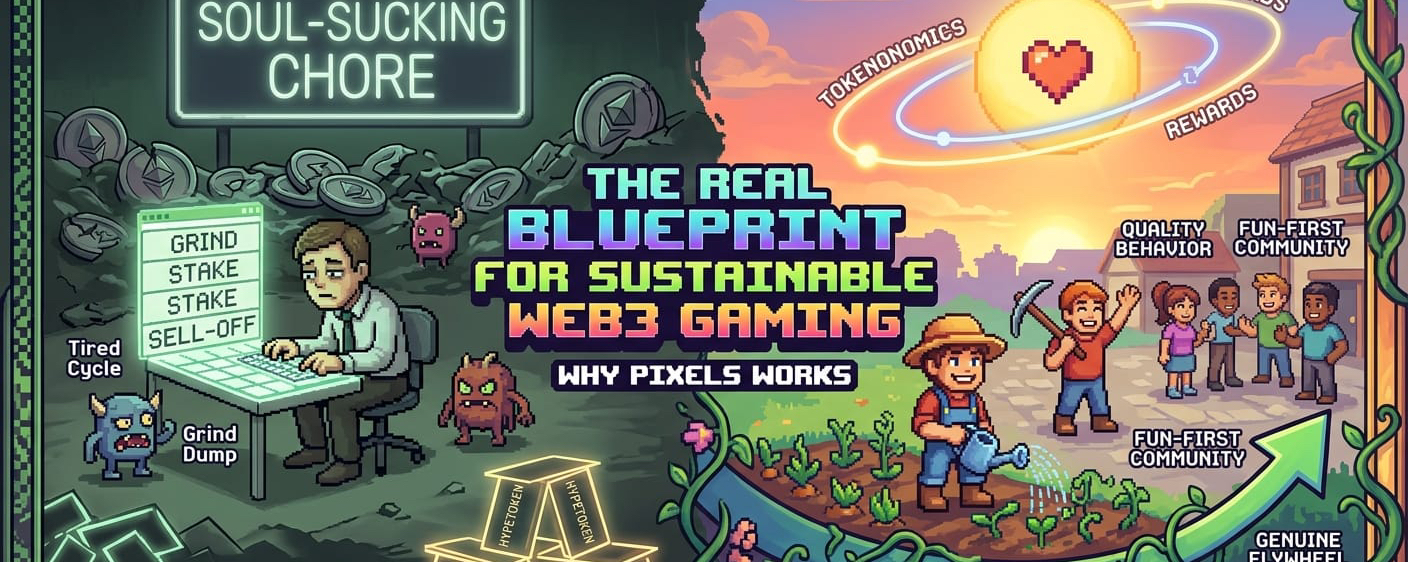

Let’s be honest: most Web3 games are just depressing financial spreadsheets with a few pixels slapped on top as a distraction. We’ve all seen the same tired cycle. A project drops with a massive war chest and a whitepaper full of complex token math, only to crater the second players realize the "game" is actually a soul-sucking chore. Pixels finally flipped that script. They realized the game has to be the sun that everything else—the tokens, the rewards, the hype—actually orbits. It’s a shift from treating people like "yield-farming users" to treating them like actual players in a world.
The logic is blunt: if your game isn’t fun, no amount of "token wizardry" will save you. You can’t bribe people into having a good time forever. Most projects try to fix ghost towns by cranking up the rewards, but that’s just a desperate race to the bottom. Instead of making the token the only reason to hit "login," Pixels treats rewards like a high-five for stuff you’d probably do anyway. Farming, crafting, or just hanging out in the square needs to feel good on its own. If that core vibe isn't there, you don't have an economy—you just have a house of cards waiting for the first big sell-off.
This is the only real way to kill the "Grind and Dump" culture that’s been rotting this space. Standard P2E models are basically a giant neon sign for bots and mercenaries to find the most efficient loop, automate it, and bleed the system dry. Pixels dodges this by killing the idea of predictable, robotic payouts. The system actually watches for quality. It’s a living feedback loop: your behavior creates data, that data proves you’re actually contributing to the world, and the rewards shift to favor real people while starving the exploiters. It makes the economy feel like a living thing rather than a programmed ATM.
Growth here isn't about lighting a marketing budget on fire to pay influencers to pump a floor price. It’s an internal gear. As more people show up and actually interact, the system gets better at spotting what keeps the community healthy. Better rewards lead to real interest, which brings in the creators and devs who want to build on that energy. It’s a genuine flywheel. When you stop living and dying by the hype cycle, you stop crashing when that hype inevitably cools off.
The "secret sauce" is simple: Pixels doesn't assume we’re all cold, profit-obsessed robots. It assumes we’re people looking for an experience that’s bigger than a wallet balance. By making "fun" and "economically viable" the same thing, they solved the biggest headache in crypto gaming: that miserable moment where playing efficiently starts feeling like a grueling second job. In Pixels, the most "profitable" thing you can do is often just being a decent member of the community.
At the end of the day, this isn't a game with a token tacked on; it’s a behavioral experiment that actually works. Whether it survives the next five years depends on if the team can keep that balance as things get weirder and bigger. But for now? It’s the most honest blueprint we’ve got for a Web3 world that actually has a soul.
