I did not expect a farming game to make me question how economies actually work.
that is how I ended up spending more time inside Pixels than I planned. I thought it was just another calm loop plant crops, water them, decorate a bit, log off. simple. Forgettable. the kind of game you open when you don’t want to think too much.
But somethIng felt off in a way I could not ignore.
because the more I played, the more I realIzed it is not just reacting to what you do it is reacting to how you do it.
at first, I kept wondering why a farming game even needs an economy in the first place. Most games don’t bother. you grind, you earn, you upgrade, and that is it. Clean loop. No memory. No continuation. your effort stays trapped inside that session and. dIsappears the moment you log out.
but Pixels does not feel lIke that.
there is a strange sense that what you build does not fully reset. lIke your actions are sitting inside a larger system that keeps moving even when you are not paying attention.
that is where ownership enters the picture.
Now honestly, I usually don’t take blockchain ownership in games too seriously. it often sounds bigger than it actually feels. but here, something subtle changes how you thInk. if I imagine building a farm for days improving it step by step it stops feeling lIke temporary progress. it starts feeling like something that carries weight beyond a single session.
still, I kept hitting a contradiction in my head.
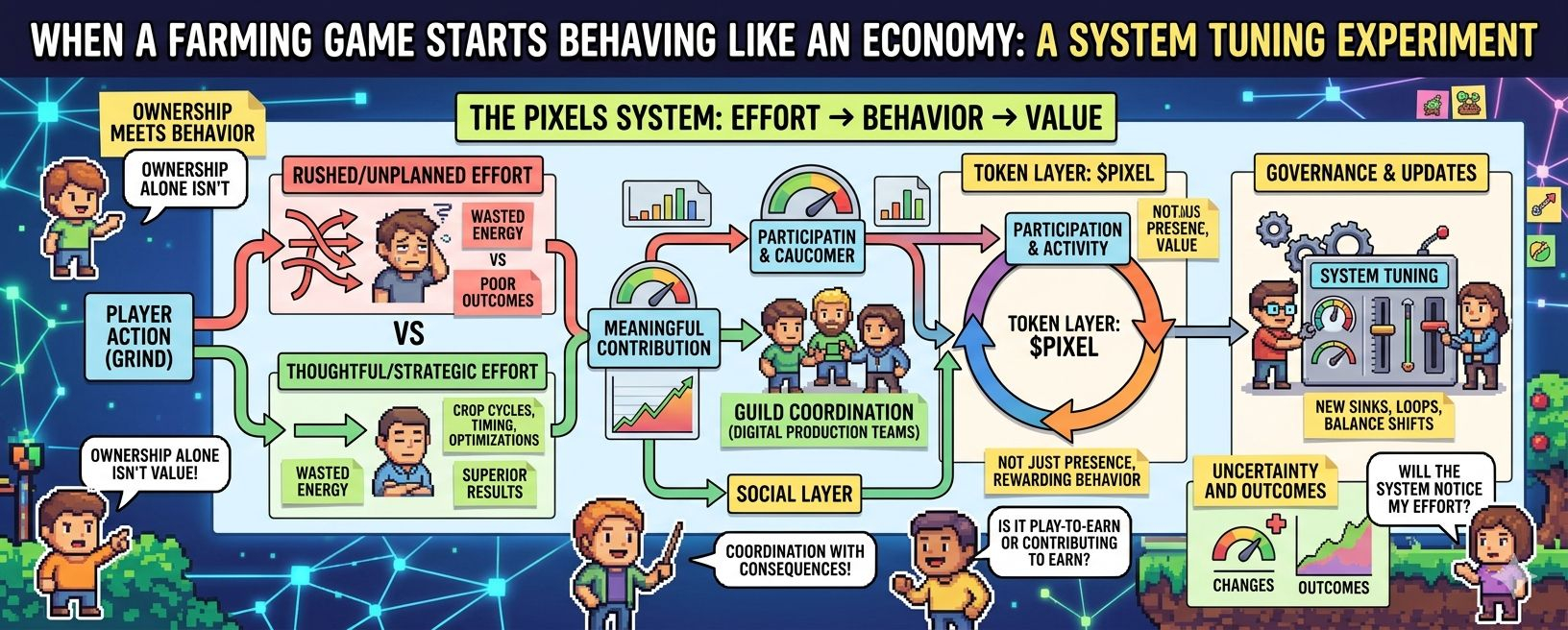
Ownership alone does not create value.
you can own something completely useless and it stIll means nothing. so the real question becomes simple: what actually gives it meaning?
the answer, surprisingly, is not ownership.
It is behavior.
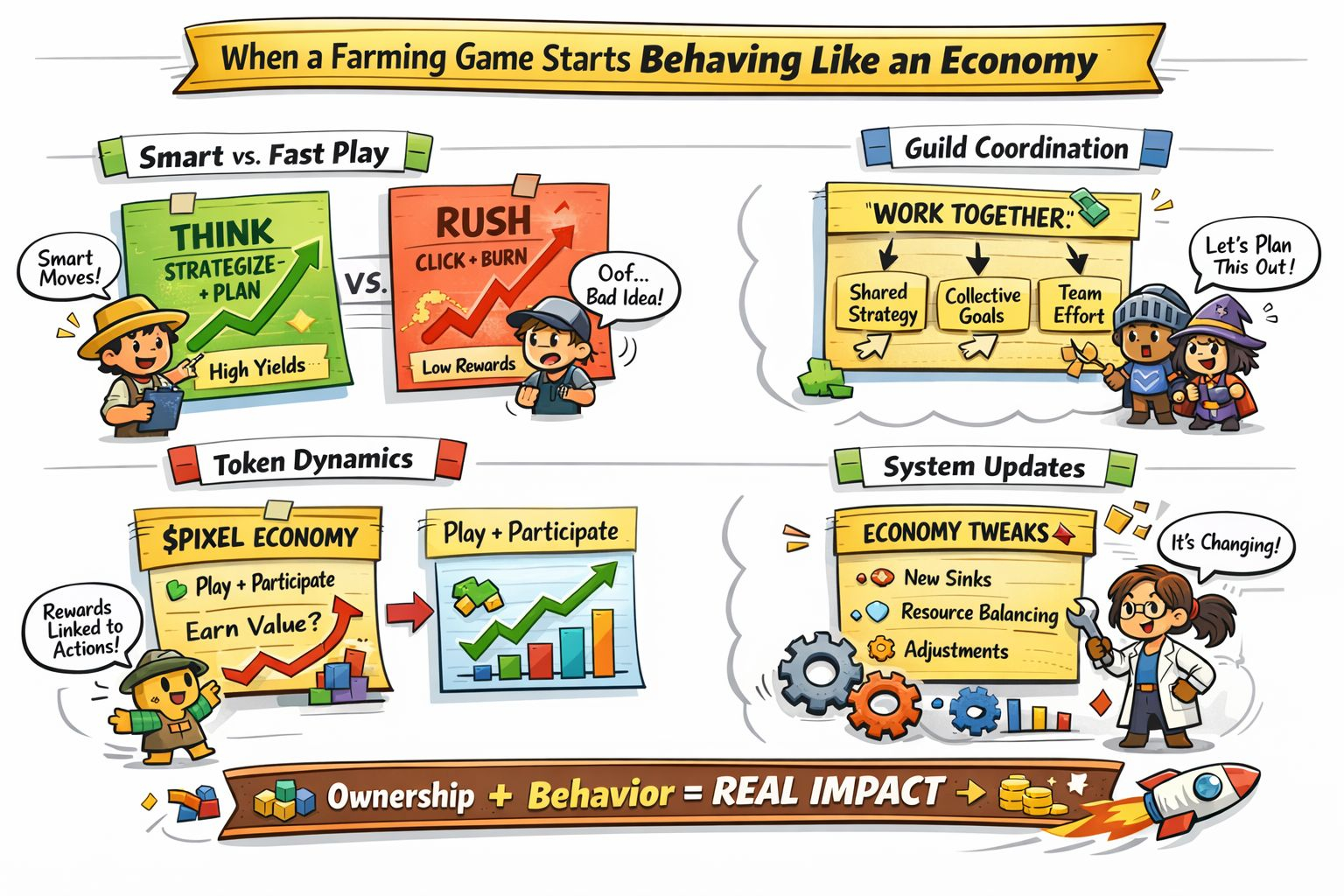
inside Pixels, I noticed something very specific two players can spend the same time, use the same tools, and still end up in completely different places.
I tested it myself without even trying to.
One time I rushed everything. no planning, just fast actions. I wasted energy, made random moves, and expected decent results.
they were not.
another time, I slowed down. I actually thought through crop cycles, timing, small optImizations. I paid attention to details I normally ignore.
Same effort. Same time.
completely different outcome.
that is where it stopped feeling lIke a normal farming game and started feeling lIke something closer to a system that rewards thinking instead of repetition.
then the social layer made it even more interesting.
Guilds usually feel like background features groups of people chatting, helping a bIt, maybe doing shared goals loosely.
but here, they start to feel more coordInated than that. People actually align their actions. they share plans, divide effort, and sometimes function lIke small digital production teams instead of casual groups.
It does not feel like multIplayer for fun anymore.
it feels lIke coordination with consequences.
the token layer, $PIXEL , adds another layer of tension to this whole system.
we have seen enough play-to-earn models fail to know the pattern rewards get extracted, value drains, systems collapse.
but here, the attempt is slightly different. Rewards are tied more closely to partIcipation and activity, not just presence.
not perfectly. Not solved. but intentional.
it shifts the mindset from:
not just play-to-earn…
but play, participate, and contribute and then see what the system reflects back
and that see what comes back part matters more than it sounds. because nothing is guaranteed, players start changing behavior instead of just grinding harder.
even the updates started to feel different once I paid attention.
at first, I thought they were just content drops new items, new mechanics, more things to do.
But over time, they started feeling lIke adjustments to a living system. new sinks. New loops. Small balance shifts that affect how everything flows.
not just game updates…
but system tuning.
that is when it clicked for me.
this is not just a farming game trying to be fun.
It is an experiment in whether a simple game can behave lIke a lightweight economy where time, effort, and coordInation actually shape outcomes instead of just filling time.
of course, it ia not perfect. Far from it.
there are still questions that matter. What happens if growth slows down? How fair is the distribution in practice? how much control is actually centralized behind the scenes?
these are not small doubts they decide whether this idea scales or breaks.
but even with all of that, I can not ignore what it is trying to test.
because it stays simple on the surface, but underneath it is doing something rare.
it is not asking you to just play.
It is quietly asking how you play and whether that actually matters.
and for me, that changed the way I see it.
I don’t look at it as play and earn anymore.
I look at it lIke this:
I play. I think. I contribute. and then I wait to see if the system even notices.
Sometimes it does. Sometimes it does not.
but that uncertainty that gap between effort and recognitIon is exactly what makes It feel real.
and if this idea scales properly, it won’t just change games.
it might change how we think about value in digital systems altogether. 🚀