
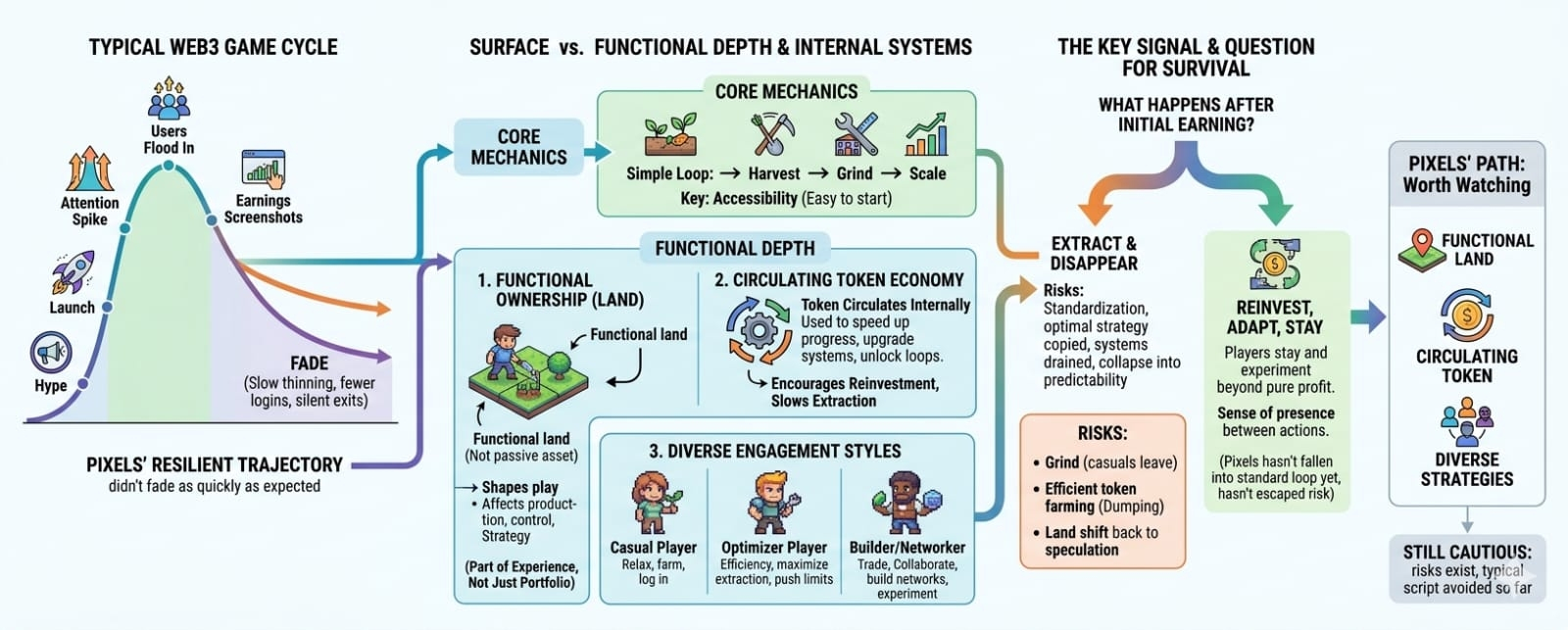
At this point, the cycle of Web3 games feels familiar. A new project launches, attention spikes, users flood in, earnings screenshots dominate timelines—and then, almost quietly, it fades. Not in a dramatic collapse, but in a slow thinning. Fewer logins, less conversation, more silent exits. If you’ve been around long enough, you start to recognize the pattern early.
That’s exactly why Pixels caught my attention again—not because it looked revolutionary, but because it didn’t fade as quickly as expected.
I’ll admit, I dismissed it at first. On the surface, it looked like a familiar formula: plant, harvest, grind, scale—or dump. We’ve seen that loop play out too many times. But watching it over time, something felt slightly different. Not dramatically so, but enough to make me pause.
The broader Web3 gaming landscape has changed. Players aren’t blindly jumping into every “play-to-earn” opportunity anymore. Most have been burned before. They understand optimization, they know how to extract value efficiently, and more importantly, they know when to leave. In that environment, any game that depends purely on rewards struggles to survive.
Pixels seems aware of that reality.
At its core, the game is simple. Farming, gathering, building—nothing overwhelming. That accessibility actually works in its favor. You don’t need to study systems just to get started. But what stands out is what happens beneath that simplicity.
Ownership, for example, feels more functional than speculative. Land isn’t just a passive asset waiting for price appreciation—it actively shapes how you play. It affects production, control, and strategy. It becomes part of your experience, not just your portfolio.
The same applies to the token. Instead of existing purely as something to farm and dump, it circulates within the game. Players use it to speed up progress, upgrade systems, and unlock new loops. That internal flow—small as it may seem—creates a different kind of dynamic. It slows down pure extraction and encourages reinvestment, at least to some degree.
What’s also interesting is how differently people engage with the game. Some players treat it casually, logging in to farm and relax. Others approach it like a system to optimize, pushing efficiency to its limits. Then there are those who build networks—trading, collaborating, experimenting with different setups. It’s not perfectly balanced, but it feels alive in a way many Web3 games don’t.
That’s where most projects fail. They standardize the experience too much. Same grind, same rewards, same optimal strategy. Eventually, someone figures out the most efficient path, everyone copies it, and the system gets drained. Pixels hasn’t fully escaped that risk—but it hasn’t completely fallen into it either.
Still, it’s far from perfect.
You can feel the grind. You can see players trying to maximize extraction. Those pressures never disappear. And the risks are still there: if it becomes too grind-heavy, casual players leave. If token farming becomes too efficient, dumping begins. If assets like land shift back into passive speculation, the entire system weakens.
None of that is new. We’ve seen it before.
But what keeps this interesting is a smaller, more subtle signal: some players aren’t just farming and leaving. They’re staying. Experimenting. Engaging beyond pure profit. That’s rare once the initial hype cycle fades.
Compared to other games, the difference isn’t dramatic—but it’s noticeable. Many Web3 games start to feel like jobs very quickly: log in, complete tasks, collect rewards, repeat. Pixels still has that loop, but it doesn’t feel entirely empty between actions. There’s at least some sense of presence beyond earning.
The real question isn’t whether players can earn. That phase never lasts. The real signal is what happens after. Do players reinvest? Do they adapt? Do they stay? Or do they extract and disappear?
That’s what determines whether a system survives.
I’m still cautious. Experience makes that unavoidable. But Pixels hasn’t followed the typical script so far—and in a space where most games collapse into predictability, that alone makes it worth watching.
