
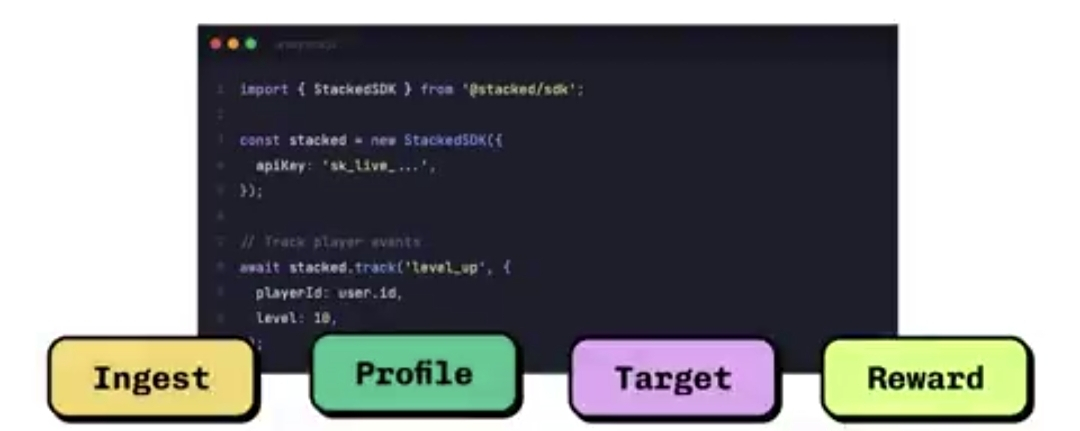

One of the most underrated strengths of @Pixels is not just its economy, but the technology layer powering its Stacked ecosystem. When you look at the simple flow shown in this image — Ingest → Profile → Target → Reward — you start to understand why Pixel is positioned for long-term sustainability. #pixel
Let’s break this down in a practical way.
The first step, Ingest, is where all player data enters the system. Every action a player takes — farming, trading, upgrading land, interacting with guilds — becomes valuable data. But instead of letting this data sit unused like in traditional games, the Stacked system transforms it into actionable insights. This is a huge shift from static reward systems to dynamic, data-driven economies.
Next comes Profile. This is where the system begins to understand each player individually. Not all players are the same — some are long-term builders, others are explorers, traders, or social players. By creating detailed profiles, the system can distinguish between genuine engagement and low-value or bot-driven activity. This is critical for protecting the integrity of the Pixel economy.
Then we move to Target. This is where intelligence comes into play. Instead of distributing rewards randomly or evenly, the system identifies who should be rewarded and when. For example, a player who is about to lose interest might receive incentives to stay engaged, while a highly active player might be rewarded in a way that encourages even deeper participation. This precision is what makes the Stacked ecosystem far more efficient than traditional play-to-earn models.
Finally, we reach Reward — the most visible part of the system. But unlike older systems, rewards here are not just about giving tokens. They are about strategically distributing value using $PIXEL. Every reward has a purpose: to strengthen engagement, improve retention, and maintain a healthy in-game economy.
When you connect this flow back to the $PIXEL utility map, everything starts to align perfectly. Rewards earned through this intelligent system can be used across VIP Memberships, NFT minting, land upgrades, governance, and premium features. This creates a closed-loop system where value continuously circulates instead of leaking out.
This is also where the concept of “value redirection” becomes powerful. Instead of spending massive budgets on external advertising, @Pixels uses its system to reward players directly. The attention, time, and loyalty of the community become the most valuable assets — and $PIXEL becomes the medium that captures and redistributes that value.
Another important advantage is how this system reduces exploitation. In many Web3 games, bots dominate because rewards are predictable and easy to farm. But with a system based on profiling and targeting, it becomes much harder for bots to extract value. Real players, who contribute meaningfully to the ecosystem, are the ones who benefit the most.
What stands out to me is how simple the concept looks on the surface, yet how powerful it is underneath. “Studios integrate in hours” is not just a statement — it highlights scalability. This means more games and applications can plug into the Stacked ecosystem, increasing demand for Pixel and expanding its use cases over time.
In the end, this is what makes @Pixels different. It is not just building a game or a token — it is building an intelligent economy where every action, every reward, and every interaction is optimized.
And at the center of it all, Pixel acts as the fuel that powers this entire system.