
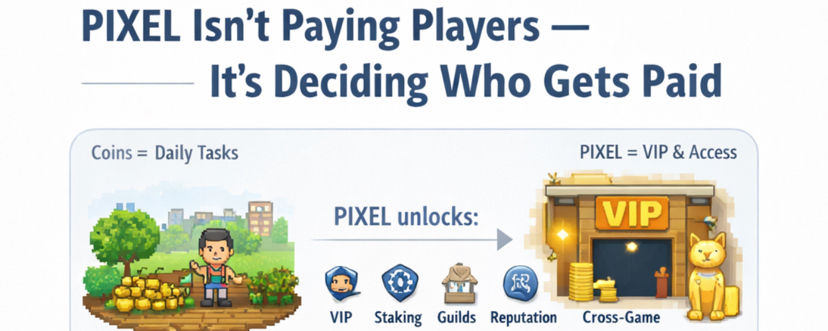
Pixels looks calm on the surface. You plant crops, walk between plots, talk to neighbors, maybe craft something simple. But underneath that relaxed pace, something more interesting is happening. Pixels isn’t really about farming — it’s about coordination. The token isn’t just a reward you collect after doing chores. It quietly tells players where to go, what to build, when to commit, and when to switch sides.
The easiest way to understand it is to imagine a busy night market. At first, people wander randomly. Then one stall starts getting crowded. Others move closer. Prices change. New vendors appear. Suddenly the whole market reorganizes itself without anyone planning it. Pixels works the same way. $PIXEL is the signal that shifts attention. When new systems launch, players move. When costs appear, players commit. The economy reshapes itself in real time.
That shift became clearer with the newer updates. Tier 5 industries didn’t just add more recipes — they changed how ownership works. Land stopped being something you simply hold and became something you operate. Slots cover only a portion of capacity and expire after about a month, which means efficiency now depends on staying active. Instead of static value, land becomes infrastructure that needs maintenance. That introduces recurring demand and keeps the economy moving rather than freezing.
At the same time, staking started to look less like passive yield and more like capital allocation. A large portion of PIXEL is staked in the main game, while smaller chunks are allocated to partner experiences like Sleepagotchi and others waiting to activate. That structure quietly turns players into decision-makers. They’re not voting with proposals — they’re voting with where they stake. It’s a softer kind of governance that happens through incentives instead of rules.
Competitive seasons pushed this even further. When factions compete and switching sides costs PIXEL plus a cooldown, the token becomes a commitment device. You’re no longer just participating; you’re choosing where to stand. That small friction stabilizes behavior. Players don’t bounce endlessly between opportunities, and the competition feels more meaningful. It’s subtle, but this kind of friction is what keeps economies from collapsing into chaos.
Creator codes and guild kickbacks add another layer. Instead of rewards flowing only from the game to players, value starts moving sideways — from players to creators, from communities to organizers. That transforms influencers into economic nodes. The more activity they coordinate, the more value flows through them. Pixels begins to look less like a game and more like a small cooperative economy.
The numbers reinforce that direction. Tens of millions of players create a wide behavioral base. Over a hundred new Tier 5 recipes increase production complexity. A large amount of PIXEL locked in staking suggests long-term positioning rather than short-term farming. Time-limited industry slots create recurring sinks. Switching costs add commitment. Creator routing introduces social demand. Cross-game allocations show the token trying to expand beyond one world. None of these pieces alone are huge, but together they form a web of small pressures that keep the token moving.
What’s interesting is that Pixels isn’t trying to remove friction. Most games aim for smooth, instant actions. Pixels does the opposite. It adds cooldowns, upkeep, switching costs, and expiring capacity. That slows players down just enough to create stability. The economy becomes less about speed and more about positioning. It’s closer to running a small shop than grinding a quest loop.
Another way to see it is like a railway network. Land becomes stations, players become trains, and resources move between them. PIXEL is both the ticket and the schedule. Without it, movement still happens, but without direction. With it, traffic flows more predictably, and some routes become more valuable than others.
There are risks, of course. An uncapped utility token needs constant demand expansion. If activity slows, pressure builds. Increasing complexity can also push away casual players, which would weaken coordination. Cross-game expansion is promising, but it also introduces dependency. If partner experiences don’t hold attention, some of that token demand disappears. And higher-tier industries may concentrate production in fewer hands over time.
The signals worth watching are fairly simple. If more PIXEL gets allocated outside the main game, the ecosystem is truly expanding. If Tier 5 usage remains strong after the first cycle, the recurring economy is working. If creator routing grows, social coordination is deepening. And if cross-game staking becomes active rather than idle, the token is successfully escaping its original map.
Pixels still feels like a peaceful farming world, and that’s intentional. The calm surface hides a system that’s constantly nudging players into alignment. The crops are just the excuse. The real game is how people organize themselves, and $PIXEL is the quiet mechanism guiding that movement.
