
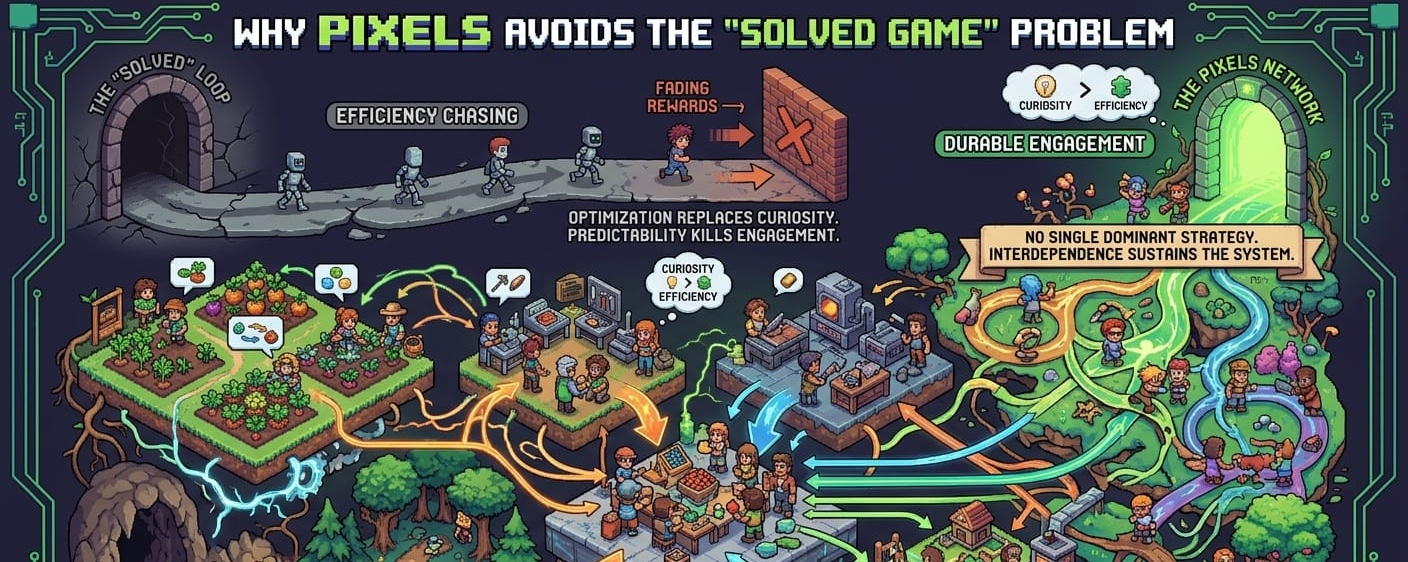

Web3 games don’t usually fail because players lose interest—they break when the game reveals a clear optimal path too early.
Most Web3 games start with the same promise: ownership, earnings, and a player-driven economy. But if you look closely at how they actually play out, the pattern is familiar. Players rush toward whatever yields the highest return, optimize it, and then the system slowly becomes predictable. Once predictability sets in, engagement usually drops—not because the rewards disappear, but because the experience stops feeling like a game.
Pixels takes a quieter, more structural approach to this problem. Instead of trying to out-incentivize human behavior with bigger rewards or more complex token mechanics, it changes the conditions under which optimization even makes sense.
At the center of its design is a simple but powerful idea: if there is no single dominant way to play, then players cannot fully “solve” the game.
In many traditional Web3 systems, the economy becomes a math problem. Players identify the most efficient loop—whether that’s farming a resource, completing a quest cycle, or rotating assets—and repeat it until the marginal returns decrease. That is where things start to break, because efficiency eventually replaces curiosity.
Pixels avoids locking itself into a single dominant loop. Instead, it spreads value across multiple interacting systems: farming, crafting, exploration, trading, and land-based progression. None of these systems is designed to fully dominate the others. Each one supports the others, but none can replace them.
This is subtle but important. Even if one activity becomes optimized, progress still depends on other players operating in different parts of the world. Resource production, item creation, and exchange are intentionally interdependent, which prevents any single behavior from becoming self-sufficient.
What emerges is closer to a network than a loop.
One of the less obvious consequences of this structure is how it affects motivation. In many reward-driven games, players start with exploration but gradually converge on efficiency. Once that convergence happens, curiosity fades. Pixels delays that collapse by keeping multiple viable paths alive at the same time, so exploration never fully stops being useful.
That connects directly to its “fun-first” philosophy. Rewards are still present, but they don’t compress the experience into a single best strategy. When everything becomes optimizable, repetition becomes rational. Pixels disrupts that logic by ensuring that repetition alone never fully replaces discovery.
Another important shift is how value behaves once it enters the system. Instead of relying heavily on external emissions, the economy is designed around circulation. Value is constantly reshaped through player interaction—trading, crafting dependencies, and land usage all act as redistribution points rather than endpoints.
This reduces dependence on constant external incentives. Activity is sustained by how densely players interact with each other rather than how frequently rewards are injected.
That interaction density also changes the social structure of the game. Progress is no longer purely individual optimization against a system; it becomes participation in a web of dependencies. Different roles emerge naturally, and no role fully exists in isolation.
The publishing flywheel reinforces this structure by making player behavior part of the growth mechanism itself. As players engage and specialize, their activity contributes indirectly to the expansion of the ecosystem, turning gameplay into a driver of visibility and adoption.
Instead of layering endless new systems to maintain attention, Pixels increases complexity through relationships between existing systems. The world becomes richer not because it grows wider, but because its parts become more connected.
A key design choice is the refusal to define a single dominant strategy. In many games, once a meta forms, it effectively becomes the correct answer. Pixels resists that convergence by ensuring multiple viable paths remain active, which keeps specialization fluid rather than fixed.
The result is slower but more durable engagement. Instead of short bursts driven by efficiency chasing, the game sustains participation through ongoing discovery and interdependence.
At its core, the design isn’t trying to maximize output or extractive efficiency. It is solving a simpler problem: what happens when players figure everything out too quickly?
The answer is not more rewards or more complexity, but less certainty. And in systems like this, uncertainty is what keeps them alive.
