Most of the time, they farm. They walk around. They gather things. They talk. They slowly figure out how the world fits together. That sounds simple, and it is. But that simplicity is probably the point.
A lot of games, especially games connected to web3, tend to introduce themselves through systems. Tokens. ownership. rewards. marketplaces. roadmaps. That kind of language creates a certain distance right away. It makes you think about structure before you feel anything about the game itself. Pixels doesn’t fully escape that world, obviously, but it’s built in a way that makes daily play come first. You’re not thrown into something that feels cold or mechanical. You’re dropped into a place that feels small enough to learn by doing.
That changes the mood.
Because once a game begins with ordinary actions, people respond to it differently. Planting crops is not exciting in some dramatic sense. Neither is cutting wood or wandering across a map to pick up materials. But these are the kinds of actions that create rhythm. And rhythm is what holds a lot of casual games together. You log in, do a few things, notice a few details, maybe speak to someone, maybe work toward a goal you set for yourself yesterday. Then you leave. Then you come back. Over time, that repetition starts building familiarity.
You can usually tell when a game understands that.
Pixels seems to know that not every game needs to rush toward intensity. Sometimes a world gets stronger by being steady. A calm loop can be more convincing than a spectacular one, because players begin to settle into it. They stop asking whether there is enough to do every second. They start noticing smaller things instead. How long a task takes. Which route is fastest. What resources are worth keeping. Which areas feel crowded. Who is around often. That’s the sort of attention that only appears when a game gives people room to breathe.
And that’s where the social side starts to matter.
Calling Pixels a social casual game makes sense, but not because it forces social interaction all the time. It feels social in a quieter way. The world is shared. Progress happens around other people. Even when you’re focused on your own little routine, you are still moving inside a place where other players are doing the same thing. That creates a background feeling of life. Not constant interaction, just presence. And honestly, that can be enough. A lot of online games are remembered less for their mechanics and more for the sense that other people were there, doing their own version of the same daily ritual.
Pixels leans into that kind of feeling.
The farming part helps with this more than it might seem. Farming mechanics slow everything down in a useful way. They make the player think in intervals instead of bursts. You plant something now, then wait, then come back. That kind of design naturally creates a habit loop. It also gives the world a softer pace. Instead of constant pressure, there’s timing. Instead of endless action, there’s maintenance. You’re not chasing one huge moment. You’re building a pattern. For a browser game, especially one tied to web3, that matters. It makes the game feel less like a test and more like a place you can dip into without having to perform.
The open-world part adds another layer.
In theory, “open world” can mean almost anything now. The phrase gets used so much that it starts to lose shape. But in a game like Pixels, it means something more grounded. It means you are not just clicking through menus. You move through a space. You discover where things are by traveling to them. You learn through wandering a bit. Exploration in this kind of game is not always about major surprises. Sometimes it’s just about orientation. Learning the logic of the world. Understanding which places connect to which systems. It becomes less about adventure in the dramatic sense and more about becoming familiar with the environment.
That familiarity is important because it makes the world feel inhabited, even when very little is happening.
Then there’s the web3 layer, which is probably the part that draws the most attention from the outside, even if it’s not the part that shapes the day-to-day feeling of the game the most. Pixels runs on Ronin, and that gives it a home inside a blockchain ecosystem that has become closely tied to gaming. On a technical level, that matters for things like asset ownership and in-game economies. But for most players, the interesting part is not the technology by itself. It’s whether the technology changes the texture of the game.
Sometimes it does. Sometimes it doesn’t.
That’s the thing with web3 games. The promise is often about ownership and value, but the experience still depends on whether people enjoy being there when the market side fades into the background. If a game only feels meaningful when players are thinking about earning, then something usually starts to feel thin after a while. Pixels seems more aware of that problem than many earlier projects were. It tries to build value through routine, community, and progression inside the game world, not just around it. Whether that balance always holds is another question, but the attempt is noticeable.
The token side, including PIXEL, sits inside that balance too. It exists as part of the game’s broader economy, but what matters more is how visible or invisible it feels during actual play. That sounds like a small detail, though it really isn’t. If the token dominates the experience, the game can start feeling like an economy with graphics. If it stays integrated into the wider loop without overwhelming it, then the world has a better chance of standing on its own. That tension doesn’t go away. It just becomes part of the design challenge.
It becomes obvious after a while that Pixels is trying to solve a very specific problem: how do you make a web3 game feel ordinary in a good way?
Not boring. Just ordinary enough that people can form habits inside it without constantly thinking about the machinery underneath. That may sound modest, but it’s actually a difficult thing to do. A lot of blockchain games wanted to feel revolutionary. Pixels feels more interested in being livable. There’s a difference. One asks for attention. The other asks for return visits.
And return visits are usually what matter most.
The visual style plays a part in that too. The pixel look is not just an aesthetic choice. It lowers the emotional volume of the whole experience. It makes the world feel approachable. Less polished in a corporate way, more handmade, more playful. That style carries a certain softness. It doesn’t demand awe. It invites comfort. In a game centered on farming, crafting, and social routine, that kind of visual language makes sense. It matches the pace of the mechanics.
Still, none of this means the game avoids the larger questions hanging over web3. Those questions are still there. How stable is the economy over time. What keeps players engaged after the novelty fades. How much of the community is there for the world itself, and how much is there for the surrounding incentives. Those are fair questions. Probably necessary ones. And they don’t disappear just because the game feels welcoming.
But maybe that’s what makes Pixels interesting to look at. It doesn’t answer those questions in some grand way. It just places them inside a quieter setting. Inside crops, paths, items, routines, and shared space. Inside a game where the player is not always being pushed toward spectacle.
So when people describe Pixels as a social casual web3 game on Ronin, that description is accurate. But it still leaves out the part that matters most, which is how the game actually feels when someone spends time in it. Slow. steady. social in the background. built around little actions that start to connect. And after a while, that seems to be the real shape of it, or at least part of it, as it keeps unfolding.
@Pixels #pixel $PIXEL

Articol
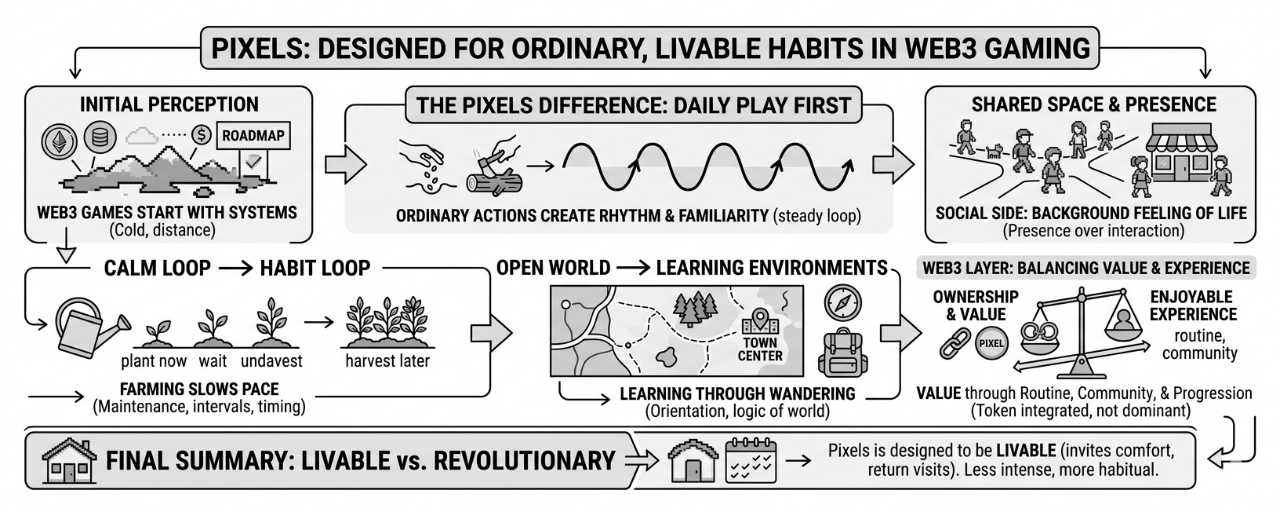
Pixels becomes easier to understand once you stop viewing it as just crypto.
Declinarea răspunderii: Include opinii ale terților. Acesta nu este un sfat financiar. Poate include conținut sponsorizat. Consultați Termenii și condițiile