
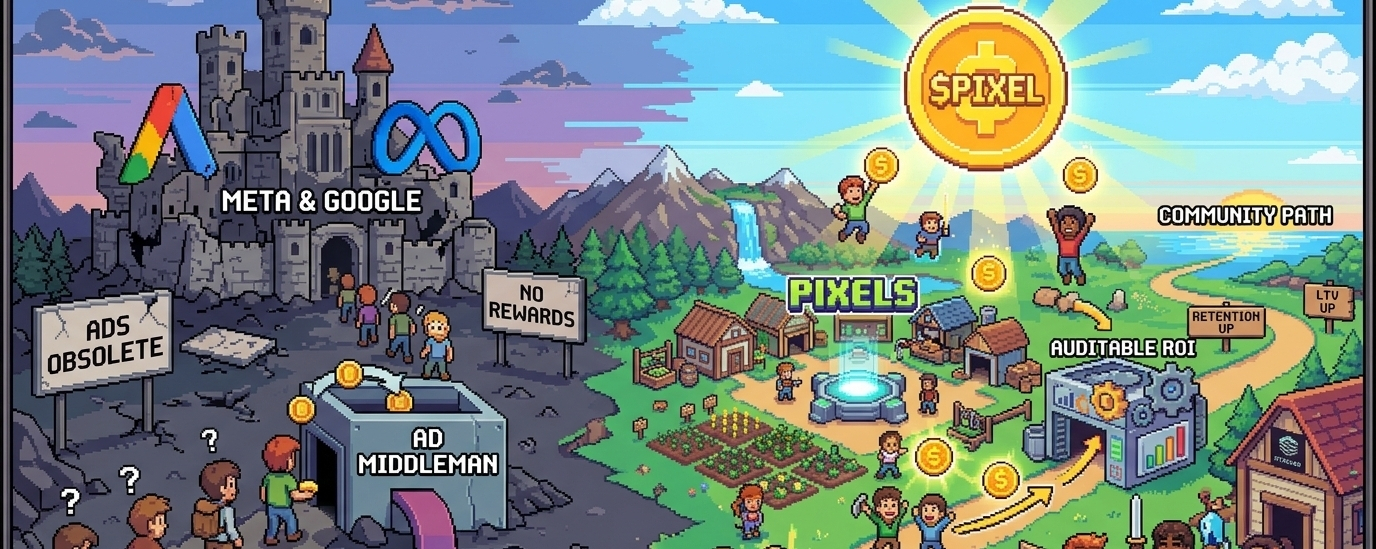
For decades, game studios have operated inside a system they did not build, do not own, and increasingly cannot afford. That system has a name: digital advertising. And at the center of it sit two gatekeepers — Meta and Google — who collectively control more than half of all digital ad spending on Earth.
This arrangement has worked. Sort of. Studios paid, players arrived, and the machine kept spinning. But something cracked in 2021 — and the fissure has been widening ever since. What Web3 gaming infrastructure, and projects like @Pixels and their Stacked engine, are building is not just an alternative to this model. It is the beginning of the end of the ad-middleman era entirely.
Here is the full story, backed by data.
The Numbers That Should Terrify Every Game Studio
Let's start with the raw economics of the current system.
In 2025, the mobile gaming industry spent $25 billion on user acquisition alone. That is not total marketing spend. That is specifically the cost of buying new players through ad platforms — mostly Meta, Google, Apple Search Ads, and AppLovin. To put that in perspective, $25 billion is more than the annual GDP of over 80 countries on Earth, spent in a single year, largely flowing to three or four technology companies that built none of the games those players are being sent to.
And what does a studio get for that spend? A cost-per-install (CPI) that has risen every single year for the past five years. In 2023, iOS CPI for mobile games crossed $4.40. By 2024, hardcore games were averaging $6.00 on iOS and $4.50 on Android. Strategy titles hit $5.50 on iOS. Between 2023 and 2024 alone, average player acquisition costs surged by 60% across key categories. The trajectory is not ambiguous — it is a straight line pointing up and to the right, with no ceiling in sight.
Meanwhile, the ad platforms collecting all of this money are growing faster than ever. Meta is forecast to reach $243 billion in net worldwide ad revenues in 2026, surpassing Google for the first time in history. Together, Meta, Google, and Amazon are projected to control 62.3% of all global digital ad spending by 2026. The concentration of this power is not a bug in the system. It is the system.
Apple Lit the Fuse
The moment the current model began unraveling publicly was April 2021, when Apple enforced App Tracking Transparency (ATT). In theory, it was a privacy feature. In practice, it was a grenade thrown into the middle of the mobile gaming economy.
ATT required apps to explicitly ask users permission before tracking their behavior across other apps and websites. Most users said no. Opt-in rates for tracking came in well below 20% in most markets. Overnight, the precision targeting that Meta and Google had spent years building became significantly less precise. CPI on iOS jumped by 20% almost immediately according to mobile attribution firm AppsFlyer. A Harvard Business Review analysis estimated that cost-per-acquisition rose 38.3% across industries in the year following ATT's introduction — with gaming suffering a 35% reduction in iOS advertising efficiency specifically.
The irony is stark: Apple, which claimed to be fighting for user privacy, saw its own advertising business explode as a result. By early 2024, Apple controlled over 50% of mobile app advertising on iOS, having created a vacuum that only its own first-party platform could fill. Game studios that lost targeting capability on Meta and Google were pushed into paying Apple's own Search Ads at doubled rates. France fined Apple $162 million in 2025 for this behavior. Germany launched antitrust investigations. The European Commission began scrutinizing the entire structure.
The platforms studios had trusted to deliver players had become adversaries. And the cost of renting access to their audiences kept climbing.
The Fundamental Lie of the Attention Economy
Before examining what comes next, it is worth naming what is structurally wrong with the traditional model — not just that it is expensive, but that it is architecturally broken for gaming specifically.
Digital advertising operates on a simple premise: you pay a platform to show your content to users who might be interested in it. The platform profits regardless of whether those users stay, spend, or ever return to your game. The incentive alignment is completely absent. Meta gets paid when someone clicks an ad. Google gets paid when someone installs an app. Neither gets paid based on whether that player is still active on Day 30, or whether they ever make a purchase, or whether they recommend the game to a friend.
This misalignment costs the gaming industry billions every year in acquired users who disappear immediately. The casual game sector saw average CPI for iOS reach $4.83 in 2024 — for users who frequently uninstall within days. With platforms demanding payment at the moment of install and the actual engagement value materializing weeks or months later, studios are perpetually front-loading costs against uncertain lifetime value.
For free-to-play games especially, the math has become near-impossible at scale. Industry benchmarks suggest that a sustainable UA campaign requires a lifetime value (LTV) at least 3x higher than the cost-per-acquisition. But with installs declining in developed markets — mobile gaming spend fell $8-10 billion per year in the two years after ATT enforcement — and CPI still rising, that ratio has become extremely difficult to maintain without either massive scale or an entirely different acquisition model.
The Web3 Alternative: Rewarding Engagement Instead of Renting Attention
This is the context in which Web3 gaming infrastructure has emerged — not as a philosophical preference for decentralization, but as a direct economic response to a broken system.
The core insight is deceptively simple: what if the money studios currently pay ad platforms to find players was paid directly to players who actually show up and engage?
Instead of spending $5 to convince a stranger on Meta to install a game they may never open again, what if that $5 became a reward for a player who reached level 10, completed a meaningful quest, or referred a friend who stayed? The ROI is not just potentially better — it is measurably auditable in a way that Meta ad spend has never been. You can see exactly what behavior was rewarded, exactly what it cost, and exactly what it produced in terms of retention and revenue.
This is the thesis that @Pixels has been operating on inside its own ecosystem, and it is the foundation on which Stacked was built. Stacked is a rewarded LiveOps engine — infrastructure that allows game studios to run real-money reward campaigns targeting specific player behaviors at specific moments, and measure the impact on retention, revenue, and lifetime value in real time.
The numbers behind it are not theoretical. Stacked-powered systems contributed to $25M+ in revenue for the Pixels ecosystem. The infrastructure has processed 200 million+ rewards across millions of real players. It already powers Pixels, Pixel Dungeons, and Chubkins — all live, all generating real data, all proving that the model works at scale.
$PIXEL sits at the center of this engine — functioning not as a single-game token but as a cross-ecosystem rewards and loyalty currency. Every new game studio that plugs into Stacked expands the demand surface for $PIXEL, creating a token thesis that is not dependent on the success of any one title.
The Fraud Problem Nobody Talks About Enough
One reason the ad-middleman system has survived as long as it has is that studios often do not know how badly they are being defrauded inside it.
Ad fraud in gaming is a massive and largely invisible problem. Bots generate fake installs. Click farms simulate engagement. Attribution systems misattribute organic players to paid campaigns, inflating apparent ROI. Industry estimates suggest that billions of dollars in gaming ad spend annually are absorbed by fraudulent traffic — money that studios believe is buying real players, which is actually buying nothing at all.
Web3 reward systems built on behavioral data face an equally serious adversarial problem: bot farming, reward exploitation, and Sybil attacks, where one entity creates thousands of identities to claim rewards repeatedly. This is what destroyed many early play-to-earn economies, including some of the most hyped titles of the 2021 GameFi wave.
The difference with infrastructure built specifically to survive this problem is significant. Stacked was not designed in a protected environment without adversarial pressure. It was built inside a live game economy that was actively attacked — and it survived. The fraud prevention, anti-bot systems, and behavioral data modeling that resulted from that process took years to develop and represent a genuine moat that cannot be replicated by shipping a quest board and calling it a reward system.
The AI Layer: Where the Model Gets a Multiplier
What makes the emerging Web3 reward model genuinely superior to traditional ad spend is not just cost redirection — it is the data layer that comes with it.
When you run a Meta ad campaign, Meta keeps the audience data. You get a click-through rate and an install count. You do not get visibility into what your acquired users actually do inside your game, how they compare to organically acquired users, or what specific game mechanics correlate with their long-term retention. That intelligence stays inside Meta's black box.
When reward behavior is processed through an engine like Stacked, the data flows in the other direction — to the studio. An AI game economist layer sitting on top of this data can answer questions that traditional UA attribution cannot: Why are high-spending players dropping between Day 3 and Day 7? Which onboarding sequences produce the strongest 30-day retention? Where is reward budget being spent on players who were going to stay anyway versus players who needed that incentive to return?
This is a fundamentally different intelligence advantage. Insight to action inside a single system, with no need to export data to a third-party tool, no waiting for attribution windows to close, and no guessing about what happened between the ad click and the player behavior.
Why This Is Inevitable, Not Just Possible
The conditions for a shift away from the ad-middleman model are converging from multiple directions simultaneously.
Privacy regulation is compressing the effectiveness of behavioral targeting that Meta and Google depend on. GDPR enforcement, CCPA restrictions, Apple ATT, and emerging EU Digital Markets Act requirements are collectively reducing the data advantage that made programmatic advertising powerful. The ad platforms are building solutions, but each solution comes with additional cost and additional friction.
The economics of acquisition are deteriorating faster than platforms can compensate for with better targeting tools. With iOS CPI up 38% YoY in casual genres as of early 2026 and installs declining in developed markets, studios with LTV problems cannot simply buy their way out. The math does not work at scale anymore.
Meanwhile, players are more sophisticated about what engagement means and more receptive to systems that reward them for genuine participation. Research indicates that Web3 gamers spend more than traditional players on average — the presence of real economic stakes increases session time and engagement depth in ways that passive advertising delivery simply cannot replicate.
The studios that figure this out first — that redirecting acquisition spend into direct player rewards with measurable ROI is more efficient than renting attention from platforms that keep the data — will have a structural advantage over those still optimizing Meta campaigns.
And the infrastructure to do this at scale, fraud-resistant, with an AI economist on top, is already built. It already works. It already has the receipts.
The Death Is Not Instant, But It Is Underway
Meta and Google will not disappear from gaming marketing next year. The transition from a broken system to a better one never happens overnight, especially when the broken system is generating $400+ billion in combined annual revenue for its operators.
But the structural conditions for disruption are present. The economics are deteriorating from above as costs rise and tracking degrades. The alternative model is proven and expanding. The token infrastructure connecting players across games is maturing. And the studios most desperate for a solution — the independent developers and mid-tier studios priced out of billion-dollar UA budgets — are exactly the audience that infrastructure like Stacked was designed to serve.
The ad-middleman is not dead yet. But it has never been more expensive, less efficient, or more vulnerable to a better alternative.
And that alternative is being built now — inside @Pixels , inside Stacked, and inside the growing ecosystem that $PIXEL powers.
Not financial advice. Always do your own research.