
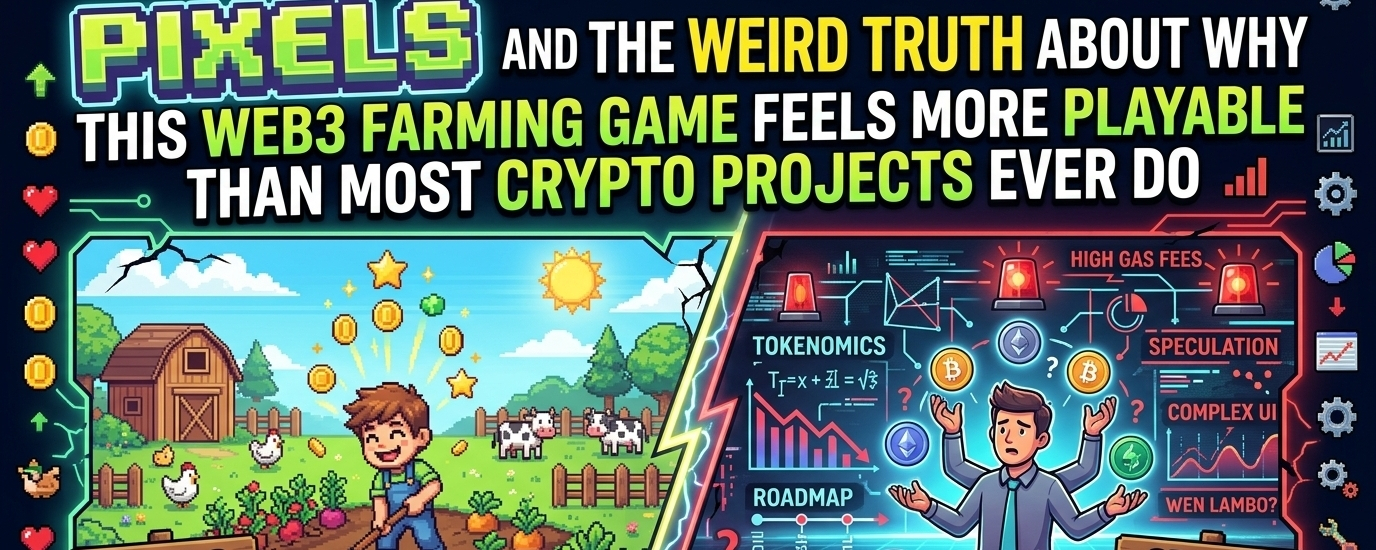
The biggest issue with Pixels is the same issue that hits almost every Web3 game before you even start playing it: the crypto label. The second people hear “blockchain game,” they expect hype, tokens, fake promises, and a lot of talk about the future instead of the actual game. And honestly, that reaction makes sense. Most crypto games have felt more like money experiments than real games. They give you economies, roadmaps, and buzzwords, but not much fun.
That is what makes Pixels a little surprising.
It is not some masterpiece, and it does not fix everything wrong with Web3 gaming, but it does something that a lot of these projects fail to do. It actually feels like a game first. That matters. A lot. Because most people do not care about digital ownership if the world itself is boring.
Pixels, built on the Ronin Network, is basically a social casual open-world game where players farm, explore, gather resources, build, and slowly create their own routine. That sounds simple, and that is probably why it works. It does not try too hard to act revolutionary. It just gives players a world they can move around in without making every second feel like work.
The farming loop is one of its strongest parts. You plant, wait, return, collect, and repeat. It is easy to understand, and more importantly, it creates a rhythm that feels calm instead of stressful. In a time when so many games are built around pressure, grinding, and constant urgency, that kind of pace is actually refreshing. Pixels works best when it feels like a place you visit because you want to, not because you are being pushed to optimize every move.
The social side helps too. You run into other players, share space, trade, chat, and slowly get the feeling that the world is alive. Not in some huge, dramatic MMO way. More in a quiet, steady way. That softer kind of multiplayer suits the game. It makes the world feel warm without becoming chaotic.
Its pixel art style also does a lot for the overall feel. The game looks simple, but in a good way. Clear, charming, easy to sit with. It does not try to overwhelm you with detail. It just tries to be pleasant, and that works in its favor.
Still, the crypto problem never fully disappears. That shadow is always there. Once money and assets become part of a game, there is always the risk that players stop treating it like a world and start treating it like a machine. That is where games like this usually fall apart. The fun gets buried under efficiency, the community turns into a market, and everything starts feeling cold.
That is why Pixels is interesting, but also fragile.
It succeeds most when it forgets to behave like a crypto project and just acts like a decent online game. A place where you can farm, wander, build, and relax for a while. That is not a flashy achievement, but it is a real one. And in the Web3 space, that alone makes Pixels stand out.