
Gaming is standing at a strange and fascinating crossroads. For decades, a game was simple: you played, you enjoyed, and when you logged out, the experience ended. Today, with models like $PIXEL and ecosystems like Pixels, that boundary is starting to blur. The question is no longer just what is a game? — it’s what is gaming becoming?
At first glance, Pixels looks familiar. It has rewards, tokens, NFTs, and all the usual components we’ve seen across Web3 gaming. But when you look deeper, it starts to feel less like a standalone game and more like a system — almost a publishing and economic infrastructure disguised as gameplay.
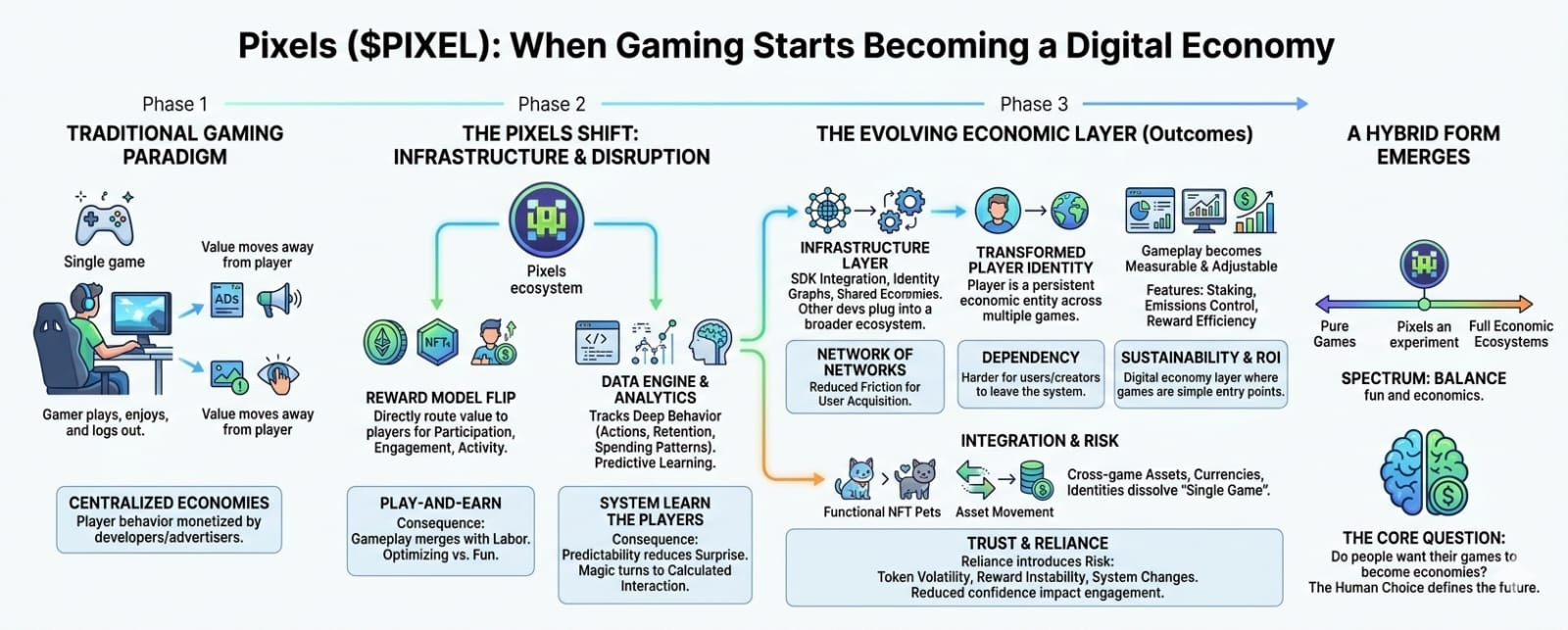
The biggest shift begins with the reward model. Traditionally, the internet runs on attention. You use platforms for free, and in return, your behavior is monetized through ads. Pixels attempts to flip that model. Instead of sending value to advertisers, it routes value directly to players. You don’t just play — you earn for participating, for engaging, for simply being active.
On the surface, this feels empowering. Players finally capture some of the value they create. But underneath, it introduces a subtle transformation: gameplay starts to merge with labor. When rewards become the primary driver, the experience risks shifting from fun to function. The loop changes. You’re no longer just playing — you’re optimizing.
The second layer is the data engine, and this is where things get more complex. Pixels tracks user behavior deeply: actions, retention, spending patterns. From the outside, it looks like analytics. Internally, it becomes predictive. The system doesn’t just respond to players — it learns them.
This creates powerful advantages. Developers can fine-tune economies, predict engagement, and design reward systems that are highly efficient. But there’s a trade-off. Games have always thrived on unpredictability — surprise, discovery, and randomness. When systems become too optimized and too predictable, something intangible starts to fade. The “magic” of play can slowly turn into calculated interaction.
Then comes the infrastructure layer — arguably the most ambitious part. Pixels isn’t just building a game; it’s building a network where other developers can plug in. With SDK integration, identity graphs, and shared economies, players are no longer tied to a single game. They become part of a broader ecosystem.
This changes identity itself. A player is no longer just a character in one world — they become a persistent economic entity across multiple games. For developers, this reduces friction in user acquisition and growth. But it also creates dependency. Once you’re inside a shared system, leaving it becomes harder, both for creators and users.
The economic mechanics reinforce this shift. Features like staking, emissions control, and dashboards measuring reward efficiency turn gameplay into something measurable and adjustable. It’s not just about fun anymore — it’s about sustainability, ROI, and liquidity. The system behaves less like a game economy and more like a managed financial environment.
One of the most interesting aspects is the cross-game integration. When assets, currencies, and identities move across multiple games, the concept of a “single game” starts to dissolve. Instead, you get something closer to a digital economy layer, where games are simply entry points into a larger system.
Even features like NFT pets reflect this evolution. These aren’t just cosmetic collectibles. Their traits affect gameplay, productivity, and outcomes. Breeding systems introduce genetic mechanics, creating markets not just for items but for potential future value. It’s no longer just about owning something — it’s about what that ownership can generate.
But this is where the biggest question emerges: trust.
When time, behavior, and money become deeply intertwined, the system becomes more than entertainment. It becomes something people rely on. And reliance introduces risk. Token volatility, reward instability, and system changes can all impact player confidence. If rewards fluctuate too much, engagement may weaken. If systems feel too controlling, users may step back.
So, does gaming remain “just a game”? Probably not.
But does it fully become a digital economy? Not entirely — at least not yet.
What we are seeing is a hybrid form emerging. A space where entertainment, economics, and identity overlap. Some players will treat it as a game. Others will treat it as an opportunity. And many will move between both mindsets without even realizing it.
Pixels is not a finished answer — it’s an experiment. A live test of whether people are willing to exist in systems where play and value are inseparable.
The future of gaming will likely not be one extreme or the other. It will be a spectrum. Some experiences will remain pure games, built only for fun. Others will evolve into full economic ecosystems. And in between, there will be models like Pixels — balancing both, not always perfectly.
