
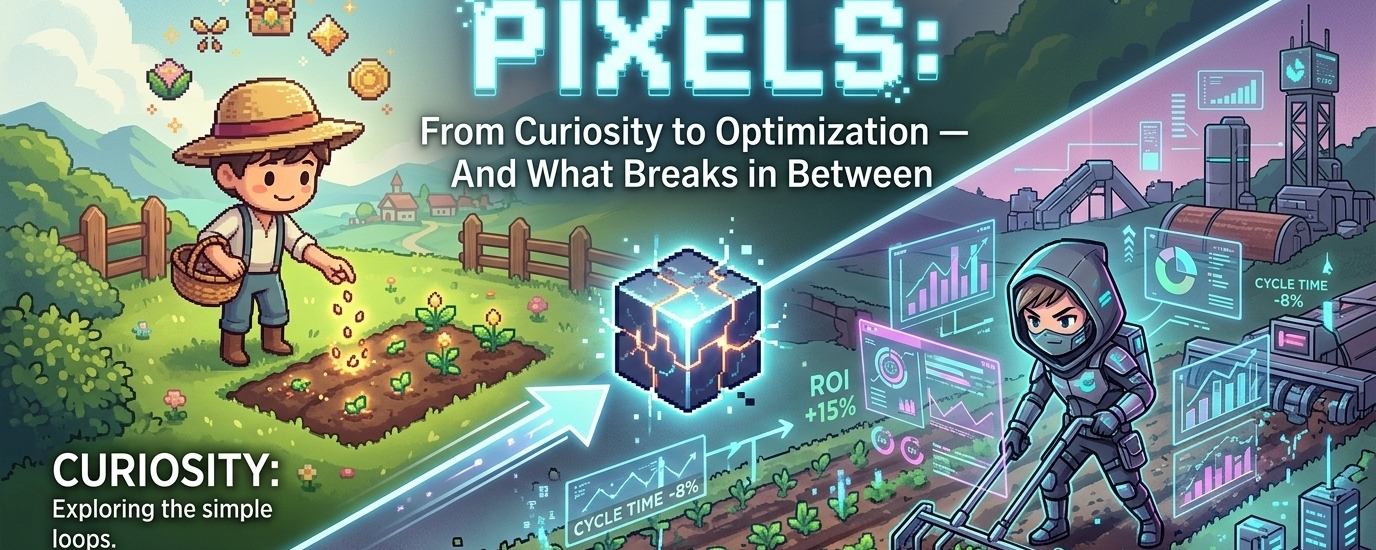
I remember the first time I opened Pixels. It felt simple—almost disarmingly so. A quiet world of farming plots, wandering avatars, and soft routines. I planted crops, walked around, clicked things, and watched small rewards accumulate. Nothing about it felt urgent. It was calm, almost meditative.
But that surface simplicity didn’t last.
The more time I spent inside Pixels, the more I started to notice that the game wasn’t really about farming or exploration. Those were just entry points. What it was actually doing—quietly, effectively—was structuring my attention. Every action fed into a loop. Plant, harvest, trade, repeat. Small rewards, frequent feedback, constant motion. It wasn’t asking me to think deeply; it was asking me to stay.
And that’s where it became interesting.
Pixels exists in a space where attention is liquidity. Not just in the financial sense, but in the behavioral sense. The more time I spend inside the system, the more valuable I become to it. My actions generate activity, my activity signals growth, and that growth attracts more users. It’s a loop built not just on gameplay, but on participation as a resource.
At first, I played out of curiosity. I wanted to understand the mechanics, the economy, the feel of it. But curiosity doesn’t last forever. Slowly, almost without noticing, my behavior shifted. I stopped exploring randomly and started optimizing. Which crops yield the best return? What’s the fastest loop? Where’s the inefficiency?
That shift—from curiosity to optimization—is where the tone of the experience changes.
Because once optimization begins, the game stops being a world and starts becoming a system. And systems have pressure points. The same loops that feel engaging at the start begin to feel repetitive. The same rewards that felt meaningful start to feel expected. Activity increases, but meaning doesn’t necessarily follow.
That’s the uncomfortable truth I kept circling back to: activity is not the same as value.
Pixels can show growth—more users, more transactions, more in-game actions—but those metrics don’t always reflect depth. Sometimes they reflect efficiency. Sometimes they reflect users learning how to extract rather than explore. And when too many participants start optimizing for output, the system becomes fragile.
Because now it depends on constant input to sustain itself.
I also started thinking about governance, even though it sits quietly in the background. In theory, systems like this evolve with their communities. In reality, most users are too focused on their loops to engage meaningfully with governance. Decisions get made, but not always with deep participation. The structure exists, but the weight of it feels uneven.
And then there’s growth.
Growth is visible. It’s measurable. It’s easy to point to. But retention—the kind that comes from genuine engagement rather than incentive—is harder to see. Over time, I began to wonder how much of the activity I was seeing was driven by interest, and how much was driven by reward structures. Because those are not the same thing, and they don’t age the same way.
There’s also a quieter force at play: erosion.
Not sudden collapse, but slow dilution. Inflation of in-game assets, diminishing returns on effort, subtle shifts in balance. Nothing dramatic enough to break the system, but enough to change how it feels over time. It’s the kind of change you don’t notice day-to-day, but you feel it when you step back.
And that’s where I find Pixels now—in a kind of balance.
There’s real potential here. The design is thoughtful, the loops are effective, and the entry point is accessible in a way many Web3 projects struggle to achieve. But there’s also risk embedded in that same design. The reliance on continuous activity, the shift toward optimization, the gap between visible growth and actual engagement.
The real test hasn’t happened yet.
It comes later—when growth slows, when new users aren’t arriving as quickly, when the system has to rely on the people who are already there. That’s when design matters most. That’s when the difference between engagement and extraction becomes clear.
And maybe that’s what Pixels reveals more than anything else—not just about itself, but about crypto more broadly.
We build systems that are very good at attracting attention. We design loops that keep people moving. But sustaining meaning inside those systems is harder. It requires more than incentives. It requires something that doesn’t fade when the rewards do.
I’m still inside Pixels, still planting, still harvesting. But now I’m watching differently. Not just what I’m doing—but why I’m doing it, and what happens when that reason starts to change.
