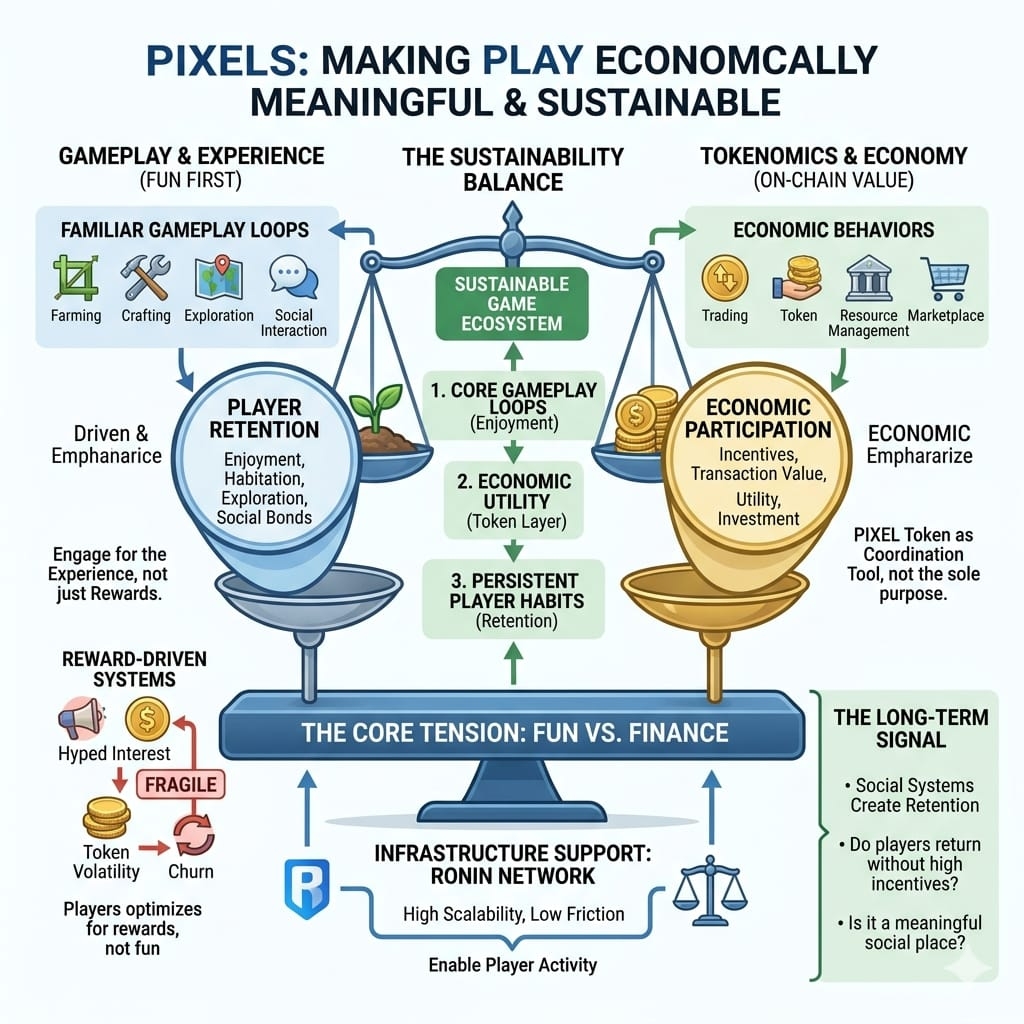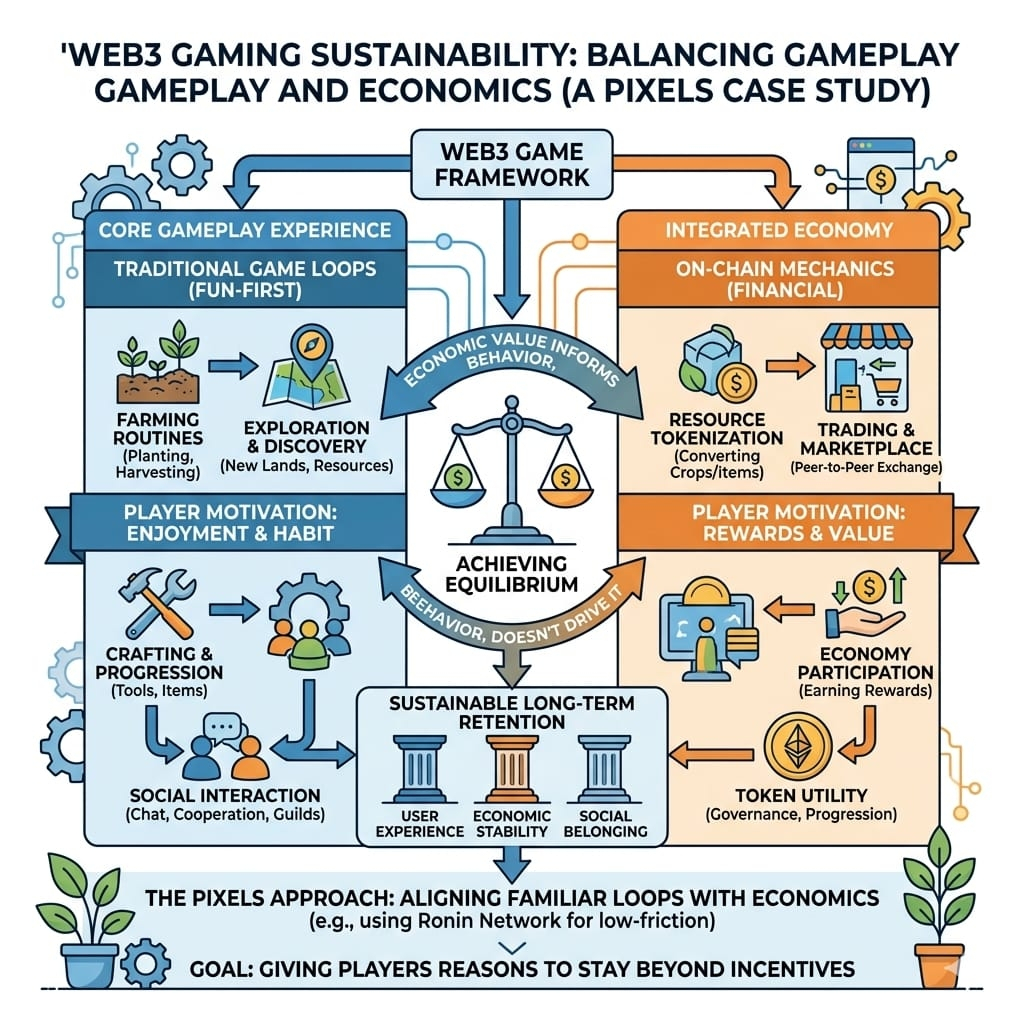
Most players in Pixels don’t think they’re participating in an economy.
They think they’re just playing a game.
They log in, spend their energy, plant crops, collect resources, maybe sell a few items—and log out. The experience feels simple, almost casual. Nothing about it screams “market dynamics” or “economic positioning.”
And that’s exactly what makes it interesting.
Because under the surface, something else is happening.
Pixels doesn’t announce its economy. It lets players drift into it.
That design choice changes everything.
In most Web3 games, the economic layer is obvious from the start. You know what earns, what matters, what’s valuable. Players enter with a mindset: optimize, extract, maximize.
Pixels takes a different route.
It delays that realization.
You start as a player. You behave casually. You explore without pressure. But over time, patterns begin to reveal themselves. Certain actions feel more rewarding. Certain items move faster. Certain decisions start to carry weight.
And without noticing, your mindset shifts.
Not because the game told you to.
Because the system showed you.
That’s the key difference.
The economy in Pixels is not introduced—it is discovered.
And discovery feels very different from instruction.
When players are told something is valuable, they treat it like a task. When they discover value themselves, they treat it like an opportunity. That small psychological difference changes how people engage.
They feel smarter. More involved. More in control.
But it also makes the shift harder to track.
Because by the time you realize you’re optimizing…
you’ve already been doing it.
This creates two types of players inside the same world.
Those who are still “playing.”
And those who have started “positioning.”
The gap between them isn’t obvious at first. Everyone is doing similar actions. But the intent behind those actions begins to diverge. One group is acting casually. The other is acting with awareness of value flow.
Over time, that difference compounds.
Not through mechanics.
Through mindset.
And that’s where $PIXEL becomes meaningful—not as a reward, but as a signal. It reflects activity, but more importantly, it reflects awareness. The players who understand the system interact with it differently than those who don’t.
Pixels doesn’t separate players by skill.
It separates them by perception.
That’s a much quieter divide.
And much harder to detect.
The interesting question isn’t whether the game has an economy.
It clearly does.
The question is how long it takes for players to realize they’re already inside it.
Because in Pixels, by the time you notice the system…
you’re already part of it.




#RAVEWildMoves #KelpDAOFacesAttack #ARKInvestReducedPositionsinCircleandBullish #BitcoinPriceTrends