
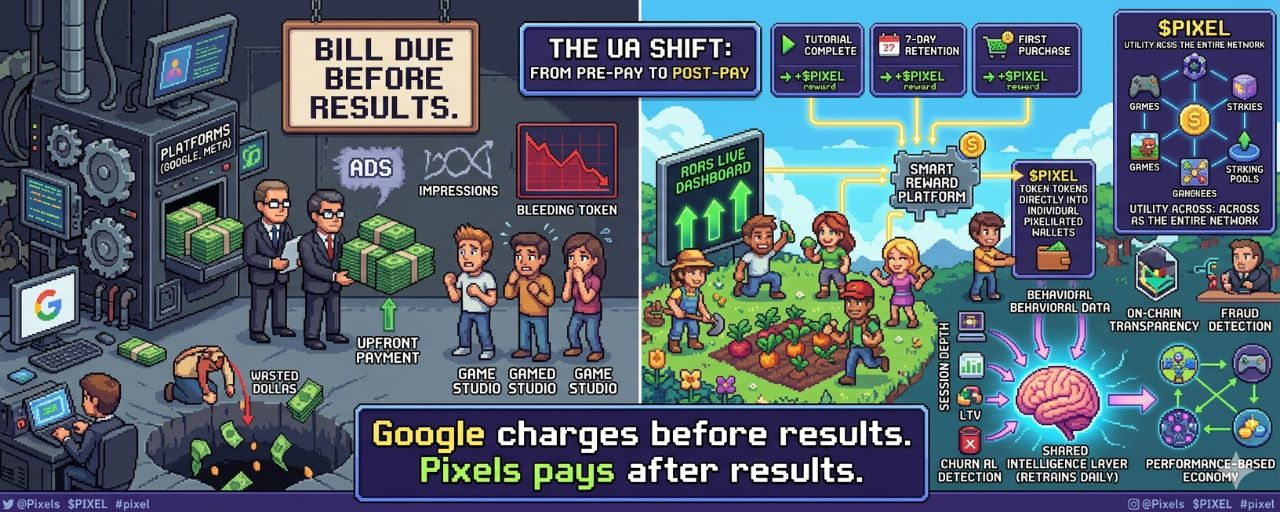
Google charges before results. @Pixels pays after results.
I could end this blog right there honestly. But I know that one sentence alone won't make you feel what I felt when I actually sat down and read through how this system works. So let me walk you through it the way I wish someone had walked me through it.
I've been on Binance Square since 2023. I've covered game launches, token unlocks, protocol updates and ecosystem announcements more times than I can count at this point. Most of them follow the same pattern. Big promises at launch. Excitement for a few weeks. Then the token starts bleeding and the team goes quiet. I've seen that movie enough times that I don't get excited easily anymore.
Pixels made me pay attention again. And the reason isn't the game itself. It's what they've built underneath it.
Let Me Explain the Problem First
Every year, game studios collectively spend somewhere worth of $100 billion on user acquisition. They hand that money to Google, Meta, TikTok and a small circle of platforms that have basically made themselves unavoidable middlemen between studios and the players those studios are trying to reach.
Here's how it works. The studio picks a target audience. The platform shows an ad. A player maybe clicks. A player maybe installs. A player maybe stays for more than three days. The studio gets a dashboard full of numbers and a bill that was due before any of those maybes played out.
Nobody in that chain gets paid for outcomes. The platforms get paid for impressions. And they've spent decades convincing an entire industry that this is just how growth works. That you pay upfront, trust the algorithm and hope the math works out in your favor.
I think about how many smaller studios have burned through their entire runway paying for installs that never converted into real players. It genuinely bothers me. The system is designed to extract from studios while giving them just enough data to feel like they're in control.
Pixels looked at that structure and decided it doesn't have to work this way. And honestly after going deep into their whitepaper I think they're right.
The Shift That Changes Everything
When a studio builds on the Pixels Smart Reward platform, something fundamental flips. They don't pay for the chance that a player might engage. They pay the player directly after the player already engaged.
Think about what that means in practice. A player finishes the tutorial. Reward triggers. A player comes back seven days in a row. Reward triggers. A player makes their first purchase inside the game or refers someone who actually sticks around. Reward triggers. The studio's budget doesn't move until something real and verifiable has already happened.
Customer acquisition cost stops being a number your marketing team estimates six weeks after a campaign wraps up. It becomes something you watch on a live dashboard sitting right next to the revenue it generated. Every token that moves through this system traces from the studio's treasury to the exact wallet of the player who earned it.
I want you to sit with that for a second. In the traditional ad model, you genuinely cannot tell whether a specific dollar you spent on a Google campaign directly caused a specific player to make a purchase inside your game. The attribution is fuzzy at best. In this model it isn't fuzzy at all. It's transparent by design because it's on-chain by design.
That isn't an improvement on the existing advertising model. That's a replacement for it.
This Is What Should Actually Make Google and Meta Nervous
Here's where it gets really interesting to me personally.
Every game that plugs into the Pixels ecosystem sends player behavioral data back into a shared intelligence layer through something called the Pixels Events API. Session depth. Spending habits. Churn signals. Lifetime value patterns. Fraud scores. All of it flowing from every single title in the network into one unified dataset that gets richer with every new game that joins.
The models built on top of this data retrain every night. They learn which types of players respond to which kinds of rewards. They learn the exact moment in a player's journey when a well-targeted incentive has the strongest impact on whether that person sticks around or quietly disappears. They learn to tell the difference between genuine engagement and bot-driven farming. And they keep getting better continuously, not just for one game but across every game simultaneously.
Google and Meta have spent twenty years assembling exactly this kind of cross-platform behavioral intelligence. They charge for access to it while keeping the raw data locked inside their own systems. Nobody outside their walls ever sees the full picture.
Pixels is building the same capability but making it available directly to studios. Grounded in first-party game data rather than social media signals. Structured so that the value flows to players and studios instead of to an intermediary who had no real stake in whether either party actually succeeded.
Studios keep full ownership of their data throughout the whole relationship. They benefit from the cross-game model improvements without giving up anything proprietary. And they get fraud detection and lifetime value modeling that most of them couldn't fund themselves even if they wanted to.
The actual integration takes less than a day through a drop-in API. You define which player actions you want to reward. You fund the pool from your own PIXEL or draw from ecosystem emissions. Then you watch a live RORS dashboard tell you whether the tokens you spent came back as revenue. No mystery. No black box billing. No invoice from a platform that genuinely didn't care if your game lived or died.
Here's the Thing Most People Covering PIXEL Are Missing
I keep seeing content about Pixels that treats PIXEL like a standard gaming token. Something that goes up during hype cycles and down when players leave. That framing completely misses what's actually being built here.
#pixel desn't just power one farming game. As more studios join the Pixels ecosystem and more user acquisition budgets start flowing through the Smart Reward platform, the demand surface for PIXEL grows with every single integration. Every studio that joins needs PIXEL to fund player rewards. Every player earning inside any game in the network holds something with utility across the whole ecosystem. Every studio that runs a healthy RORS feeds back into the staking pools that power the next wave of growth.
The Pixels whitepaper actually describes this positioning in a way I found pretty bold when I first read it. They're calling it a decentralized version of AppsFlyer or AppLovin built for both Web3 and Web2 gaming. If you've ever looked at what those companies actually do in the industry and how deeply embedded they've become in how studios plan their growth, that comparison carries real weight. It isn't aspirational marketing language. It's an accurate description of the infrastructure they're putting together.
The difference is that AppsFlyer charges for analytics it controls. AppLovin takes a margin on every ad dollar that runs through its system. The value flows upward toward the platform in both cases. In the Pixels model it flows outward toward stakers, toward players, toward studios themselves and back through the ecosystem in a loop that gets more efficient with every cycle.
One Thing I Respect More Than Almost Anything in Crypto
I want to be real with you about why I find this worth writing seriously about rather than treating it as just another campaign topic.
The Pixels team didn't design this system on a whiteboard and call it a vision. They built it inside their own game first. They ran it under genuinely adversarial conditions with real bots trying to drain it, real players pushing its economic edges, and real market pressure bearing down on the token throughout 2024. They processed hundreds of millions of rewards through it. They generated over $25 million in revenue alongside it. They made real mistakes, admitted those mistakes publicly in their own whitepaper, and rebuilt specific parts of the system to fix each one.
That's infrastructure with receipts. I can't tell you how rare that actually is. Most projects that position themselves this ambitiously in crypto show you a roadmap and a funding announcement. Pixels is showing you a track record of actual volume that ran through a live system under real conditions.
I'm not saying they've figured out everything. There's genuine execution risk in scaling this across ten studios, twenty studios, fifty studios. Phase 3 open pools being able to consistently attract games with strong enough economics to keep RORS climbing is still an open question worth watching carefully.
But the foundation isn't theoretical. It works. At least at one game's scale. The question now is whether it holds up as the ecosystem expands.
If it does, $PIXEL at the center of something that most of the people currently trading it haven't fully understood yet. And in my experience over the past two years in this space, that gap between what something actually is and what the market currently thinks it is tends to be exactly where the most interesting opportunities show up.
That's the only reason I keep paying attention to Pixels.