
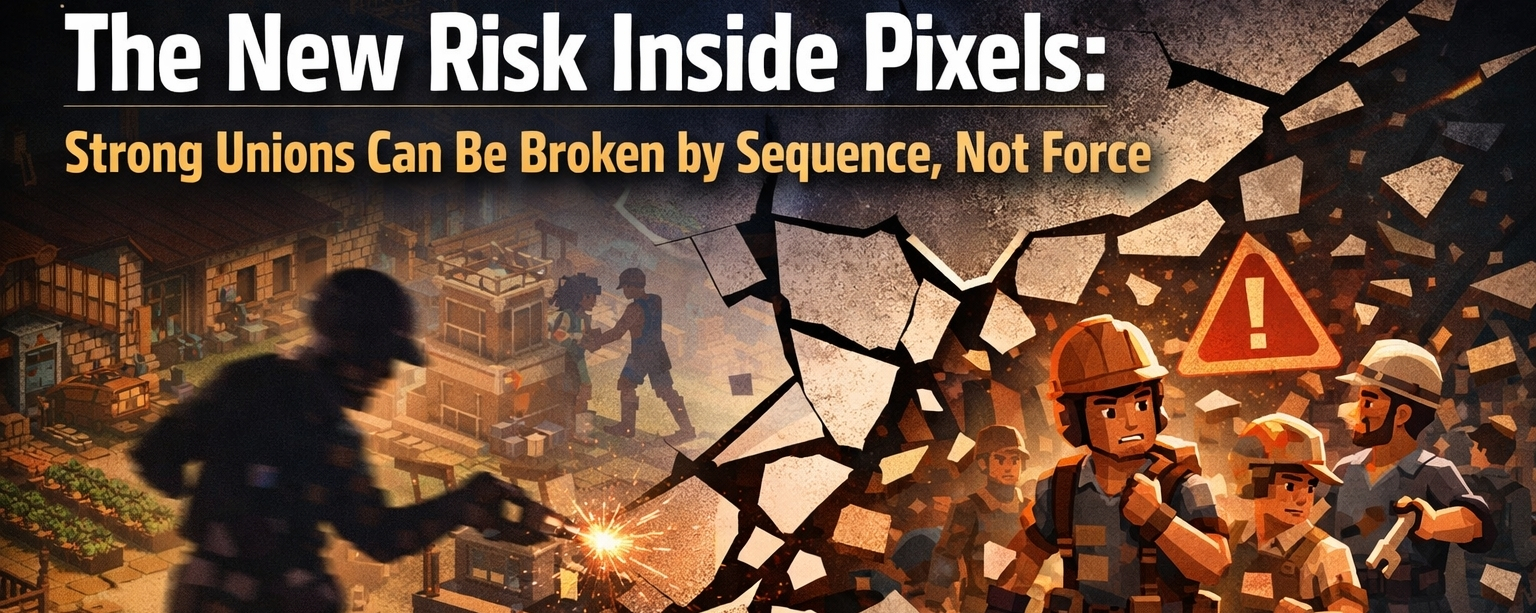

The more closely I watch what is happening inside Pixels, the more convinced I become that competition is moving into a more demanding form than before. There was a time when strength could still be confused with scale: more members, more visible activity, more constant motion. That reading is becoming less useful. What matters now is not simply how many people a union can gather, but whether it can preserve operational rhythm once somebody deliberately tries to interfere with it.
That distinction is becoming central. From what I have observed, a serious union in Pixels is no longer just a collection of players moving toward the same target. At its best, it begins to function like a decentralized operating structure. Sometimes five or six players, if they understand the flow deeply enough, can produce efficiency that feels far larger than their number. The reason is simple: each person is no longer reacting only to their own task. They are carrying part of the group’s active logic — who is stabilizing the resource line, who is feeding the bottleneck, who is rotating into pressure points, and which delay will quietly damage everything behind it. At that stage, the union’s value stops being additive. It becomes structural.
That is also why sabotage becomes more meaningful as unions become more organized. In a weak formation, disruption often requires direct force. In a stronger one, timing is enough. You do not need to destroy the group. You only need to interrupt sequence at the right point. One delayed handoff, one role switch mistimed, one short break in the resource flow, one hesitation at a sensitive point in the cycle — and the union is no longer converting effort into clean output. It is spending energy recovering its own shape.
To me, that recovery cost is where most of the misunderstanding still lives. The visible disruption may look small, but the real damage is not the incident itself. It is the reconstruction that follows. Once rhythm breaks, people begin making local corrections from partial context. Each adjustment may seem reasonable in isolation, yet the group as a whole starts drifting away from synchronized output. That is a specific weakness of decentralized coordination: there is no single controller restoring order in real time. The system survives only while local judgment remains aligned. Once that alignment slips, inefficiency spreads quietly, and often faster than the participants themselves can recognize.
This is why I think the real design boundary in Pixels is not scale, but rhythm tolerance. A union is only as strong as its ability to absorb disruption without falling into reassembly mode. That is the metric I would take seriously. Not total headcount. Not surface-level activity. Not even peak efficiency under stable conditions. The harder question — and the more honest one — is this: after a deliberate interruption, how much productive sequence is still intact?
That, in my view, is the deeper competitive layer Pixels is entering. The unions that will matter most are not simply the ones that create the most movement. They are the ones that lose the least structure when someone tries to throw them off rhythm. They will build cleaner handoffs, faster substitution, stronger role overlap, and enough shared operational memory that disruption remains local instead of becoming systemic.
The production test is unforgiving. A healthy union does not pause to remember how it works when pressure hits. Output remains close to baseline, replacements happen without visible confusion, bottlenecks are refilled before delay spreads, and sabotage fails to turn into collective hesitation. If that is not true, then the union does not yet have durable coordination. It only has temporary momentum.