
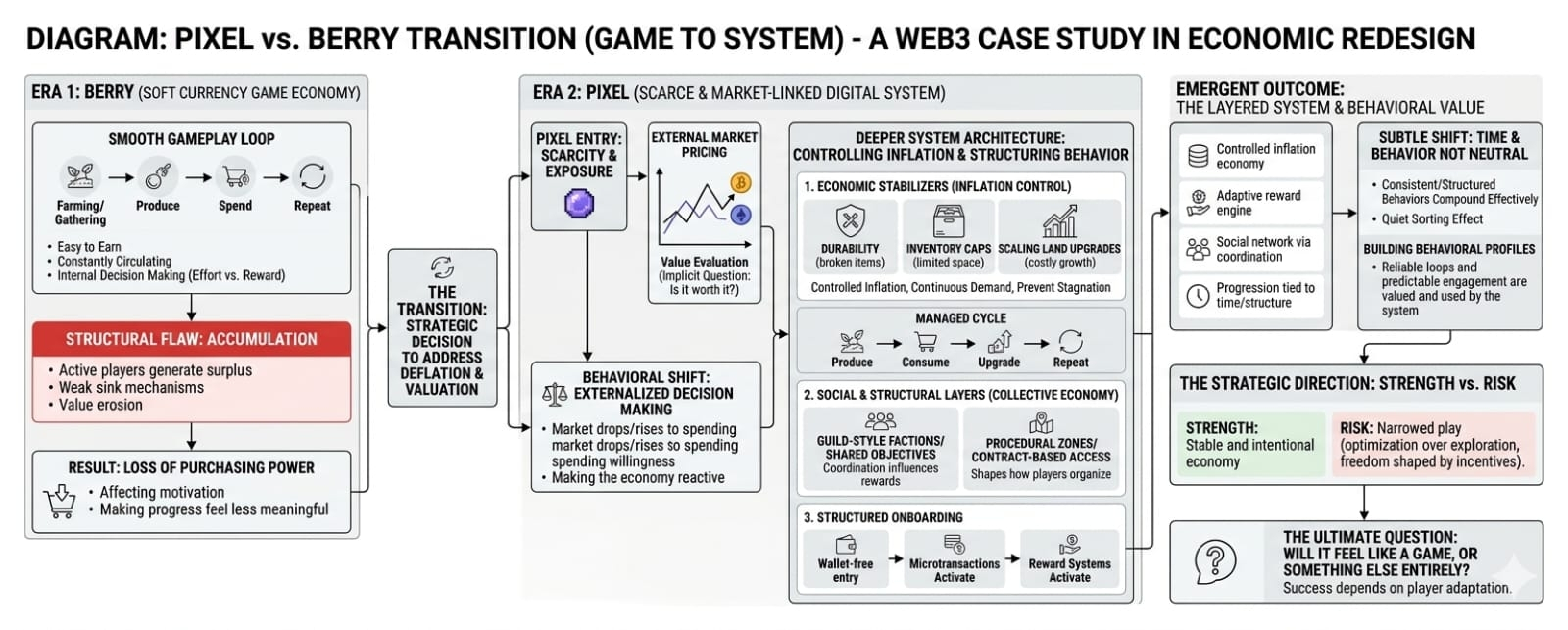
There’s a pattern in Web3 games that doesn’t get discussed honestly enough: when a core currency gets replaced, it usually means something in the original design stopped working. Not necessarily in a dramatic collapse, but in a quieter way where the numbers no longer behave as intended. The shift from BERRY to PIXEL in Pixels fits into that pattern—and understanding it helps explain what the game is becoming today.
BERRY was designed as a classic soft currency. It followed a familiar model borrowed from traditional free-to-play games: easy to earn, constantly circulating, and used for everyday in-game actions. In theory, this creates a smooth gameplay loop where players are always producing and spending. But soft currencies come with a structural flaw—they accumulate. Over time, active players generate more than they can realistically spend, and unless strong sink mechanisms exist, that surplus erodes value.
That’s exactly where pressure begins. When a currency loses purchasing power inside the game, it doesn’t just affect prices—it affects motivation. Progress starts to feel less meaningful because the resource tied to it becomes abundant. The loop still exists, but the tension disappears.
PIXEL enters as the counterweight to that problem. Unlike BERRY, it is scarce, market-linked, and exposed to external pricing. This changes the nature of the economy entirely. The primary unit of value is no longer just something you earn and spend casually—it’s something you evaluate. Every action now carries an implicit question: is this worth it?
That shift might seem small, but it fundamentally changes player behavior.
Under BERRY, decisions were mostly internal. Players thought in terms of effort and reward within the game loop. Under PIXEL, decisions become externalized. Now, upgrades, crafting, and progression are indirectly tied to market conditions. A drop in crypto prices can affect how willing players are to spend. A rise can make in-game actions feel more “expensive.” The economy stops being isolated and becomes reactive.
This is where Pixels begins to move away from being just a game.
The introduction of systems like durability, inventory caps, and scaling land upgrades shows a clear direction: controlling inflation while maintaining continuous demand. Items no longer last forever. Storage is limited. Growth comes with increasing cost. These aren’t just gameplay mechanics—they are economic stabilizers designed to keep resources flowing instead of stagnating.
The loop evolves from simple repetition into a managed cycle: produce → consume → upgrade → repeat. Not because it’s fun by default, but because the system needs it to remain balanced.
Then comes the deeper shift—social and structural layers.
With features like guild-style factions, shared objectives, and event-driven gameplay, the economy is no longer purely individual. It becomes collective. Rewards are influenced by coordination, not just activity. Add to that procedurally generated exploration zones and contract-based access, and the system starts shaping not just what players do, but how they organize.
Even onboarding reflects this transition. A wallet-free entry phase lowers friction, while microtransactions and reward systems activate gradually. This isn’t accidental—it’s designed to pull players into the system before exposing them to its full economic complexity.
What emerges is something more layered than a typical game:
An economy with controlled inflation
A reward engine that adapts to behavior
A social network built around coordination
A progression system tied to both time and structure
And this is where the most subtle shift happens.
Time itself stops being neutral.
Not all player activity produces the same outcomes anymore. Certain behaviors—consistent, repeatable, structured—seem to compound more effectively. Progress feels smoother not necessarily because of effort, but because of alignment with the system’s expectations. Over time, this creates a quiet sorting effect. The system begins to favor patterns it can recognize and reinforce.
That changes what players are actually building.
They’re not just earning tokens—they’re developing behavioral profiles. Reliable loops, efficient routines, predictable engagement. These patterns become valuable because the system can use them, reward them, and potentially extend them into future layers of the ecosystem.
In that sense, PIXEL is more than a currency. It becomes a bridge between behavior and outcome. A mechanism that translates structured time into measurable progression.
This creates both strength and risk.
On one hand, it leads to a more stable and intentional economy. On the other, it can narrow how people play. As players optimize for what “works,” diversity in behavior may shrink. Exploration gives way to efficiency. Freedom becomes shaped by incentives.
So the question isn’t simply whether Pixels is a good game.
It’s whether players are comfortable participating in a system where gameplay, economy, and behavior are tightly interconnected.
The transition from BERRY to PIXEL wasn’t just a token change. It was a directional decision. One that moved Pixels away from a self-contained game economy toward a broader, structured digital system.
And whether that system succeeds won’t depend only on design.
It will depend on how naturally players adapt to it—and whether that structure feels like a game, or something else entirely.
