
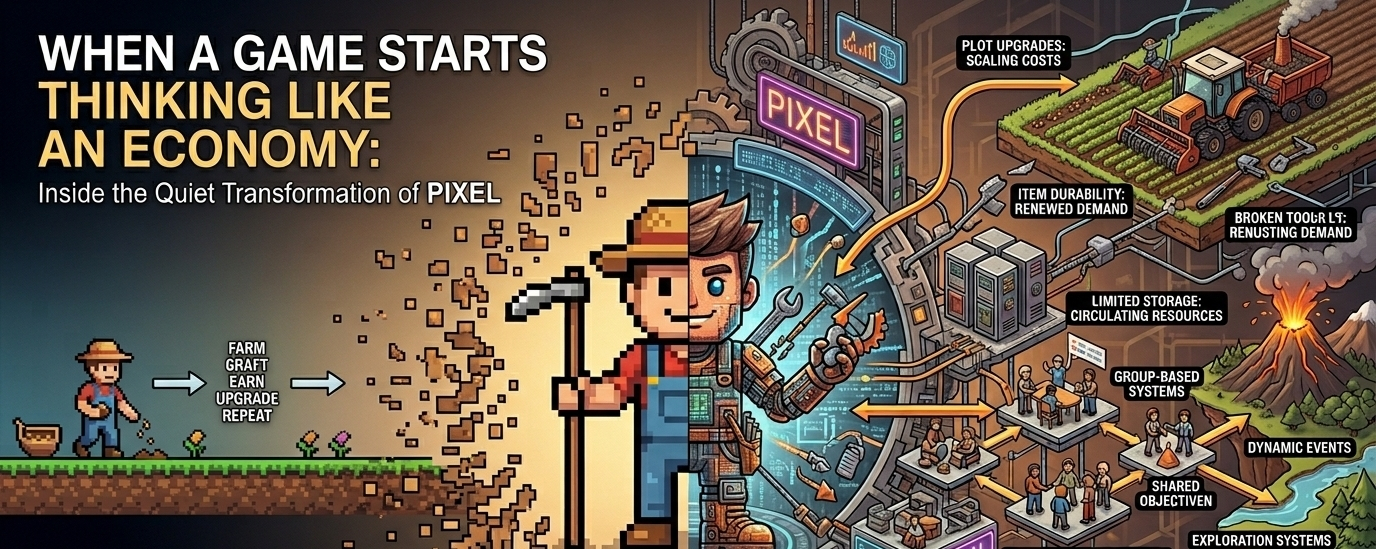
@Pixels I keep coming back to the same uneasy thought every time I spend time observing Pixels more closely. On the surface, it still behaves like a game you already understand. You farm, you craft, you earn, you upgrade, and you repeat. Nothing about that first impression feels revolutionary. But the longer you sit with it, the more that surface begins to crack, and something else starts to show through. It doesn’t feel like the core focus is gameplay anymore. It feels like the real effort is going into shaping an economy that doesn’t collapse under its own weight. And that shift changes how everything inside the system starts to make sense.
What stands out is how deliberately the system seems to be addressing problems that most Web3 games never fully solve. Inflation creeps in quietly when rewards keep flowing but meaningful spending doesn’t exist. At the same time, players often burn out because early progression feels exciting, but the later stages offer very little that feels worth staying for. When those two issues meet, the result is predictable. The economy grows in numbers but loses depth, and the player experience begins to feel empty. Pixels seems aware of that pattern, and instead of ignoring it, it is slowly redesigning itself around it.
That is why even small mechanics feel intentional. Expansion is no longer just about growth for the sake of growth. Systems like plot upgrades introduce scaling costs, which means progression comes with pressure. It creates a subtle tension where players have to think before expanding, rather than simply accumulating. The same applies to crafting changes. Items are no longer permanent anchors in the system. They wear down, they disappear, and that disappearance forces demand to come back. Even storage limitations start to matter more than expected, because they quietly discourage hoarding and keep resources circulating instead of freezing in place. When you step back, all of these changes point toward one consistent direction. The system is being reshaped into a loop that feeds itself rather than one that gets exhausted over time.
What feels different now is that the design is no longer only economic. There is a clear push toward building a social layer that actually matters. Earlier versions of these kinds of games often felt like isolated loops, where every player was running their own race without ever needing others. That isolation slowly drains engagement. Pixels seems to be pushing against that by introducing structures that depend on collective participation. Group-based systems, shared objectives, and faction-style competition begin to change the tone completely. When progress depends on coordination instead of just repetition, the experience naturally becomes more alive. It stops being something you grind alone and starts becoming something you exist inside.
At the same time, there is a noticeable effort to make the world feel less static. Exploration systems, dynamic events, and limited-time activities are not just there for variety. They act as pressure points that pull players back into the system at different moments. They interrupt routine and replace it with movement. Social tools like interaction features, simple communication layers, and referral mechanics quietly strengthen that effect. They do not feel like major innovations on their own, but together they create a sense that the system is trying to keep people connected, not just active.
Another layer that makes this more interesting is how onboarding and accessibility are being handled. Reducing friction at the entry point, especially for users unfamiliar with wallets or blockchain mechanics, suggests a clear intention to move beyond a niche audience. At the same time, introducing smaller transaction layers early on allows players to engage with value without feeling overwhelmed. It creates a gradual entry into the economy instead of forcing it all at once. When you combine that with the presence of both token-based and stable reward structures, it starts to feel like the system is trying to balance volatility with reliability rather than relying entirely on one side.
All of this builds toward something that no longer feels like a simple game loop. It feels like a layered system where economy, behavior, and interaction are being carefully stitched together. That does not mean it is perfect, and it definitely does not mean it is guaranteed to succeed. The biggest uncertainty still sits at the center of everything. Motivation. If players are only staying because rewards are engineered to keep them in place, then the system risks becoming artificial over time. But if the structure becomes natural enough that players engage without constantly thinking about incentives, then something more durable could emerge.
What makes Pixels worth watching is not that it has already solved the problem, but that it is clearly trying to. It is moving away from the easy path of short-term hype and leaning into something slower, more structural, and more complex. And maybe that is where the real shift is happening. The question is no longer whether it looks like a game. The question is whether people will eventually treat it like a living system they return to, not because they have to, but because it fits into how they already behave. That answer is still forming, but the direction is becoming harder to ignore.