
i write this as an internal incident report that slowly stops sounding like one.
At first, everything in PIXELS looks like a performance problem. TPS graphs, latency charts, block finality targets—metrics that behave like they matter more than they actually do in failure postmortems. The early assumption is simple: if the chain is fast enough, nothing breaks.
That assumption never survives contact with reality.
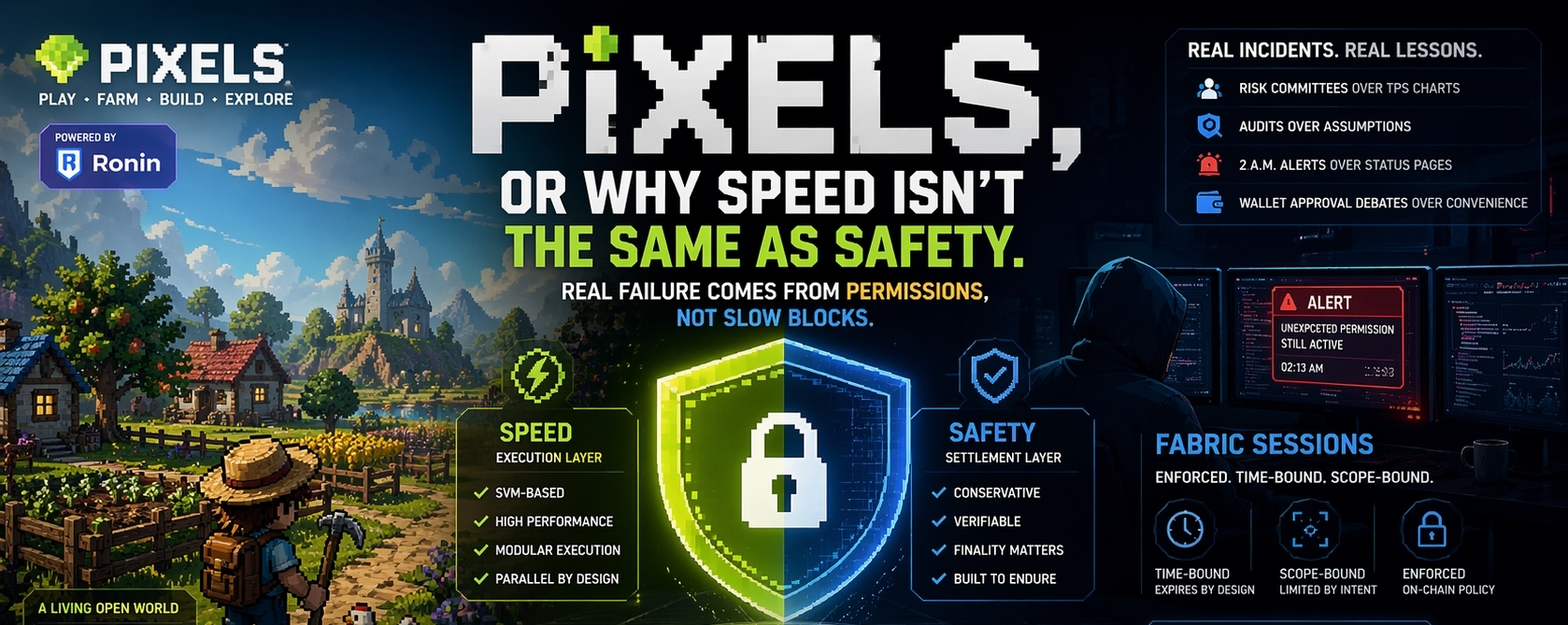
The real incidents don’t start with slow blocks. They start with permission mistakes. Over-broad approvals. Forgotten sessions. A wallet signature that was technically correct, but contextually wrong. That is where the damage lives—outside the TPS narrative entirely.
Risk committees don’t talk about speed. They talk in quieter language. Scope creep. Key exposure radius. Session invalidation windows. They meet in silence, not because there is nothing to say, but because the conclusions are repetitive: most failures are authorization failures, not throughput failures.
Audits confirm it. Overnight runs don’t flag congestion—they flag trust boundaries that were drawn too wide. At 2 a.m., alerts rarely say “network slow.” They say “unexpected permission still active.”
Wallet approval debates, when observed closely, are not UX discussions. They are survival mechanics. Every additional signature is not friction—it is a checkpoint against irreversible state change. And yet, the industry keeps arguing about speed as if it is the primary axis of safety.
PIXELS doesn’t fit that framing cleanly.
As an SVM-based high-performance L1, it treats execution as modular and aggressively parallel, but settlement remains deliberately conservative. That split matters. Execution can be fast. Settlement cannot afford to be wrong.
The architecture pushes complexity outward into controlled surfaces: Fabric Sessions. These are enforced, time-bound, scope-bound delegations. Not open-ended permissions disguised as convenience, but constrained authority that expires by design. It is not trustless. It is trust-bounded with expiration.
“Scoped delegation + fewer signatures is the next wave of on-chain UX.”
That line shows up in internal notes often, not as marketing, but as a warning to design teams: fewer signatures only works if scope becomes stricter, not looser.
The system is modular above the settlement layer, not instead of it. That distinction is where most misunderstandings begin. Execution environments can iterate quickly. Settlement layers must resist emotional urgency. They are not meant to feel fast; they are meant to remain correct under stress.
EVM compatibility exists here, but only as tooling friction reduction—not identity. It is a convenience layer, not a constitutional one. The real system identity is expressed in how permissions decay, not how contracts compile.
PIXELS’ native token behaves less like a speculative object and more like security fuel. Staking is not framed as yield optimization; it is framed as responsibility allocation. Participation is not passive. It is weighted exposure to system correctness.
Over time, the pattern becomes clear: speed is not the differentiator. It never was.
The differentiator is containment.
What can fail, and how far it can spread when it does.
And in that sense, the system stops optimizing for how quickly actions execute—and starts optimizing for how narrowly failure is allowed to travel.
i close this report knowing the conclusion is not technical, but structural.
Fast systems impress.
Safe systems endure.
