
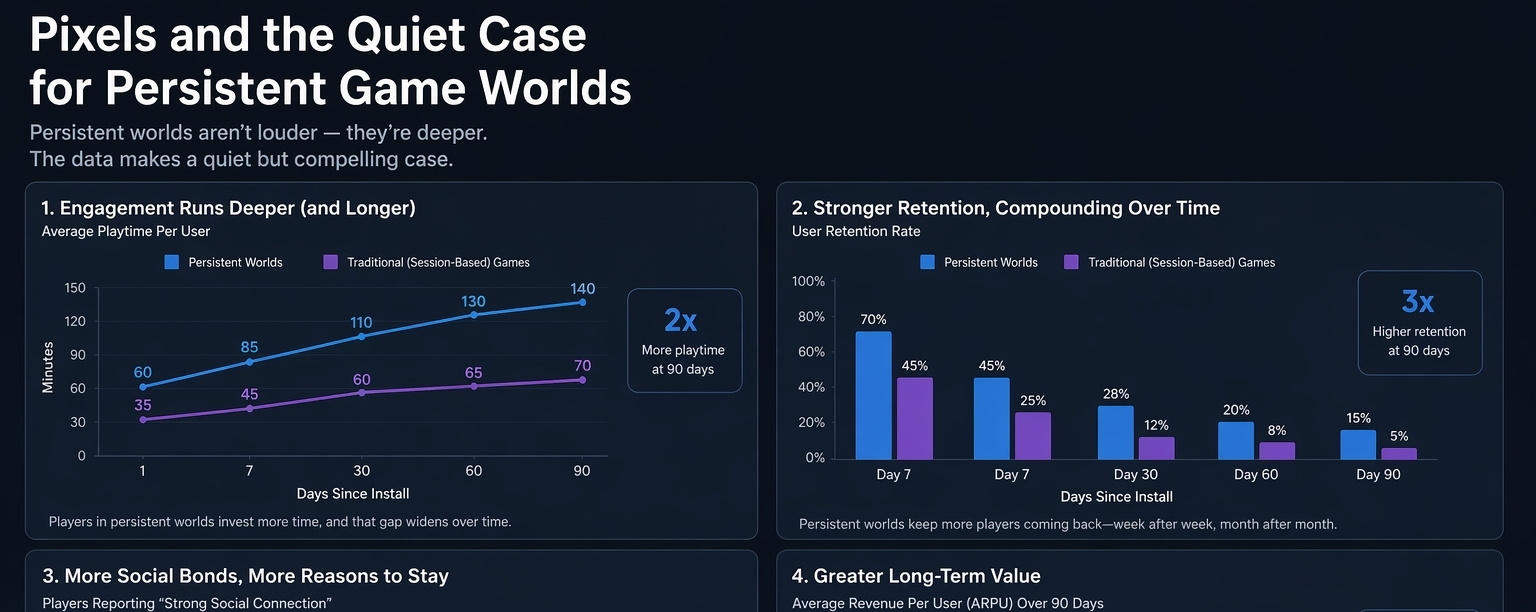
Project Pixels starts from a place that feels less like ambition and more like quiet frustration. Not the loud kind you see in pitch decks, but the slower kind that builds up after spending too much time in digital worlds that don’t really remember you. It’s a social, casual Web3 game running on the , built around farming, exploration, and creation, but those words don’t quite explain why it exists.
It feels like it comes from the simple irritation that most games reset your effort into nothing. You spend hours, sometimes months, building something, learning systems, repeating loops, and then eventually it all just dissolves into the next update, the next season, the next distraction. Pixels seems like it’s trying to slow that down, or at least push back against it a little. Not dramatically, just enough to see if something more persistent can survive.
The world itself is not overwhelming. That’s the first thing that stands out. It doesn’t try too hard to impress. There’s land, there are crops, there are small routines that repeat in a way that feels almost ordinary. You plant something, you come back later, you see the result. It’s a loop that doesn’t demand constant attention, which already puts it slightly out of sync with the rest of the space. Most projects want you engaged all the time. This one seems oddly comfortable with you leaving and returning.
But that calm doesn’t last untouched once people start treating the system like something to optimize.
Because the moment there’s even a hint that time spent might carry value, behavior begins to shift. What feels like a simple farming loop slowly becomes something else. People start calculating instead of experiencing. Efficiency replaces curiosity. Even exploration begins to feel less like wandering and more like searching for advantage. It’s not something the project forces—it’s just what happens when real users interact with systems that might reward them.
That’s where the tension quietly builds.
On one side, Pixels leans into this idea of a persistent space, something that keeps going whether you’re there or not, something that holds onto your actions in small ways. On the other side, it lives inside an ecosystem where persistence often turns into ownership, and ownership rarely stays neutral for long. It becomes priced, traded, compared. And once that happens, the tone of the whole experience starts to shift, even if the mechanics stay the same.
You can feel that it hasn’t fully resolved that contradiction. Maybe it can’t.
There’s still something about it that keeps attention, though. Not because it’s doing something entirely new, but because it’s doing something slower. It doesn’t rush to explain itself. It doesn’t constantly push urgency. In a space where everything is about speed—faster gains, faster growth, faster cycles—that kind of pacing stands out, even if only slightly.
And yet, that same slowness might become its weakness later.
Because when the initial curiosity fades, what remains is repetition. And repetition is where most systems either settle into something meaningful or start to feel empty. Farming can be calming, or it can become mechanical. Social interaction can feel natural, or it can turn into silent competition. Creation can feel expressive, or just decorative. It depends less on the design itself and more on how people choose to exist inside it over time.
That’s the part that no roadmap really answers.
Pixels, like many projects in this space, will eventually face that quieter phase where nothing new is happening on the surface. No major announcements, no sudden waves of attention. Just the same world, the same players, the same routines repeating. That’s when the truth usually shows up. Not in the early excitement, but in the long stretches where a system has to justify itself without noise.
Right now, it feels like it’s still somewhere in between. Not early enough to be just an idea, not mature enough to prove its staying power. Just existing, slowly collecting behavior, letting people shape it in ways that aren’t always predictable.
Maybe that’s why it feels more human than most projects around it. Not because it’s perfect, but because it hasn’t fully decided what it wants to be yet. It carries that uncertainty in a way that feels familiar. Like something still figuring itself out while being used at the same time.
And in this space, that kind of uncertainty usually tells you more than confidence ever does.