

Written by: Jaka Kotnik, CMO
The agent stack is finally starting to make sense.
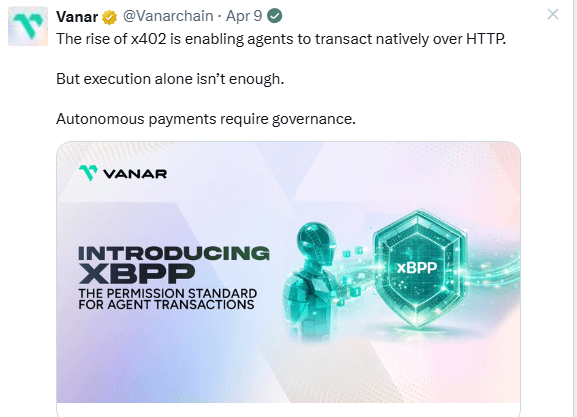
Agents are no longer just generating outputs. They are starting to act. Payment protocols like x402 now let agents transact natively, paying per request, per call, per outcome. As @0xSammy pointed out, this turns execution into a market, where agents discover services, call endpoints, and settle value without human friction. Frameworks like xBPP are emerging alongside to answer a deeper question. Not just how an agent pays, but whether it should. Decision-making is moving closer to the transaction layer.
https://x.com/Vanarchain/status/2042233393086103572
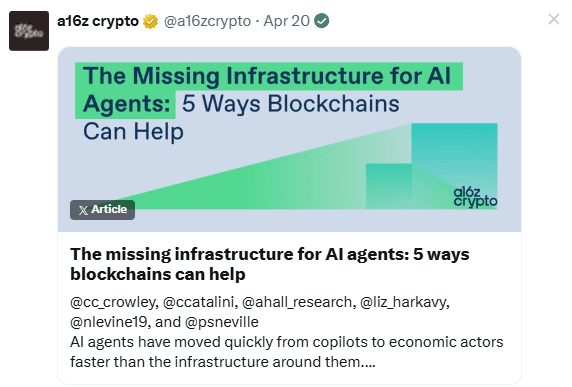
This tracks with what @a16zcrypto laid out in their recent piece on agent infrastructure. Agents are becoming economic actors, but still lack standardized identity, permissions, and coordination across environments. That layer is being built now, with wallets, programmable payments, and verifiable execution forming the foundation. Add control systems like AgentVault, and the full stack comes into view. Agents that can act, pay, and operate within defined boundaries.
https://x.com/a16zcrypto/status/2046243550715945367
Step back, though, and an uncomfortable question sits underneath all of it.
What happens after the transaction?
Right now, your agent can discover a service, decide to use it, pay for it, execute a task, and return an answer. The stack works. But the moment that task is done, the system forgets. The next request starts from raw data again. Same inputs, same noise, same inefficiencies. You would not trust a trader, an operator, or an analyst who resets after every action, yet that is exactly how most agents behave today.
The gap is not in execution, payments, or permissions. It’s in the intelligence layer.
Khala Research recently highlighted that many AI failures are not caused by weak reasoning, but by poor routing and data access. Models often choose the wrong source or fail to use the right tools, even when the correct data exists. But even when routing improves, the underlying issue remains. Agents are still working on fragmented, stateless data, where every interaction is disconnected from the next. Nothing compounds. Nothing improves. The system never gets better over time.
https://x.com/KhalaResearch/status/2044042270337331631

Inflectiv builds that layer. Messy real-world inputs are transformed into structured datasets that agents query and update through API. Agents don’t just read data.
They write back into it.
Every interaction adds structure, context, and signal to the dataset. The next run starts from a better state than the last. Market data gets cleaner as signals are refined. User data gets more useful as segmentation evolves. Research accumulates context instead of starting from scratch. Isolated transactions become systems that compound.
https://x.com/inflectivAI/status/2041844008721211697

This is how the layers fit together. AgentVault enforces control. Inflectiv ensures every action feeds back into a dataset that gets better with use. Without that last layer, agents can act but they cannot compound. With it, every action contributes to a system that improves.
The current conversation is focused on enabling agents to act. That is necessary. But the next phase will be defined by enabling agents to compound. The difference between a useful agent and a valuable system is not how many actions it can take, but whether those actions make the system better over time.
Agents can now pay.
They can decide.
They can execute.
The next step is making sure they learn, because now they actually can.
The intelligence layer is live at app.inflectiv.ai. Every query makes it better.