

Most games I’ve played follow the same pattern.
They try to keep me inside as long as possible.
More time usually means more progress, more rewards, more output. It’s a simple structure, and after a while, it becomes easy to recognize. You log in expecting to stay, to optimize, to make every minute count.
#pixel didn’t feel like that to me.
When I started spending time in it, there was no real pressure to stay longer than necessary. I could log in, do a few things, and leave without feeling like I was missing out. Nothing was pushing me to maximize every action.
At first, I assumed that was just part of the simplicity.
But after a while, I noticed something else.
Even without that pressure… I kept coming back.
Not urgently. Not because I had to.
Just consistently.
That’s when I started looking at it differently.
In most systems, engagement is about how long I stay in a single session. The longer I stay, the more “engaged” I am supposed to be. But I’ve also seen how that usually ends. Players optimize quickly, extract what they can, and eventually leave once everything becomes predictable.
I’ve done that myself in other games.
Here, my behavior didn’t follow that pattern.
I wasn’t staying longer.
I wasn’t pushing harder.
But I wasn’t leaving either.
That’s where it started to feel different for me.
Instead of trying to maximize my time today, the system seemed to naturally pull me back tomorrow.
Not in an obvious way.
Nothing felt forced.
But over time, I realized I had built a rhythm.
I log in.
I do what makes sense.
I leave.
And then I come back again.
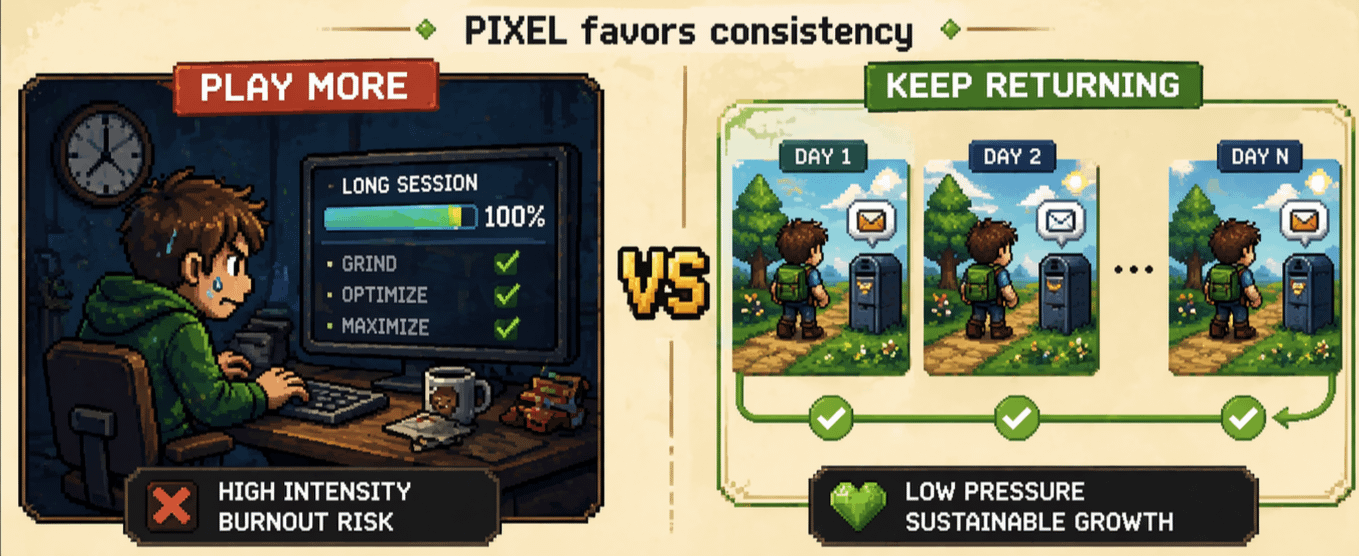
(“I log in… I come back again.”)
After noticing that pattern, the whole structure started to look different.
If a system isn’t trying to keep me inside for as long as possible, then what is it actually optimizing for?
The answer, at least from my experience, feels like retention.
Not how much I do in one session,
but whether I return consistently over time.
That changes how I interact with it.
I’m not thinking about squeezing maximum value out of every action. I’m not trying to solve the system as quickly as possible. Instead, I’m moving at a pace that feels sustainable, even if it’s not perfectly efficient.
And that’s unusual for anything tied to rewards.
Because normally, the moment value is introduced, behavior shifts toward optimization. I’ve seen that happen across almost every system.
But here, that pressure feels… delayed.
I’m not saying it doesn’t exist.
Over time, players will always try to optimize. That’s natural. But right now, the structure feels like it’s designed to slow that process down, or at least spread it out.
Instead of forcing convergence into one optimal path, it allows different approaches to exist at the same time.
And because of that, I don’t feel the same urgency to “figure it out” immediately.
When I think about the $PIXEL token in that context, it also starts to make more sense.
It doesn’t just reward output.
It depends on whether players like me keep showing up.
If I stop coming back, the system weakens.
If I stay, even at a moderate pace, it holds.
That’s a different kind of balance.
Not based on intensity,
but on continuity.
I’m still watching how this evolves.
Because systems like this don’t prove themselves early. They need time. They need consistent behavior. And they need to hold that balance between incentive and experience without breaking it.
But from where I’m standing, it doesn’t feel like it’s trying to take more of my time.
It just makes it easier for me to return.
And if that continues… @Pixels
then the real loop isn’t about how long I play.
It’s about why I come back.