
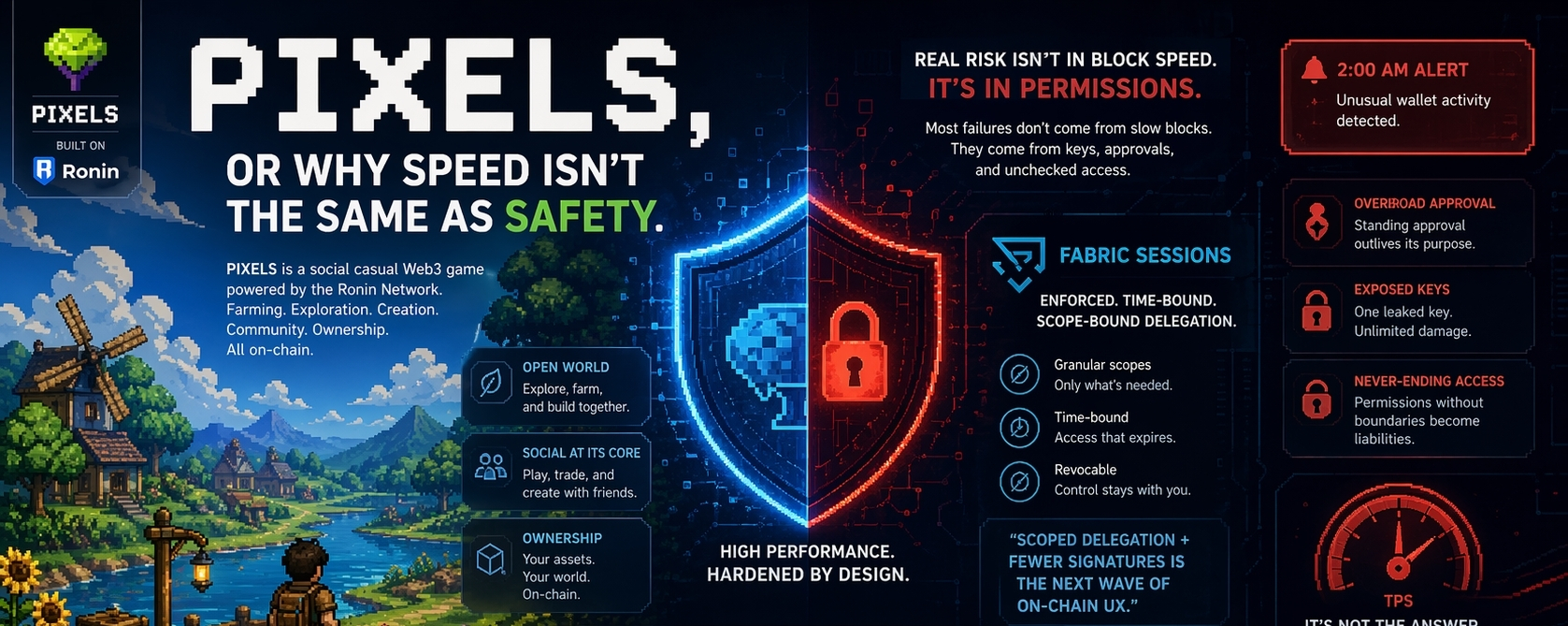
I’m writing this the way we log incidents—plain, timestamped in my head, stripped of hype. The dashboards were green. Throughput targets were met. Blocks were fast, finality was acceptable, user growth was clean. And yet, the alerts that matter rarely come from speed metrics. They come at 2 a.m., when a wallet signs something it shouldn’t, when a permission lingers longer than anyone remembers granting it, when a “harmless” approval becomes a quiet liability.
PIXELS doesn’t look like a system under strain. It’s a social, casual Web3 game—farming loops, exploration arcs, creation mechanics. It feels light. That’s precisely why it’s dangerous to think about it lightly. Systems like this don’t fail loudly. They degrade through trust surfaces—through keys, signatures, and assumptions.
In the early reviews, the conversation drifted—as it always does—toward TPS. How fast can it go? How many actions per second can it process when the map is full and inventories are moving and land is being modified in real time? I’ve sat in those meetings. The charts are impressive. The room nods. But speed isn’t where the real incidents begin.
They begin with permissions.
I’ve seen postmortems where the root cause wasn’t congestion or latency. It was a standing approval that outlived its context. A private key reused across environments. A session that never expired because expiring it felt like friction. We don’t like friction. Users don’t like friction. Product doesn’t like friction. But friction is often the last visible sign that something is being constrained for a reason.
PIXELS runs on a high-performance, SVM-based L1, designed to keep interactions fluid. That part works. The system is capable. But what caught my attention wasn’t the execution speed—it was the guardrails wrapped around it.
Fabric Sessions.
Not as a feature. As a control surface.
They enforce delegation that is time-bound and scope-bound. Not “sign once and trust forever,” but “sign for this, for now, and nothing else.” In incident terms, that changes the blast radius. If a session key leaks, it expires. If it’s misused, it’s constrained. The system assumes compromise is possible and designs the damage to be small.
I’ve sat through wallet approval debates where the question wasn’t “is this secure?” but “is this tolerable?” How many pop-ups before a user abandons the flow? How many signatures before they stop reading? The uncomfortable truth is that more signatures don’t necessarily mean more safety. They often mean more fatigue—and fatigue is where bad approvals slip through.
“Scoped delegation + fewer signatures is the next wave of on-chain UX.”
I didn’t believe that the first time I heard it. It sounded like a trade-off. Now it reads like a correction. The goal isn’t to make users approve more—it’s to make each approval mean less in isolation. Limit what it can do. Limit how long it lasts. Accept that keys are fallible and design accordingly.
Underneath, PIXELS separates execution from settlement in a way that feels deliberately conservative. High-frequency actions live in a modular execution layer—fast, responsive, built for interaction. But the finality anchor, the place where state becomes durable, is slower by design. That separation matters. It means you can optimize for experience without compromising the integrity of what ultimately gets recorded.
There’s been some mention of EVM compatibility, mostly framed as a convenience. That’s the right framing. It reduces tooling friction. It doesn’t define the system. Compatibility is a bridge, not a foundation.
What matters more is how the system treats responsibility.
The native token shows up once in the model, and it’s not as a speculative centerpiece. It’s security fuel. It underwrites the network, aligns incentives, and, through staking, asks participants to take on risk in exchange for trust. Staking isn’t passive yield in this framing—it’s accountability. You’re not just earning; you’re standing behind the system’s behavior.
I keep coming back to the alerts. Not the ones we celebrate—the throughput spikes, the user peaks—but the ones that wake people up. Unauthorized approvals. Suspicious contract calls. Keys behaving in ways they shouldn’t. Those are the signals that tell you whether a system understands its own risk.
PIXELS, for all its color and ease, seems to take those signals seriously. It doesn’t pretend that speed will save it. It assumes the opposite—that speed amplifies mistakes if left unchecked. So it narrows permissions. It expires trust. It separates what can be fast from what must be final.
In the incident logs, the difference between a scare and a breach is often a single constraint that held when everything else failed.
Speed helps you move.
Safety decides whether you should have moved at all.
