
For the longest time, I never really questioned how free-to-play systems work. The pattern is familiar: you start out with freedom, progress feels smooth, and then eventually things slow down. Rewards shrink, time stretches, and suddenly spending money feels like the logical next step. It’s a formula most players recognize.
But Pixels doesn’t follow that script—at least not on the surface.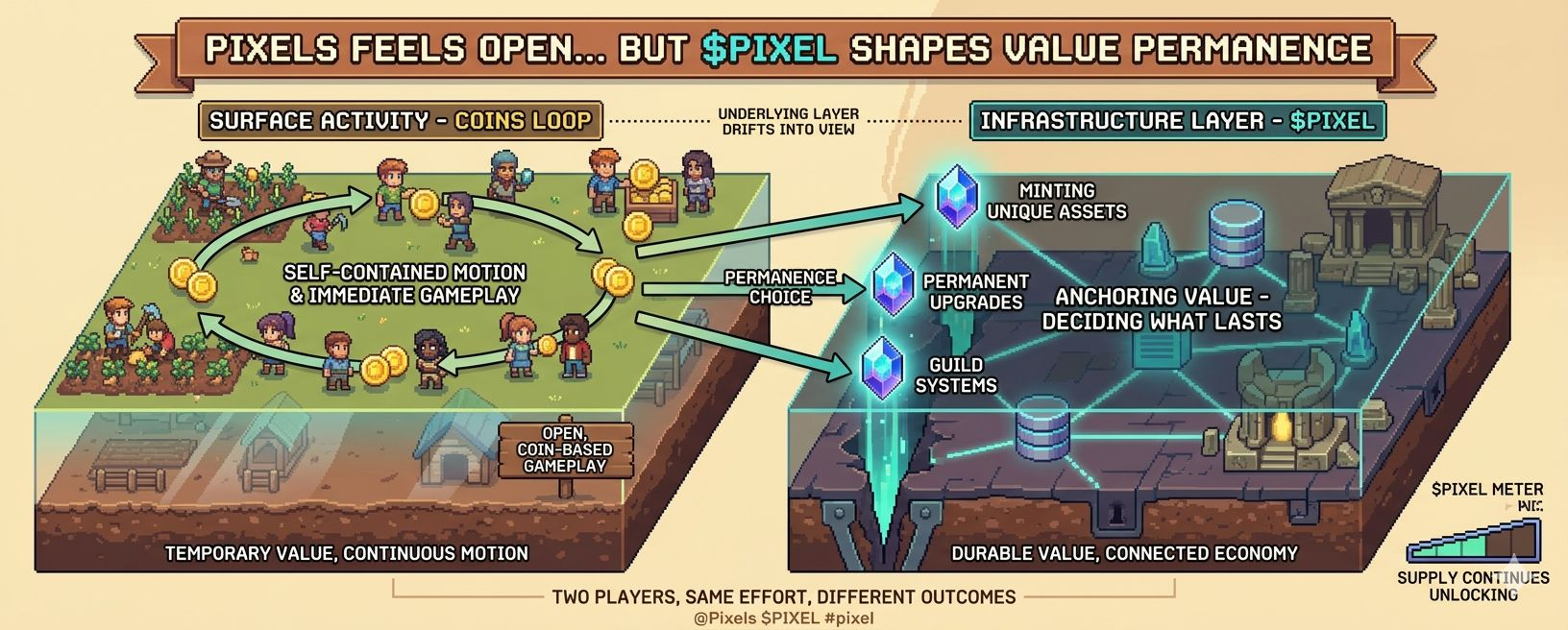
You can spend hours in the game without ever touching $PIXEL. You farm, trade, loop through activities, and everything seems to function just fine using Coins. It feels self-sufficient, almost too comfortable. Nothing is pushing you toward the premium layer, and that’s what makes it different… and a bit intriguing.
After a while, though, something starts to feel slightly off.
The effort you put in doesn’t always match what you get to keep.
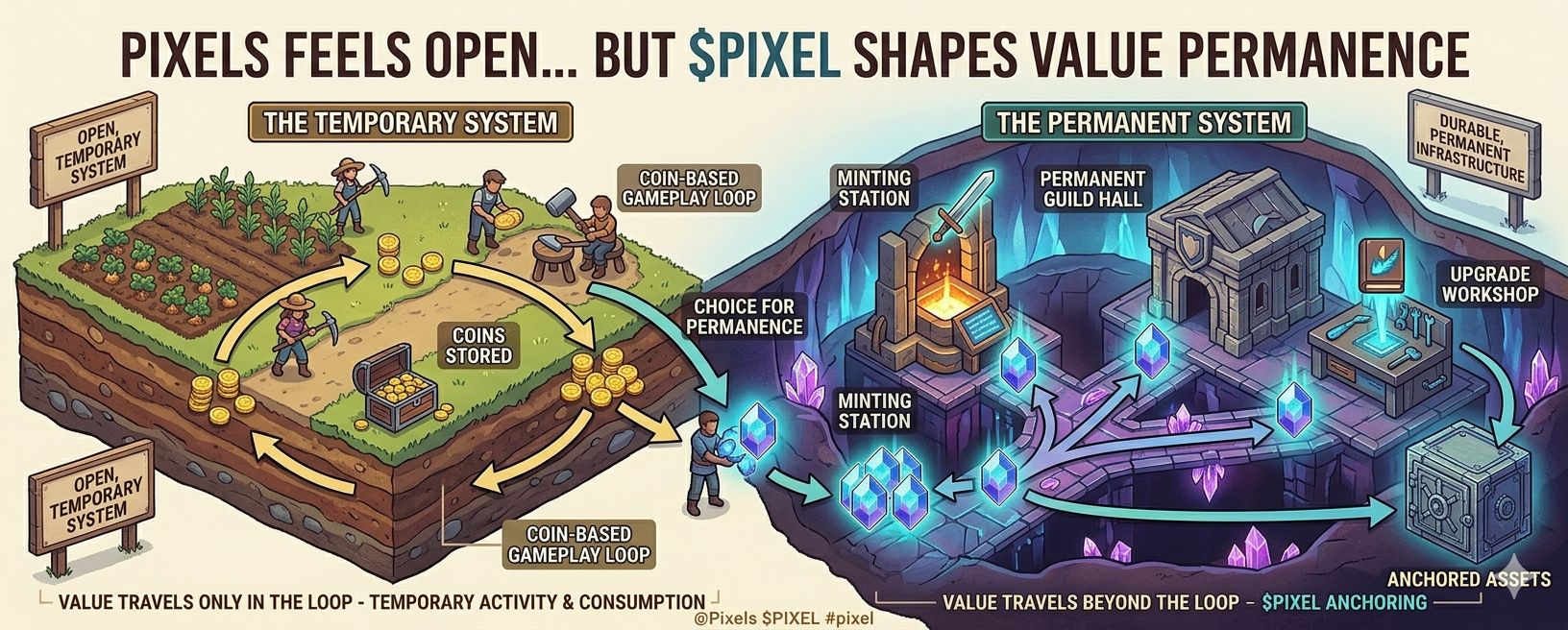
Coins dominate the visible economy. You earn them, spend them, and keep moving. But they don’t really hold long-term weight. They exist in the moment—useful, but temporary. They don’t travel beyond the loop. And that’s when pixel starts to stand out.
It’s not everywhere. In fact, it’s mostly absent from the areas where players spend most of their time. Instead, it appears in specific, almost strategic places—minting, upgrades, guild systems—points where progress becomes more permanent or connected to something bigger.
That’s when it clicked for me: this isn’t about paying to move faster. It’s about deciding what actually lasts.
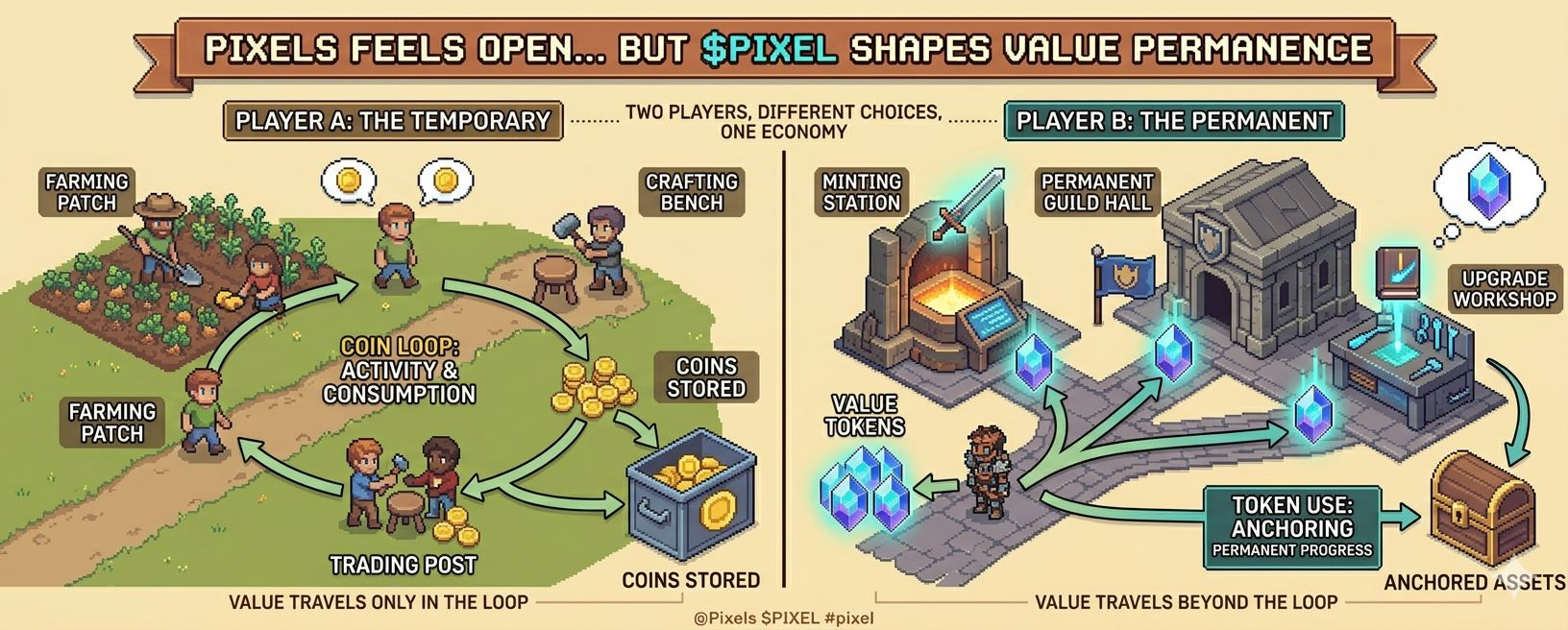
Two players can invest the same amount of time. One stays entirely within the Coin loop, staying active but contained. The other occasionally steps into $PIXEL—not constantly, just enough to anchor their progress into something more durable.
At first, the difference is barely noticeable. But over time, it grows.
It actually reminds me of how some systems separate activity from final outcomes. You can have a lot happening on the surface, but only certain actions truly stick. In Pixels, most gameplay feels like motion—while $PIXEL feels closer to permanence.
What makes this design interesting is how subtle it is.
There’s no pressure. No early friction. You can ignore $PIXEL for a long time and still enjoy the game. That’s unusual, especially when most games make the premium layer obvious almost immediately.
Here, the gap doesn’t hit you—it slowly drifts into view.
The real question is whether players will notice.
Most people don’t think in systems or layers when they play. They just respond to what’s in front of them. If the distinction between Coins and pixel remains too abstract, a large portion of players might never engage with that deeper layer at all.
And if that happens, the token risks becoming disconnected—existing in the ecosystem, but not fully integrated into everyday gameplay behavior.
There’s also the reality of supply. Tokens continue to unlock and circulate regardless of how players interact. If the use cases for pixel don’t expand at the same pace, pressure builds elsewhere. That imbalance has affected other ecosystems before.
Still, there’s something undeniably compelling here.
If Pixels continues to grow—especially beyond a single gameplay loop—this layered system could become more meaningful. Coins handle the present. Pixel could evolve into something that links different parts of the ecosystem together, carrying value forward.
That’s where things start to shift.
It stops being just a game economy and begins to feel more like infrastructure.
But there’s also a subtle tension in that idea. If most players remain in the visible loop while value quietly accumulates in another layer, then the system isn’t entirely neutral. It’s selective—not through obvious paywalls, but through what it chooses to preserve.
Whether that’s intentional or simply how the system evolved is hard to say.
What’s clear is this: Pixels doesn’t force you to see any of this. You can play for a long time without questioning it.
And maybe that’s exactly why it works.
On the surface, it feels like a free and open system.
But underneath, it’s structured in layers.
And depending on where you spend your time, the same effort might not mean the same thing.