
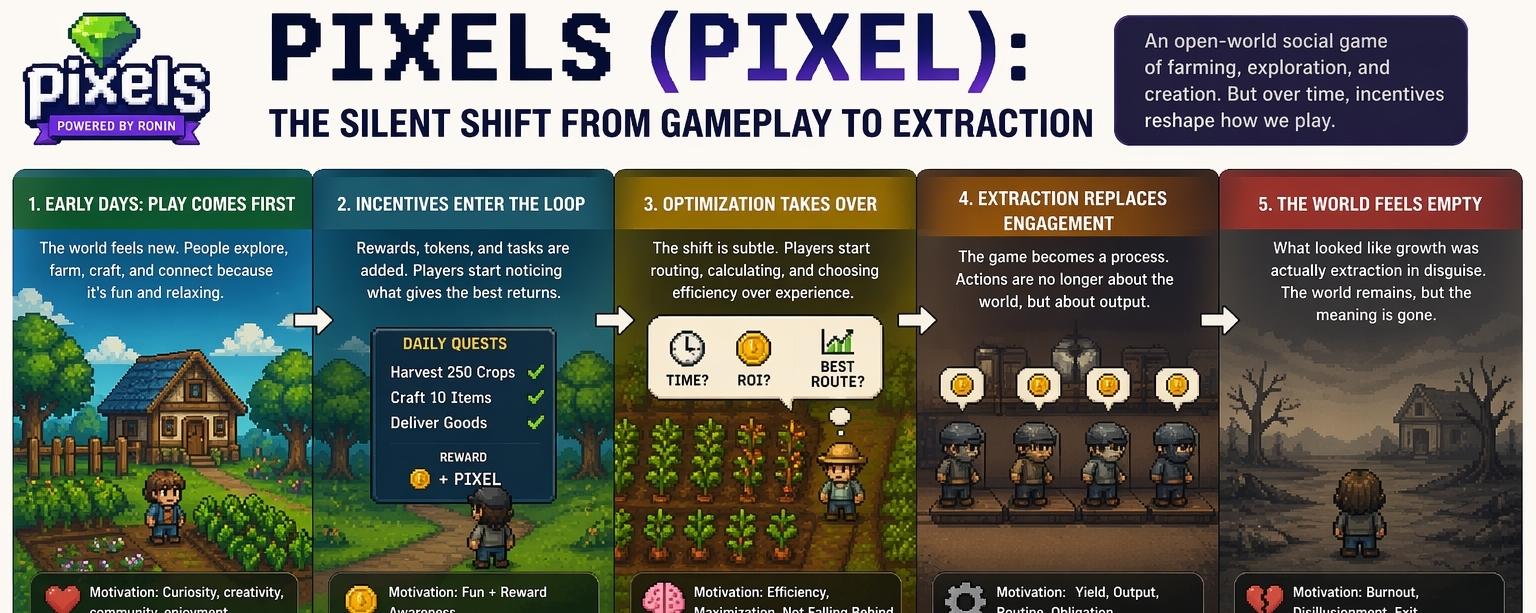
I’ve noticed something shifting in the way people move through Web3 games, and it didn’t arrive as a loud change. It was quiet, almost easy to miss at first, like watching a familiar place slowly adjust its lighting without telling anyone. When I first spent time around Pixels, it felt like what most open-world farming and creation games promise at the beginning: a loose rhythm of exploration, simple tasks, and the comfort of building something over time. But what stood out to me wasn’t the game itself changing overnight, it was how the behavior inside it started to bend around the idea of reward.
PIXELS At first, everything still looked like engagement. Players were farming, crafting, moving through spaces that felt alive in a casual way. There was repetition, but it didn’t feel heavy yet. The shift was subtle. Over time, I started to notice that actions weren’t always being chosen because they were interesting or satisfying. They were being chosen because they were efficient. That’s usually the first quiet signal that something deeper is changing in a system like this.
What looked like natural gameplay slowly started to feel structured by expectation. People weren’t just exploring; they were routing. They weren’t just building; they were optimizing. And it wasn’t that anyone explicitly decided to play differently. The environment itself was teaching them to do it. Incentives have a way of rewriting attention without asking for permission.
The more I watched, the clearer the pattern became. In systems like Pixels, where farming, exploration, and creation are layered with reward structures, the reward doesn’t just sit beside the gameplay. It starts to sit inside it. And once that happens, every action quietly develops a second meaning. A simple interaction becomes a calculation. A moment of play becomes a potential return. Even silence in the game begins to feel like missed opportunity.
What struck me most wasn’t the presence of rewards, but how quickly they began to distort the emotional shape of engagement. The game still looked the same on the surface, but the motivation underneath it had shifted direction. Instead of asking “what do I want to do here?”, the unspoken question became “what should I be doing here to not fall behind?”
And that’s where something interesting happens in these ecosystems. The system doesn’t break loudly. It doesn’t collapse in a visible moment. It slowly transitions from being a space of interaction into a space of extraction. Players start to treat it less like a world and more like a process. The world remains intact visually, but behaviorally it begins to flatten.
I kept thinking about PIXELS how this kind of shift rarely feels dramatic while it’s happening. There’s no clear moment where engagement turns into optimization. It just becomes normal to check efficiency first and experience second. And once that becomes normal, it’s hard to even remember what the earlier version felt like.
Underneath all of it, what interested me most was how design and behavior start to mirror each other over time. The system responds to what players chase, and players respond to what the system rewards. It becomes a loop that quietly reinforces itself. And in that loop, even creativity can slowly get pulled toward repetition if repetition is what pays.
There were moments when the world still felt alive, especially when people were just interacting without thinking too far ahead. But those moments started to feel less frequent, or maybe just less visible under the weight of optimization patterns. The more I observed, the more I realized that engagement doesn’t disappear in these systems, it just gets redistributed. A portion of it stays playful, and a portion of it gets absorbed into efficiency thinking.
What also stood out to me was how easily extraction-based behavior can be mistaken for growth. More activity, more movement, more participation on the surface. But underneath, the intent behind those actions can shift away from curiosity and toward return. And when that happens across enough participants, the ecosystem doesn’t feel richer in experience, only busier in motion.
It started to feel like PIXELS the game was no longer just hosting players, but also quietly training them to interpret value in a very specific way. Not through exploration, but through output. Not through discovery, but through yield. And once that framing settles in, it becomes difficult to unsee it.
Still, none of this happens in a dramatic collapse. That’s what makes it harder to point to. Everything continues functioning. The world still exists. Players still log in. Actions still happen. But the meaning behind those actions keeps drifting, almost imperceptibly, until you realize you’re no longer watching people play in the same way they started.
At some point, I stopped looking for changes in the environment and started paying more attention to changes in intention. That’s where the real transformation sits. Not in what the game shows, but in what it slowly teaches people to prioritize without telling them directly.
And maybe that’s PIXELS what stayed with me the most. The idea that systems like this don’t need to break to change fundamentally. They only need to guide attention long enough for behavior to reframe itself. After that, everything looks familiar, but it no longer feels the same.