
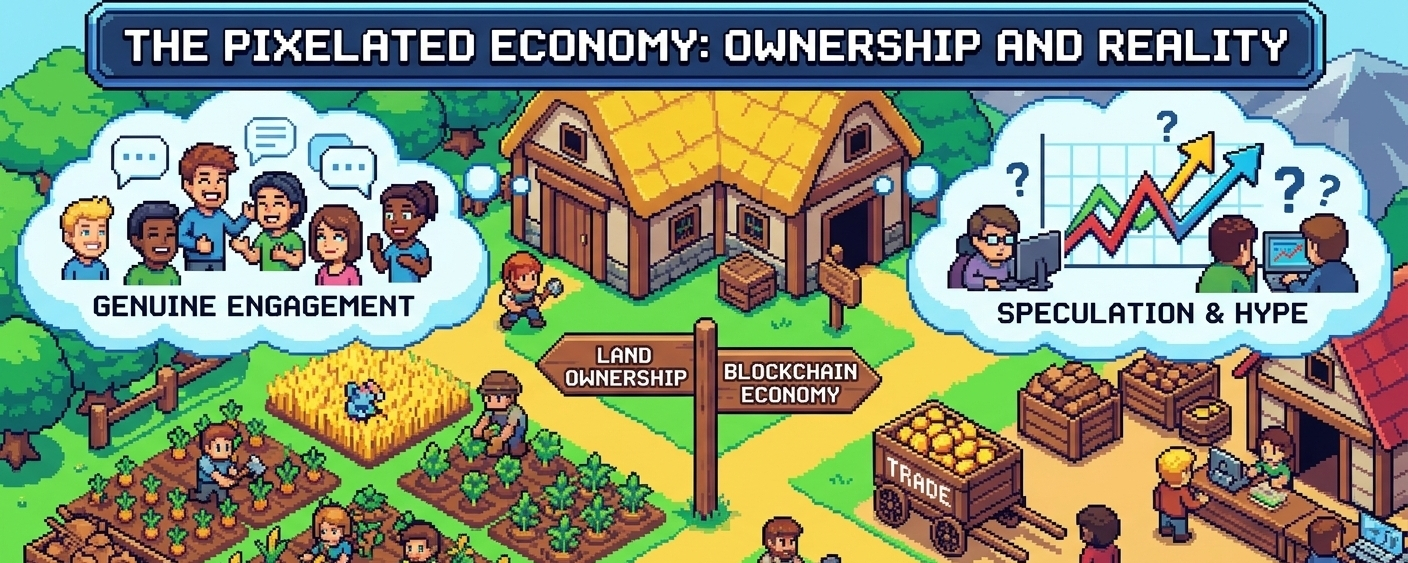
I wasn’t looking for anything in particular when I stumbled across Pixels. It felt more like one of those accidental discoveries you make late at night, when curiosity quietly replaces intention. At first glance, it looked simple—almost too simple. Bright, pixelated farmland, tiny characters moving around, crops growing in neat little grids. It reminded me of the kind of games I used to play without thinking too much about them. But then I paused. This wasn’t just a game… it was something else layered underneath.
I started digging, slowly, the way I usually do when something feels deceptively straightforward. Pixels isn’t just about farming or collecting resources—it’s built on blockchain, which immediately changes the way I look at it. Ownership becomes real, not just a line of code locked inside a company’s server. The land, the items, the progress—it all belongs to the player in a way that traditional games never really allowed.
At that point, I found myself asking a simple question: does that actually matter to most players? Or is it just something that sounds exciting on paper?
As I explored more, I noticed how the game leans heavily into community and economy. Players aren’t just playing; they’re participating. There’s a loop here—grow, gather, trade, expand—and it mirrors real-world systems in a simplified way. It’s almost like a digital village economy, where everyone contributes something and extracts value in return. That idea stuck with me. It’s familiar, yet strangely experimental.
What intrigued me most wasn’t the mechanics themselves, but the psychology behind it. There’s something powerful about giving players a sense of ownership. When people feel like they actually own something, their behavior changes. They invest more time, more attention, sometimes even more money. It’s no longer just entertainment—it becomes participation in a system.
But then again, I couldn’t ignore the bigger picture. I’ve seen this pattern before in crypto. A new project emerges, it combines something familiar—like gaming—with blockchain, and suddenly there’s a wave of excitement. People rush in, not always because they love the product, but because they’re hoping to be early. That early energy can build momentum, but it can also distort reality.
So I kept wondering: how much of Pixels’ growth is driven by genuine engagement, and how much is fueled by speculation?
The game itself feels intentionally simple, almost minimalistic. That might actually be its strength. It lowers the barrier to entry. You don’t need to be a hardcore gamer or a blockchain expert to understand what’s going on. You just start playing. And maybe that’s the real hook—accessibility. In a space that often feels overly complicated, Pixels takes a step back and says, “Just come in and try it.”
Still, simplicity can be a double-edged sword. It draws people in, but it also raises expectations. If players stay, it won’t be because of novelty alone. They’ll need depth, progression, and a reason to keep coming back beyond earning tokens or trading assets.
That’s where the long-term question starts to form in my mind. Can a project like this sustain itself when the hype fades? Because it always does. Markets move in cycles—excitement, saturation, decline, and then sometimes, reinvention. I’ve watched enough projects rise and fall to know that initial success doesn’t guarantee longevity.
And yet, there’s something quietly compelling about Pixels. It doesn’t try too hard to impress. It doesn’t overwhelm with complexity. It just exists, inviting people to participate in its little world. Maybe that’s why it’s gaining traction—it feels approachable in a space that often feels intimidating.
I also found myself thinking about the broader idea of “play-to-earn” and how it has evolved. Early versions felt forced, almost like financial systems disguised as games. Players were grinding, not playing. But Pixels seems to be leaning more toward “play-and-earn,” where the game comes first and the earning is secondary. That subtle shift might actually matter more than it seems.
Of course, challenges are inevitable. Balancing an in-game economy is never easy, especially when real value is involved. Too much inflation, and rewards lose meaning. Too little, and players lose interest. Add to that the unpredictability of crypto markets, and suddenly the entire ecosystem feels fragile.
So I kept circling back to my initial curiosity. What makes this special?
Maybe it’s not just one thing. Maybe it’s the combination—a familiar game structure, layered with ownership, wrapped in a social economy, and placed inside a rapidly evolving market. It’s not revolutionary in any single aspect, but together, it creates something that feels… different.
As I stepped back from it all, I realized I wasn’t entirely sure what to think. Part of me sees potential—a glimpse of how gaming and digital ownership could merge into something meaningful. Another part of me sees risk—the same patterns that have played out countless times before in this space.
And maybe that’s the most honest place to land. Somewhere between excitement and skepticism.
Because in the end, I can’t help but wonder—am I looking at the early stages of a new kind of digital world quietly taking shape, or just another well-designed experiment riding the ever-repeating wave of crypto curiosity?
