
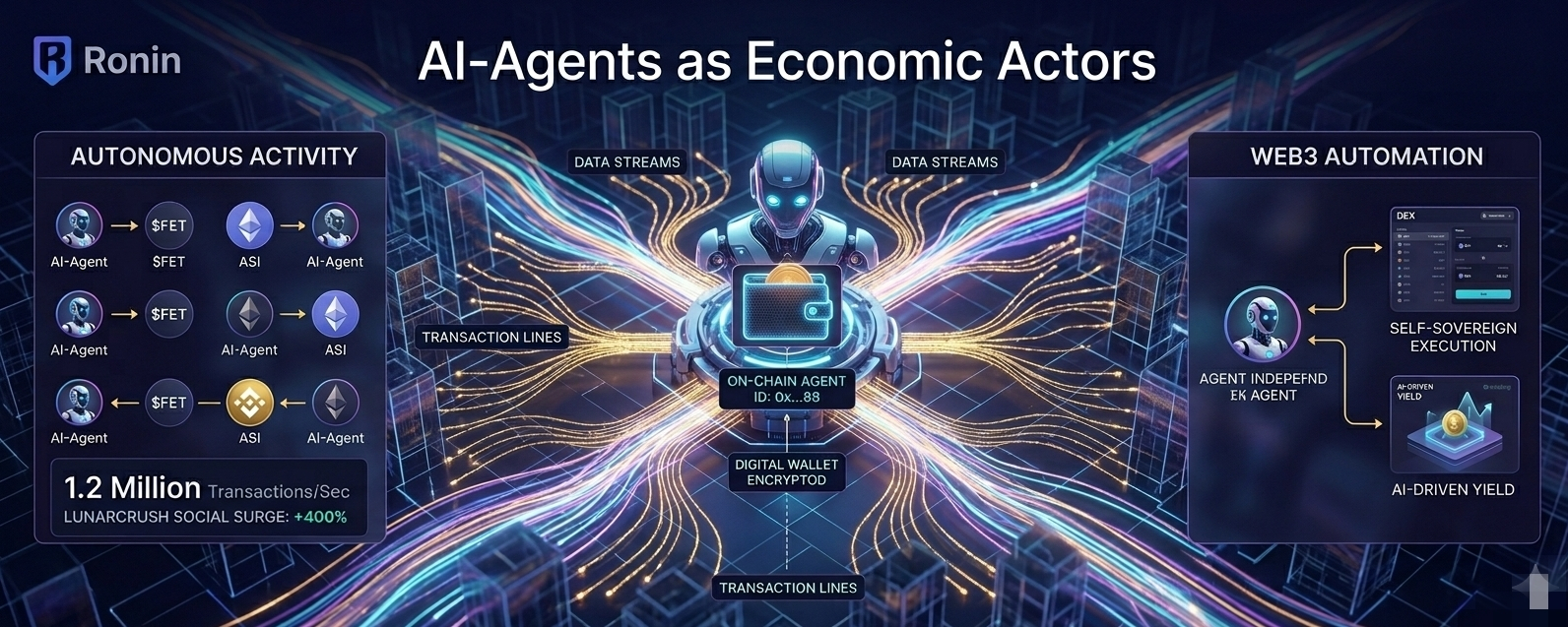
For years, the intersection of AI and Blockchain was viewed as a speculative "narrative." However, as we move through the second quarter of 2026, a paradigm shift has occurred. AI is no longer just something we talk about on-chain; it has become a literal user of the blockchain. Autonomous AI Agents software entities capable of making independent economic decisions and executing transactions via on-chain wallets are now responsible for a staggering portion of total network activity.
The LunarCrush Signal: Social Interest Meets On-Chain Reality
Recent data from LunarCrush indicates a massive spike in social engagement and "Social Intelligence" metrics regarding AI-Agent protocols. Unlike previous hype cycles, this interest is backed by a vertical climb in Automated Transaction Volumes.
Protocol Dominance: Projects like Fetch.ai ($FET) and Virtuals have seen their ecosystem activity triple in the last 90 days.
The "Invisible" User: Unlike retail traders who follow emotions, AI Agents operate 24/7, executing thousands of micro-transactions per second based on logic, arbitrage, and resource allocation.
Economic Autonomy: These agents are now earning, spending, and staking assets independently to fulfill their programmed objectives, creating a self-sustaining Autonomous Economy.
How AI Agents Use the Blockchain as a "Digital Nervous System"
In 2026, the blockchain has become the primary infrastructure for AI agents because it provides three essential elements that traditional banking cannot:
On-Chain Wallets (Self-Sovereignty): AI Agents can hold their own private keys. This allows them to pay for their own API calls, server costs, and data sets without human intervention.
Permissionless Settlement: An agent in Europe can settle a micro-payment with an agent in Asia in seconds, bypasssing the legacy 3-day banking settlement period.
Smart Contract Governance: Agent protocols use smart contracts as "laws" to ensure that agents cooperate or compete within defined ethical and economic boundaries.
The Major Players: ($FET )and the Web3 Automation Wave
The market is currently consolidating around the most robust agentic frameworks:
Fetch.ai ($FET) / ASI Alliance: As the cornerstone of the AI Superintelligence Alliance, Fetch.ai has transitioned from a development toolkit into a massive network of "uAgents" that handle everything from supply chain logistics to automated DeFi yield farming.
Web3 Automation: We are seeing the rise of "Intent-Centric" blockchains where users simply state a goal (e.g., "Find the best yield for $500 with 5% risk"), and AI Agents execute the complex multi-step transactions across several bridges and DEXs.
Why Transaction Volume is Exploding
The reason 2026 is seeing record-breaking volumes is simple: Agents don't sleep.
While a human might make 5-10 trades a day, a single AI-Agent cluster can execute 10,000+ transactions in the same timeframe to optimize a single liquidity pool. This high-frequency, logic-driven activity is creating a massive "fee-burn" for networks like Ethereum (L2s), Solana, and specialized AI chains, significantly increasing the value of the underlying gas tokens.
Conclusion and Market Outlook
The "Autonomous Economy" is the final stage of Web3’s evolution. By late 2026, analysts predict that over 60% of all on-chain transactions will be initiated by non-human actors. For investors, the focus has shifted from "Which AI project has the best marketing?" to "Which AI protocol has the most active agents?"
Are you ready to share the blockchain with millions of autonomous agents? Is the rise of ($FET) and AI-Agents the beginning of the end for manual trading? Share your perspective in the comments and follow for more insights into the machine-driven future of finance.
#BinanceSquare #AIAgents #AutonomousEconomy #Web3Automation #BlockchainRevolution $FET
