
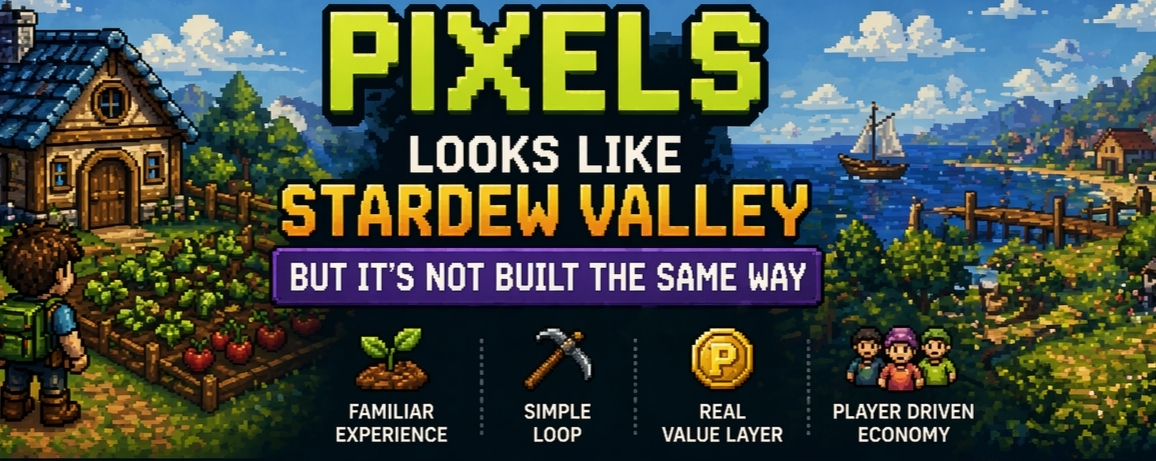

At a glance, Pixels feels familiar.
The visuals are calm.
The loop is simple.
You plant, harvest, craft, and return later.
If you’ve ever played Stardew Valley, it’s hard not to see the resemblance. That same relaxed rhythm, the same low-pressure environment, the same sense that you can play at your own pace without being forced into anything.
That’s what pulled me in at the beginning.
It didn’t feel like most Web3 games I’ve tried before. There was no immediate push to optimize everything, no aggressive prompts telling me what to do next, no sense that I had to treat it like a system instead of a game.
For a while, it actually felt like I could just play.
But the longer I stayed, the more I started to notice where the similarity ends.
Because even though #pixel looks like a traditional farming game on the surface, it doesn’t operate under the same conditions.
In a game like Stardew Valley, progression is self-contained. Everything you do feeds back into your own experience. Time invested translates into personal growth, unlocking more content, building your farm, and shaping your own version of the world.
There’s no external pressure attached to it.
Pixels doesn’t work like that.
At some point, I realized that my decisions weren’t just about what felt enjoyable anymore. They started to carry a different kind of weight. Not overwhelming, not immediate, but present enough to influence how I approached the game.
I wasn’t just thinking about what I wanted to do.
I was thinking about what made sense to do.
That shift is subtle, but it changes everything.
Because once a system introduces external value, even in a controlled way, player behavior starts to evolve. The loop may look the same, but the intent behind each action becomes different.
In Stardew Valley, planting crops is part of the experience.
In Pixels, planting crops can also be part of a broader system.
That doesn’t automatically make it worse.
But it does make it different.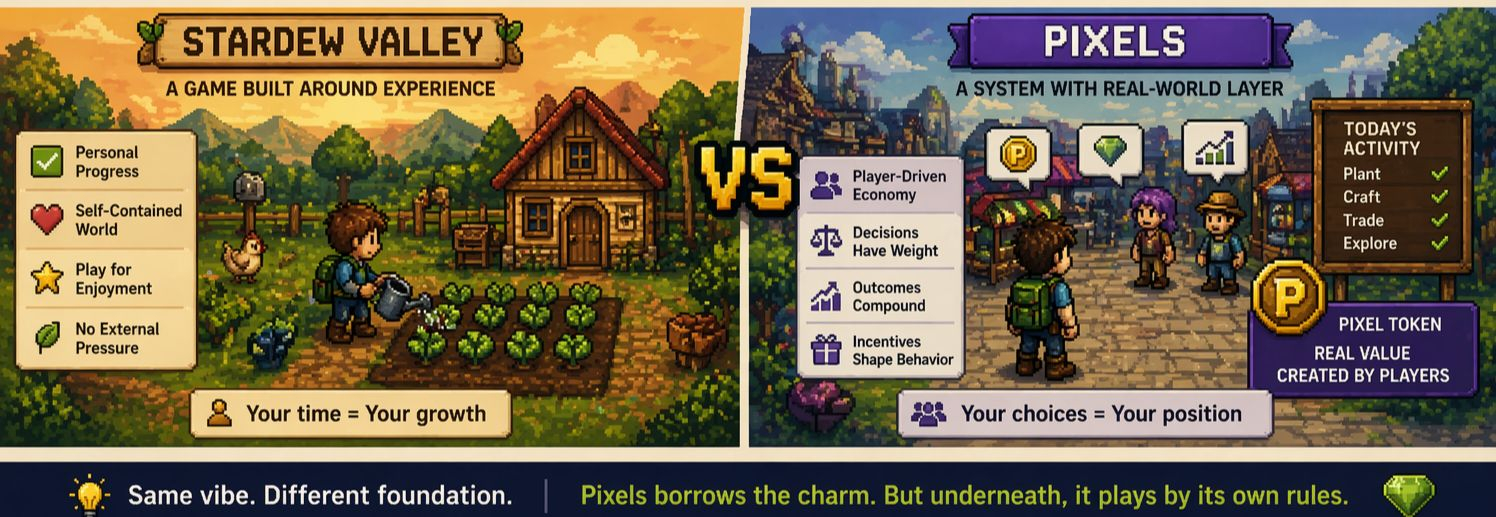
(after “But it does make it different.”)
The more time I spent inside @Pixels the more I noticed how players around me were behaving.
At first, it looked identical. Same actions, same loop, same pace.
But over time, outcomes started to separate.
Some players progressed in ways that weren’t immediately visible. Not faster in a raw sense, but more structured. Their decisions seemed to connect better over time. Small advantages started to build, even if they weren’t obvious at the beginning.
That’s not something you usually see in purely casual games.
It made me realize that Pixels isn’t trying to replicate the experience of Stardew Valley.
It’s borrowing the surface layer.
But underneath, it’s operating as a system.
And systems behave differently than games.
Games are designed around experience.
Systems are designed around outcomes.
Pixels seems to sit somewhere in between.
It keeps the experience accessible and familiar, but introduces a structure where behavior starts to matter over time. Not in a forced way, but enough to influence how players adapt.
You can still play casually.
But if you stay long enough, it becomes harder to ignore the underlying layer.
That’s where the real challenge is.
Not whether Pixels can feel like Stardew Valley.
But whether it can maintain that feeling while operating as something fundamentally different.
Because once incentives exist, even subtle ones, players will eventually start to optimize around them.
That doesn’t happen all at once.
It builds slowly.
And when it does, the experience can shift without the game itself changing.
I don’t think $PIXEL is trying to become a direct equivalent of Stardew Valley.
It feels more like an attempt to merge two different ideas:
A game that feels simple,
and a system that evolves based on player behavior.
Whether that balance holds is still unclear.
Because maintaining a relaxed experience while introducing meaningful incentives is one of the hardest problems in Web3 gaming.
Too much pressure, and it stops feeling like a game.
Too little, and the system loses its purpose.
Right now, Pixels sits somewhere in the middle.
And that middle ground is where everything will be decided.
It may look like Stardew Valley.
But it’s not built the same way.
And over time, that difference becomes harder to ignore.